




Neetika Ahlawat
@neetikaahlawat.bsky.social
Evolutionary Biologist | Early Career Fellow, DBT/Wellcome Trust India Alliance at IIT Bombay
Reposted by Neetika Ahlawat

So this came online over the weekend: My dive into the "definition" of coevolution is online ahead of publication in @journal-evo.bsky.social!
Don’t ask "when is it coevolution?" — ask "how?"
doi.org/10.1093/evol...
Don’t ask "when is it coevolution?" — ask "how?"
doi.org/10.1093/evol...

Don’t ask “when is it coevolution?” — ask “how?”
Abstract. Coevolution has come to be widely understood as specific, simultaneous, reciprocal adaptation by pairs of interacting species. This strict-sense
doi.org
September 30, 2025 at 3:30 PM
So this came online over the weekend: My dive into the "definition" of coevolution is online ahead of publication in @journal-evo.bsky.social!
Don’t ask "when is it coevolution?" — ask "how?"
doi.org/10.1093/evol...
Don’t ask "when is it coevolution?" — ask "how?"
doi.org/10.1093/evol...
Reposted by Neetika Ahlawat

Interested in #virulence? Not sure what it is - or how to explain it? Just curious? 🧐🦠🧬🦋
@kayla-king.bsky.social and I just wrote a Primer for @currentbiology.bsky.social on the ecology and evolution of virulence!
Check it below and share :)
#MicroSky #EvoSky #pathogens
@kayla-king.bsky.social and I just wrote a Primer for @currentbiology.bsky.social on the ecology and evolution of virulence!
Check it below and share :)
#MicroSky #EvoSky #pathogens

Ecology and evolution of virulence
Silva and King discuss the concept of virulence and the ecological and evolutionary
factors that shape it.
www.cell.com
September 22, 2025 at 3:22 PM
Interested in #virulence? Not sure what it is - or how to explain it? Just curious? 🧐🦠🧬🦋
@kayla-king.bsky.social and I just wrote a Primer for @currentbiology.bsky.social on the ecology and evolution of virulence!
Check it below and share :)
#MicroSky #EvoSky #pathogens
@kayla-king.bsky.social and I just wrote a Primer for @currentbiology.bsky.social on the ecology and evolution of virulence!
Check it below and share :)
#MicroSky #EvoSky #pathogens
Reposted by Neetika Ahlawat

The endoplasmic reticulum donates lipids through a tunnel-like protein to help lysosomes expand.
Learn more in a new #SciencePerspective: https://scim.ag/45GWQrS
Learn more in a new #SciencePerspective: https://scim.ag/45GWQrS

A protein tunnel helps stressed lysosomes swell
The endoplasmic reticulum donates lipids through a tunnel-like protein to help lysosomes expand
scim.ag
September 2, 2025 at 3:10 PM
The endoplasmic reticulum donates lipids through a tunnel-like protein to help lysosomes expand.
Learn more in a new #SciencePerspective: https://scim.ag/45GWQrS
Learn more in a new #SciencePerspective: https://scim.ag/45GWQrS
Reposted by Neetika Ahlawat
A bit late to sharing, but this amazing study from @vdisanto.bsky.social @scrippsocean.bsky.social is too good not to share🐟✨ Read about the amazing 6th sense that help blind fish navigate underwater caves in my Outside @jexpbiol.bsky.social 🌌🔦
journals.biologists.com/jeb/article/...
journals.biologists.com/jeb/article/...

Blind cave fish navigate through the dark with a sixth sense
Humans have five senses: sight, smell, sound, taste and touch. Fish, however, can tap into an extraordinary sixth sense called the lateral line. This sense – which consists of rows of special cells wi...
journals.biologists.com
August 28, 2025 at 1:53 PM
A bit late to sharing, but this amazing study from @vdisanto.bsky.social @scrippsocean.bsky.social is too good not to share🐟✨ Read about the amazing 6th sense that help blind fish navigate underwater caves in my Outside @jexpbiol.bsky.social 🌌🔦
journals.biologists.com/jeb/article/...
journals.biologists.com/jeb/article/...
Reposted by Neetika Ahlawat

I wrote about how genetic risk works in the context of embryo selection and how people often think about it all wrong. A short 🧵:

What we talk about when we talk about risk
How embryo selection exploits our flawed intuitions about risk
open.substack.com
August 10, 2025 at 7:08 PM
I wrote about how genetic risk works in the context of embryo selection and how people often think about it all wrong. A short 🧵:
Reposted by Neetika Ahlawat

Moreno, @lionelguy.bsky.social et al. applied experimental evolution to identify genes conferring host specificity to L. pneumophila, highlighting the importance of mutations targeting the LerC protein and the LPS synthesis cluster.
🔗 doi.org/10.1093/molbev/msaf161
#evolbio #molbio #legionella
🔗 doi.org/10.1093/molbev/msaf161
#evolbio #molbio #legionella

Host-Specific Adaptation of Legionella pneumophila to Single and Multiple Hosts
Abstract. Legionella pneumophila is an endosymbiotic bacterial species able to infect and reproduce in various protist and human hosts. Upon entry into hum
doi.org
August 5, 2025 at 5:23 PM
Moreno, @lionelguy.bsky.social et al. applied experimental evolution to identify genes conferring host specificity to L. pneumophila, highlighting the importance of mutations targeting the LerC protein and the LPS synthesis cluster.
🔗 doi.org/10.1093/molbev/msaf161
#evolbio #molbio #legionella
🔗 doi.org/10.1093/molbev/msaf161
#evolbio #molbio #legionella
Reposted by Neetika Ahlawat
OUT in @PLOS #Pathogens! 🦠🦟
We evolved a parasite to transmit early/late from its #Anopheles host—spending less/more time inside. We ask what this means for #transmission, social #behaviour, classical #virulence theory, and (mis)used composite virulence metrics.
#MicroSky
1/3
doi.org/10.1371/jour...
We evolved a parasite to transmit early/late from its #Anopheles host—spending less/more time inside. We ask what this means for #transmission, social #behaviour, classical #virulence theory, and (mis)used composite virulence metrics.
#MicroSky
1/3
doi.org/10.1371/jour...
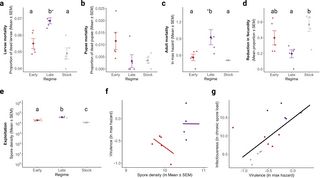
Complex interactions in the life cycle of a simple parasite shape the evolution of virulence
Author summary Classical expectations on parasite evolution assume a trade-off between transmission rate and harm to the host (virulence), favoring parasites with intermediate virulence. However, rece...
doi.org
June 30, 2025 at 6:39 PM
OUT in @PLOS #Pathogens! 🦠🦟
We evolved a parasite to transmit early/late from its #Anopheles host—spending less/more time inside. We ask what this means for #transmission, social #behaviour, classical #virulence theory, and (mis)used composite virulence metrics.
#MicroSky
1/3
doi.org/10.1371/jour...
We evolved a parasite to transmit early/late from its #Anopheles host—spending less/more time inside. We ask what this means for #transmission, social #behaviour, classical #virulence theory, and (mis)used composite virulence metrics.
#MicroSky
1/3
doi.org/10.1371/jour...
Reposted by Neetika Ahlawat
Rising ocean acidity could reduce populations of phytoplankton, which may exacerbate climate warming.

More carbon dioxide in oceans could harm carbon-eating microbes, speed climate change
Increased ocean acidity could reduce populations of phytoplankton more than previously thought
scim.ag
March 29, 2025 at 2:07 PM
Rising ocean acidity could reduce populations of phytoplankton, which may exacerbate climate warming.
Reposted by Neetika Ahlawat
Newly published in Genetics:
academic.oup.com/genetics/adv...
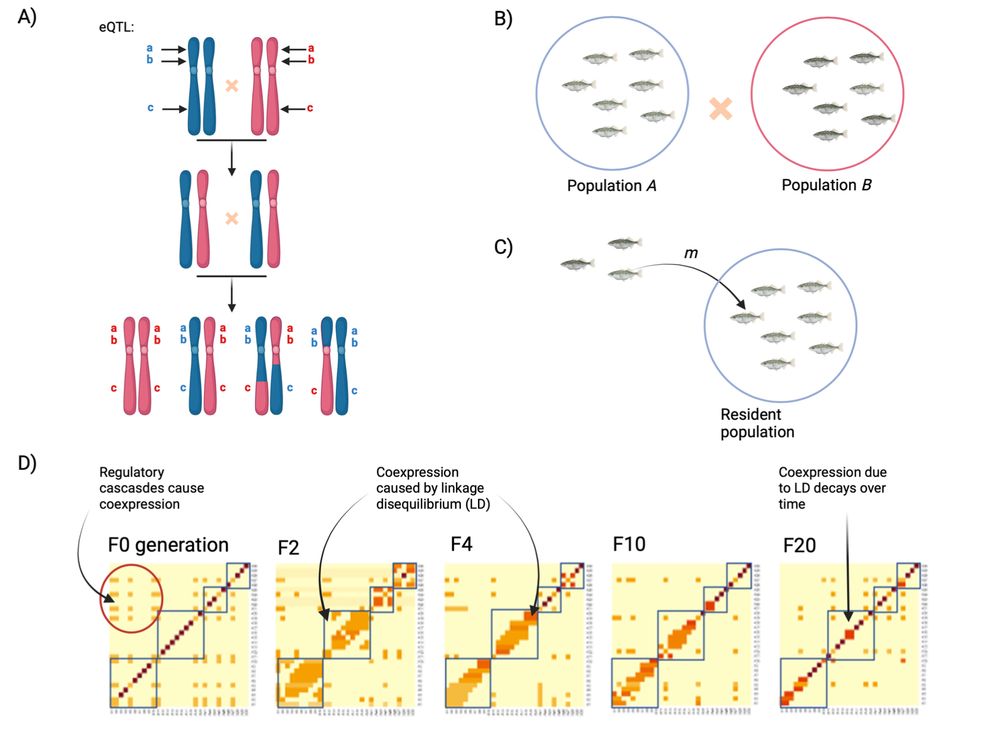
We ask what gene flow & introgression do to gene coexpression networks. The answer is: a lot.
academic.oup.com/genetics/adv...
We ask what gene flow & introgression do to gene coexpression networks. The answer is: a lot.
March 27, 2025 at 6:13 PM
Newly published in Genetics:
academic.oup.com/genetics/adv...
We ask what gene flow & introgression do to gene coexpression networks. The answer is: a lot.
academic.oup.com/genetics/adv...
We ask what gene flow & introgression do to gene coexpression networks. The answer is: a lot.
Reposted by Neetika Ahlawat
New study maps ~6,000 antibiotic resistance gene transfers across 1M+ bacterial genomes & 20K metagenomes. HGT is widespread, but co-host detection gaps mean we may be underestimating ARG transmission especially between humans & wastewater. #AMR #OneHealth
www.nature.com/articles/s41...
www.nature.com/articles/s41...

Genetic compatibility and ecological connectivity drive the dissemination of antibiotic resistance genes - Nature Communications
The dynamics of antimicrobial resistance gene transfer remain unclear. Here, by integrating bacterial genome and metagenome data with machine learning the authors show that genetic incompatibility is ...
www.nature.com
March 17, 2025 at 3:58 AM
New study maps ~6,000 antibiotic resistance gene transfers across 1M+ bacterial genomes & 20K metagenomes. HGT is widespread, but co-host detection gaps mean we may be underestimating ARG transmission especially between humans & wastewater. #AMR #OneHealth
www.nature.com/articles/s41...
www.nature.com/articles/s41...
Reposted by Neetika Ahlawat

Evolution of resistance and disease tolerance mechanisms to oral bacterial infection in Drosophila melanogaster
#Drosophila
#Drosophila
Evolution of resistance and disease tolerance mechanisms to oral bacterial infection in Drosophila melanogaster
#Drosophila
PubMed link
pubmed.ncbi.nlm.nih.gov
March 12, 2025 at 4:23 PM
Evolution of resistance and disease tolerance mechanisms to oral bacterial infection in Drosophila melanogaster
#Drosophila
#Drosophila
Reposted by Neetika Ahlawat

📣 New article on the chimeric evolutionary origins of eukaryotic central carbon metabolism, by @santanamolina.bsky.social @tweethinking.bsky.social Berend Snel and @anja1.bsky.social
Now out in @natureecoevo.bsky.social
www.nature.com/articles/s41...
#mevosky #microsky #archaeasky
Now out in @natureecoevo.bsky.social
www.nature.com/articles/s41...
#mevosky #microsky #archaeasky

March 6, 2025 at 3:27 PM
📣 New article on the chimeric evolutionary origins of eukaryotic central carbon metabolism, by @santanamolina.bsky.social @tweethinking.bsky.social Berend Snel and @anja1.bsky.social
Now out in @natureecoevo.bsky.social
www.nature.com/articles/s41...
#mevosky #microsky #archaeasky
Now out in @natureecoevo.bsky.social
www.nature.com/articles/s41...
#mevosky #microsky #archaeasky