




Naiara Rodriguez-Ezpeleta
@naiarare.bsky.social
Head of the Molecular Ecology & Biotechology unit at @azti.bsky.social; Editor @molecology; Chair of @icesmarine.bsky.social #WGAGFA; purple glasses on; ocean, DNA, evolution, conservation, management
Our model links traditional acoustic-trawl data with eDNA concentration, providing a more comprehensive picture of fish distribution and abundance. Applied to anchovy in the Bay of Biscay, the model reflects known patterns, yet eDNA points to broader distribution and potentially higher abundance.

June 17, 2025 at 8:44 AM
Our model links traditional acoustic-trawl data with eDNA concentration, providing a more comprehensive picture of fish distribution and abundance. Applied to anchovy in the Bay of Biscay, the model reflects known patterns, yet eDNA points to broader distribution and potentially higher abundance.
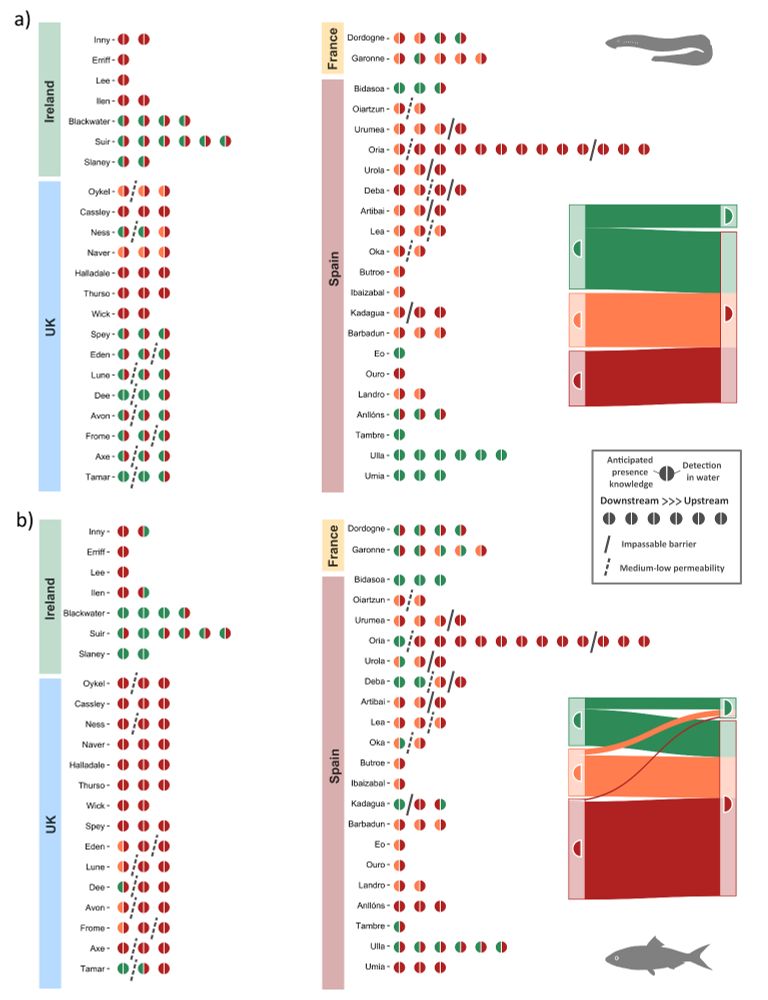
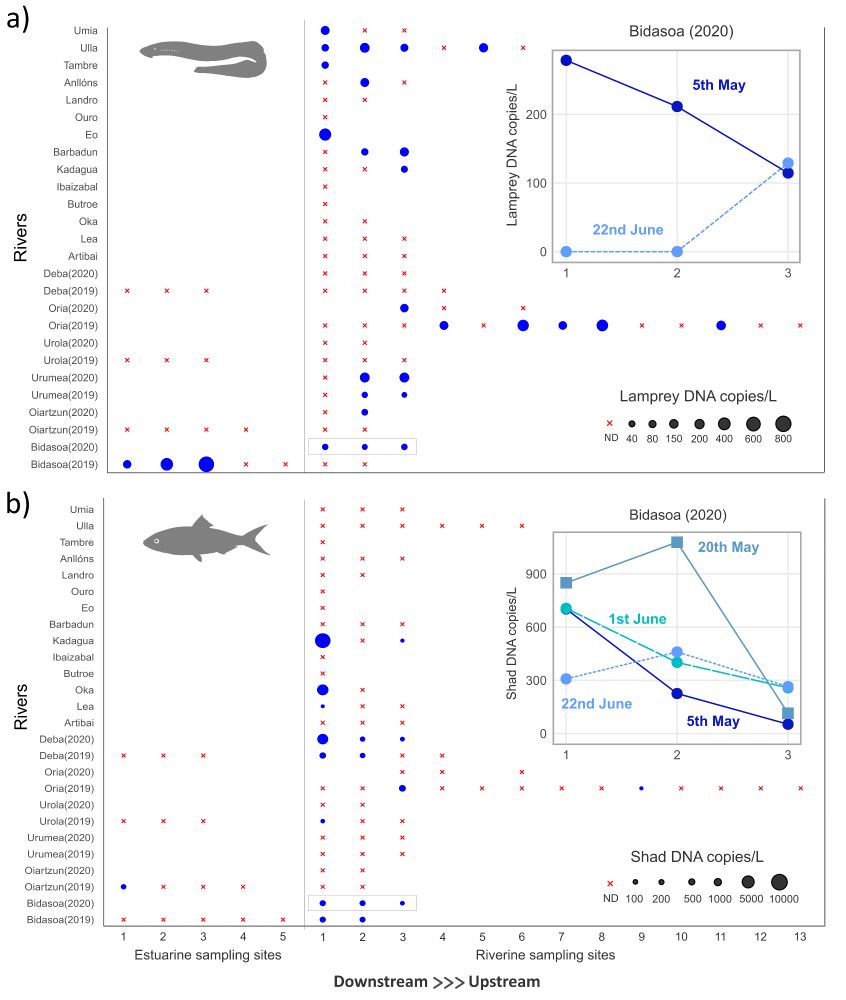
By combining historical datasets with a broad eDNA survey, we improved understanding of these migratory fishes' distribution. This international effort highlights the need for well-designed sampling & species-specific assays for effective long-term monitoring.
@mukeshbhendarkar.bsky.social
@mukeshbhendarkar.bsky.social
February 13, 2025 at 9:23 AM
By combining historical datasets with a broad eDNA survey, we improved understanding of these migratory fishes' distribution. This international effort highlights the need for well-designed sampling & species-specific assays for effective long-term monitoring.
@mukeshbhendarkar.bsky.social
@mukeshbhendarkar.bsky.social
Using qPCR & dPCR, we found that qPCR efficiently detected shads, while dPCR’s higher sensitivity was crucial for spotting the elusive sea lamprey, which sheds less eDNA due to its larval stage being burrowed in sediments for years.

February 13, 2025 at 9:23 AM
Using qPCR & dPCR, we found that qPCR efficiently detected shads, while dPCR’s higher sensitivity was crucial for spotting the elusive sea lamprey, which sheds less eDNA due to its larval stage being burrowed in sediments for years.
Monitoring diadromous fishes is key for conservation, but their complex life cycles make in-situ data collection tough. This study used #eDNA to track sea lamprey (Petromyzon marinus) & European shads (Alosa alosa & A. fallax) across 44 river basins in Spain, France, Ireland & the UK.

February 13, 2025 at 9:23 AM
Monitoring diadromous fishes is key for conservation, but their complex life cycles make in-situ data collection tough. This study used #eDNA to track sea lamprey (Petromyzon marinus) & European shads (Alosa alosa & A. fallax) across 44 river basins in Spain, France, Ireland & the UK.
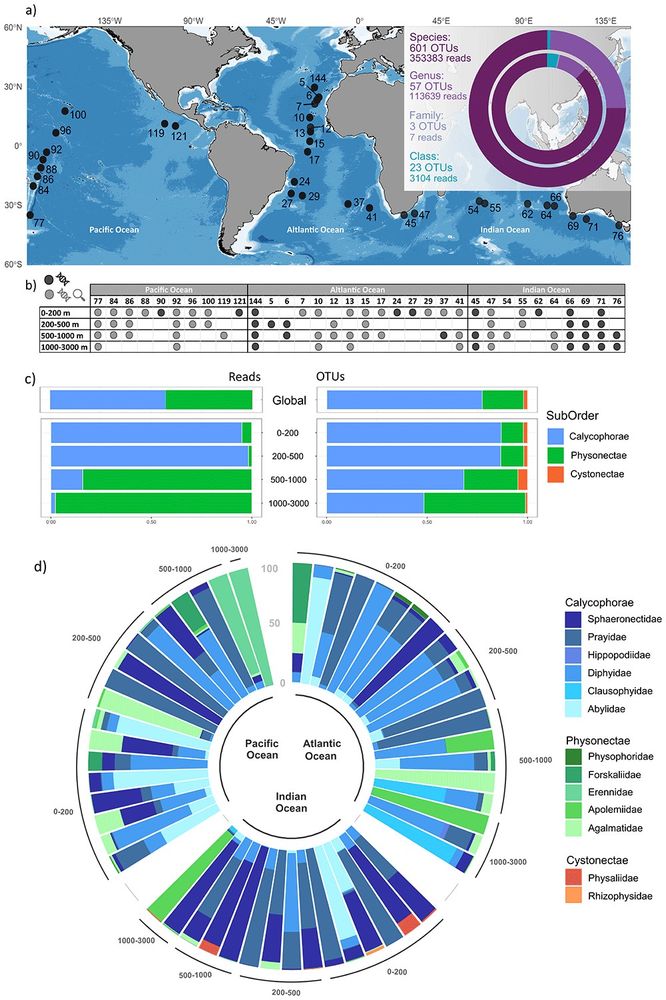
Siphonophore community composition is vertically structured. Moreover, we found that siphonophores without pneumatophores (gas-filled structures related with floatability) are dominat shallow oceanic layers, whereas siphonophores with pneumatophores dominate the deep sea.

December 11, 2024 at 1:57 PM
Siphonophore community composition is vertically structured. Moreover, we found that siphonophores without pneumatophores (gas-filled structures related with floatability) are dominat shallow oceanic layers, whereas siphonophores with pneumatophores dominate the deep sea.
We identified 42 species, representing about a quarter of all known siphonophores, some of which have wider distributions than previously thought. We provide insights into the existence of genetic variations within certain species that dominate some ocean basins or depth ranges.


December 11, 2024 at 1:57 PM
We identified 42 species, representing about a quarter of all known siphonophores, some of which have wider distributions than previously thought. We provide insights into the existence of genetic variations within certain species that dominate some ocean basins or depth ranges.
New publication by the team, led by PhD student Cristina Claver and result of @ec.europa.eu funded SUMMER project, led by @azti.bsky.social.
"Global distribution patterns of siphonophores across horizontal and vertical oceanic gradients" by reanalyzing data from the Malaspina expedition.
"Global distribution patterns of siphonophores across horizontal and vertical oceanic gradients" by reanalyzing data from the Malaspina expedition.

December 11, 2024 at 1:57 PM
New publication by the team, led by PhD student Cristina Claver and result of @ec.europa.eu funded SUMMER project, led by @azti.bsky.social.
"Global distribution patterns of siphonophores across horizontal and vertical oceanic gradients" by reanalyzing data from the Malaspina expedition.
"Global distribution patterns of siphonophores across horizontal and vertical oceanic gradients" by reanalyzing data from the Malaspina expedition.
Registration for @TheFSBI symposium is now open!!
Key dates:
Symposium Award application deadline: 1st April
Early bird and presenter registration closes: 1st May
Late registration closes: 17th June
fsbi.org.uk/symposium-20...
#FSBI2024

March 15, 2024 at 8:55 AM
Registration for @TheFSBI symposium is now open!!
Key dates:
Symposium Award application deadline: 1st April
Early bird and presenter registration closes: 1st May
Late registration closes: 17th June
fsbi.org.uk/symposium-20...
#FSBI2024
Overall, our work supports the neutral theory of biodiversity and thus the importance of oceanic currents and barriers to dispersal in shaping global plankton communities.

February 1, 2024 at 9:21 AM
Overall, our work supports the neutral theory of biodiversity and thus the importance of oceanic currents and barriers to dispersal in shaping global plankton communities.
3) Also, we reveal a consistent increase in mesozooplankton beta-diversity with depth, indicating reduced connectivity at deeper layers, and identify a water mass type-mediated structuring of bathypelagic communities, instead of an oceanic basin-mediated as observed at upper layers.

February 1, 2024 at 9:19 AM
3) Also, we reveal a consistent increase in mesozooplankton beta-diversity with depth, indicating reduced connectivity at deeper layers, and identify a water mass type-mediated structuring of bathypelagic communities, instead of an oceanic basin-mediated as observed at upper layers.
2) By analysing mesozooplankton community spatial distribution, we confirm global biogeographical patterns across the temperate to tropical oceans both in the vertical and horizontal gradients.

February 1, 2024 at 9:18 AM
2) By analysing mesozooplankton community spatial distribution, we confirm global biogeographical patterns across the temperate to tropical oceans both in the vertical and horizontal gradients.
1) By conducting a hidden diversity analysis, we highlight the still scarce knowledge on global mesozooplankton diversity and identify the Indian Ocean and the deep sea as the most understudied areas.

February 1, 2024 at 9:18 AM
1) By conducting a hidden diversity analysis, we highlight the still scarce knowledge on global mesozooplankton diversity and identify the Indian Ocean and the deep sea as the most understudied areas.
We applied DNA metabarcoding to mesozooplankton samples collected during the Malaspina-2010 circumnavigation expedition.


February 1, 2024 at 9:16 AM
We applied DNA metabarcoding to mesozooplankton samples collected during the Malaspina-2010 circumnavigation expedition.
Abstract submissions for the 2024
FSBI Symposium is now OPEN!
Join us for a fantastic gathering in #Bilbao hosted by @azti.bsky.social and featuring leading names in fisheries genomics
fsbi.org.uk/symposium-20...
FSBI Symposium is now OPEN!
Join us for a fantastic gathering in #Bilbao hosted by @azti.bsky.social and featuring leading names in fisheries genomics
fsbi.org.uk/symposium-20...

January 10, 2024 at 1:41 PM
Abstract submissions for the 2024
FSBI Symposium is now OPEN!
Join us for a fantastic gathering in #Bilbao hosted by @azti.bsky.social and featuring leading names in fisheries genomics
fsbi.org.uk/symposium-20...
FSBI Symposium is now OPEN!
Join us for a fantastic gathering in #Bilbao hosted by @azti.bsky.social and featuring leading names in fisheries genomics
fsbi.org.uk/symposium-20...
And we made it to the cover ;)

December 26, 2023 at 2:30 PM
And we made it to the cover ;)
By comparing the same mackerel stomach samples analyzed visually and through DNA analyses, we found that although the inferred main food source coincides (Arthropoda and Vertebrata), 12% of the diet was composed of cnidarians according to DNA whereas this group was not detected visually.


December 20, 2023 at 7:59 AM
By comparing the same mackerel stomach samples analyzed visually and through DNA analyses, we found that although the inferred main food source coincides (Arthropoda and Vertebrata), 12% of the diet was composed of cnidarians according to DNA whereas this group was not detected visually.
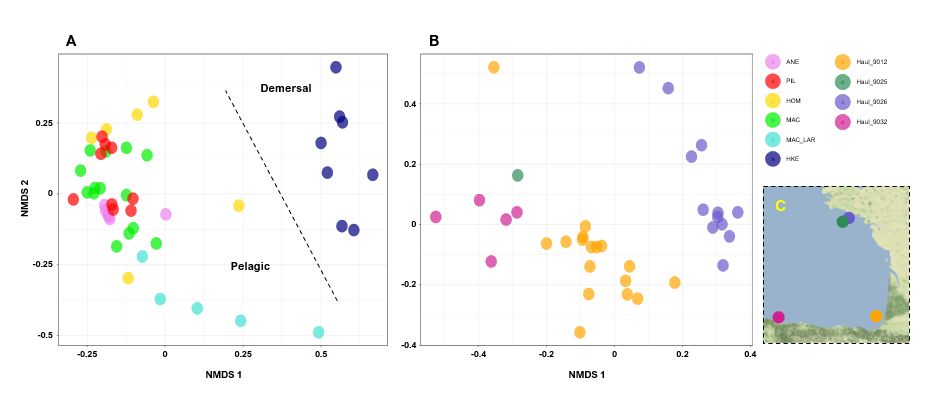
Using the developped primers, we analyzed the diet of the target species and even found that samples cluster according to their habitat (pelagic/demersal), developmental stage (larvae/adult) and sampling location.

December 20, 2023 at 7:55 AM
Using the developped primers, we analyzed the diet of the target species and even found that samples cluster according to their habitat (pelagic/demersal), developmental stage (larvae/adult) and sampling location.
Thus, we developped blocking primers for commercially important species and produced mock communities with potential preys and with different combinations of increasing amounts of predator DNA and of blocking primer. We tested the blocking primer efficienci and potential co-blocking effects.

December 20, 2023 at 7:50 AM
Thus, we developped blocking primers for commercially important species and produced mock communities with potential preys and with different combinations of increasing amounts of predator DNA and of blocking primer. We tested the blocking primer efficienci and potential co-blocking effects.
So, what if we just put the stomachs into a blender, extract their DNA, sequence it and compare it against a reference database? That could work, but first, we need to get rid of the predator DNA, which otherwise, would account for >99% of the DNA reads obtained.

December 20, 2023 at 7:42 AM
So, what if we just put the stomachs into a blender, extract their DNA, sequence it and compare it against a reference database? That could work, but first, we need to get rid of the predator DNA, which otherwise, would account for >99% of the DNA reads obtained.
Analyzing stomach contents visually is very time-consuming and difficult or impossible depending on degradation status of preys and a method that allow accurate and cost-effective analysis of stomach contents is needed.

December 20, 2023 at 7:40 AM
Analyzing stomach contents visually is very time-consuming and difficult or impossible depending on degradation status of preys and a method that allow accurate and cost-effective analysis of stomach contents is needed.
We aim at providing a tool for the easy and cost-effective analysis of stomach contents so that trophic webs can be better understood and information included in multispecific and ecosystem models for imprementation of an Ecosystem Approach to Fisheries Management.

December 20, 2023 at 7:37 AM
We aim at providing a tool for the easy and cost-effective analysis of stomach contents so that trophic webs can be better understood and information included in multispecific and ecosystem models for imprementation of an Ecosystem Approach to Fisheries Management.
🚨 New keynote speaker for #FSBI2024 confirmed!!
Sophie von der Heyden from Stellenbosch University in South Africa utilizes #genetic and #genomic approaches for studying various aspects of marine and freshwater systems
Don't miss it!
bit.ly/3rV6fft
Sophie von der Heyden from Stellenbosch University in South Africa utilizes #genetic and #genomic approaches for studying various aspects of marine and freshwater systems
Don't miss it!
bit.ly/3rV6fft

December 14, 2023 at 11:32 AM
🚨 New keynote speaker for #FSBI2024 confirmed!!
Sophie von der Heyden from Stellenbosch University in South Africa utilizes #genetic and #genomic approaches for studying various aspects of marine and freshwater systems
Don't miss it!
bit.ly/3rV6fft
Sophie von der Heyden from Stellenbosch University in South Africa utilizes #genetic and #genomic approaches for studying various aspects of marine and freshwater systems
Don't miss it!
bit.ly/3rV6fft
Great day in Montpellier for the thesis of Agnes Duhamet. Can we use #eDNA to inform marine spatial planning? Are we there yet? If not, what is missing? 🤔


December 12, 2023 at 9:42 PM
Great day in Montpellier for the thesis of Agnes Duhamet. Can we use #eDNA to inform marine spatial planning? Are we there yet? If not, what is missing? 🤔
🚨 Excited to announce another keynote speaker for #FSBI2024!! Join us as Stefano Mariani from the @marianilab.bsky.social shares invaluable insights on #traceability and #IUUfishing and how reliable DNA tools could unveil major issues in the seafood trade.
Read more at ⏩ bit.ly/3rV6fft
Read more at ⏩ bit.ly/3rV6fft

December 4, 2023 at 9:12 AM
🚨 Excited to announce another keynote speaker for #FSBI2024!! Join us as Stefano Mariani from the @marianilab.bsky.social shares invaluable insights on #traceability and #IUUfishing and how reliable DNA tools could unveil major issues in the seafood trade.
Read more at ⏩ bit.ly/3rV6fft
Read more at ⏩ bit.ly/3rV6fft
📢🗣 Thrilled to announce the third keynote speaker for #FSBI2024!!
👩🔬 Suzana Musilova (Charles University of Prague) works on the #evolution of fish sensory systems, focusing on different groups of fish from the deep-sea lineages.
Learn more at ▶bit.ly/3rV6fft
👩🔬 Suzana Musilova (Charles University of Prague) works on the #evolution of fish sensory systems, focusing on different groups of fish from the deep-sea lineages.
Learn more at ▶bit.ly/3rV6fft

November 19, 2023 at 5:49 AM
📢🗣 Thrilled to announce the third keynote speaker for #FSBI2024!!
👩🔬 Suzana Musilova (Charles University of Prague) works on the #evolution of fish sensory systems, focusing on different groups of fish from the deep-sea lineages.
Learn more at ▶bit.ly/3rV6fft
👩🔬 Suzana Musilova (Charles University of Prague) works on the #evolution of fish sensory systems, focusing on different groups of fish from the deep-sea lineages.
Learn more at ▶bit.ly/3rV6fft