




Eduardo Méndez Quintas
@mendezquintas.bsky.social
Researcher focused on the Lower Palaeolithic age in Europe and Africa Postdoc researcher at the Universidad de Vigo
@uvigo
@uvigo
February 19, 2025 at 10:00 AM
This study enriches our understanding of early Acheulean technology, showing that large flake production and complex planning appeared earlier than thought.
Check out the full paper here: link.springer.com/epdf/10.1007...
Check out the full paper here: link.springer.com/epdf/10.1007...
Unravelling the Development of Large Flake Technology During the Early Acheulean: The Evidence from Simbiro Gully at Melka Kunture (Upper Awash, Ethiopia)
link.springer.com
February 19, 2025 at 10:00 AM
This study enriches our understanding of early Acheulean technology, showing that large flake production and complex planning appeared earlier than thought.
Check out the full paper here: link.springer.com/epdf/10.1007...
Check out the full paper here: link.springer.com/epdf/10.1007...
Simbiro’s finds challenge previous ideas that complex large flake production emerged later. By 1.2 Ma, hominins here were already mastering large cores and predetermined flake production. 🧠💪
February 19, 2025 at 10:00 AM
Simbiro’s finds challenge previous ideas that complex large flake production emerged later. By 1.2 Ma, hominins here were already mastering large cores and predetermined flake production. 🧠💪
The study found evidence of Victoria West-like techniques, where flaking patterns on the core ensured the production of standardised, usable flakes. This is an early example, predating similar finds in South Africa.

February 19, 2025 at 10:00 AM
The study found evidence of Victoria West-like techniques, where flaking patterns on the core ensured the production of standardised, usable flakes. This is an early example, predating similar finds in South Africa.
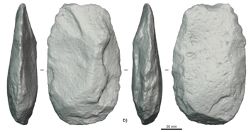
Cleavers-on-flake at Simbiro were made from large flakes with minimal reshaping, indicating that flakes were often predetermined during core reduction. 🪨➡️🔪
February 19, 2025 at 10:00 AM
Cleavers-on-flake at Simbiro were made from large flakes with minimal reshaping, indicating that flakes were often predetermined during core reduction. 🪨➡️🔪
Why large flakes? 🪓
They provided blanks for shaping complex tools. Simbiro’s core produced many large flakes, suggesting careful planning and skillful knapping.
They provided blanks for shaping complex tools. Simbiro’s core produced many large flakes, suggesting careful planning and skillful knapping.
February 19, 2025 at 10:00 AM
Why large flakes? 🪓
They provided blanks for shaping complex tools. Simbiro’s core produced many large flakes, suggesting careful planning and skillful knapping.
They provided blanks for shaping complex tools. Simbiro’s core produced many large flakes, suggesting careful planning and skillful knapping.
Simbiro Gully offers rare insights with many cleavers-on-flakes and a huge basalt core (360 mm long, 16 kg!). This core shows complex flaking strategies, far more advanced than typical early Acheulean examples.

February 19, 2025 at 10:00 AM
Simbiro Gully offers rare insights with many cleavers-on-flakes and a huge basalt core (360 mm long, 16 kg!). This core shows complex flaking strategies, far more advanced than typical early Acheulean examples.
The Acheulean (from ~1.95 Ma) is famous for large cutting tools (LCTs) like handaxes and cleavers. But producing large flakes was a key innovation, requiring strength, skill, and organised techniques.
February 19, 2025 at 10:00 AM
The Acheulean (from ~1.95 Ma) is famous for large cutting tools (LCTs) like handaxes and cleavers. But producing large flakes was a key innovation, requiring strength, skill, and organised techniques.