


McGill Interstellar Flight Research Group
@mcgill-adastra.bsky.social
Interstellar Flight Experimental Research Group @mcgill.ca : Researching the technologies that will make our civilization multi-stellar.
https://interstellarflight.space/
https://interstellarflight.space/
One of the members of our research group was out watching the Perseids on Tuesday night in Montreal and captured these images of the plume.


August 14, 2025 at 12:27 PM
One of the members of our research group was out watching the Perseids on Tuesday night in Montreal and captured these images of the plume.
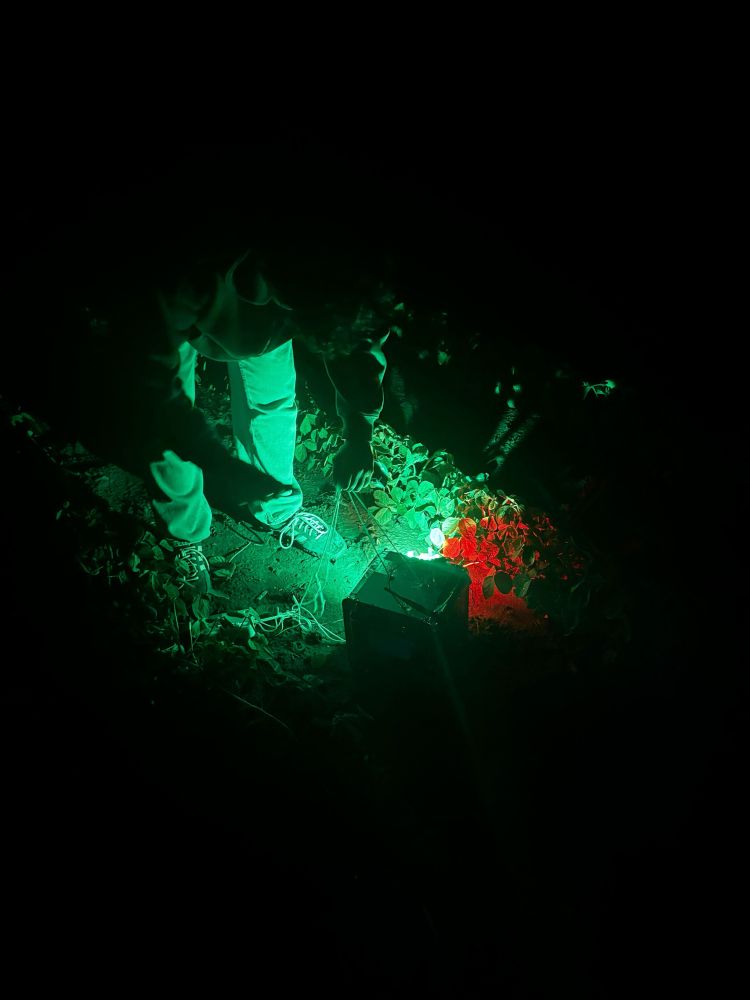
Successful payload recovery! After a long night, we located and recovered the payload 52 km from the launch site.

July 5, 2025 at 12:34 PM
Successful payload recovery! After a long night, we located and recovered the payload 52 km from the launch site.
10:10 pm: We’ve reached astronomical dark and that means launch!
July 5, 2025 at 2:16 AM
10:10 pm: We’ve reached astronomical dark and that means launch!
Inflation complete. If you’ve never done this before, launching a balloon—even a small weather balloon—isn’t as trivial as it sounds; it demands extraordinary coordination among the team.

July 5, 2025 at 2:04 AM
Inflation complete. If you’ve never done this before, launching a balloon—even a small weather balloon—isn’t as trivial as it sounds; it demands extraordinary coordination among the team.
With flight preparations complete, all that’s left is to sit back, chill, and wait for our launch window to open at sunset.

July 5, 2025 at 1:55 AM
With flight preparations complete, all that’s left is to sit back, chill, and wait for our launch window to open at sunset.
In addition to a new Iridium-based tracker, we’ll be using our own LoRa-based line-of-sight telemetry to track and control aspects of the flight.

July 5, 2025 at 1:55 AM
In addition to a new Iridium-based tracker, we’ll be using our own LoRa-based line-of-sight telemetry to track and control aspects of the flight.
Our high-altitude balloon launches have been on hold for months as we worked around a fault in our once-trusty Globalstar-based tracker (which recently proved far from trusty). Having resolved the issue, we’re ready to fly high again tonight from a remote site north of Montreal.

July 5, 2025 at 1:54 AM
Our high-altitude balloon launches have been on hold for months as we worked around a fault in our once-trusty Globalstar-based tracker (which recently proved far from trusty). Having resolved the issue, we’re ready to fly high again tonight from a remote site north of Montreal.
Astronautics propulsion often comes down to plumbing, and interstellar propulsion will be no exception. So we had Swagelok Québec bring their training trailer to campus and put our personnel through a valve & fitting bootcamp.

June 20, 2025 at 6:33 PM
Astronautics propulsion often comes down to plumbing, and interstellar propulsion will be no exception. So we had Swagelok Québec bring their training trailer to campus and put our personnel through a valve & fitting bootcamp.
For the same reason, water fountains aboard O’Neill cylinders will be spectacular.

June 20, 2025 at 11:14 AM
For the same reason, water fountains aboard O’Neill cylinders will be spectacular.
Can you comment on the implications for Planet 9? It doesn’t appear follow the perihelion clustering that inspired the Planet 9 conjecture. In the arXiv paper, N-body simulations using the P-9 model of Siraj et al. (2025) show this ETNO would be ejected in ~100 million years but is stable w/o P-9.

May 22, 2025 at 6:56 PM
Can you comment on the implications for Planet 9? It doesn’t appear follow the perihelion clustering that inspired the Planet 9 conjecture. In the arXiv paper, N-body simulations using the P-9 model of Siraj et al. (2025) show this ETNO would be ejected in ~100 million years but is stable w/o P-9.
If confirmed, this new extreme TNO could spell trouble for the Planet 9 hypothesis. It doesn’t follow the perihelion clustering that inspired the Planet 9 conjecture. N-body simulations using P-9 model of Siraj et al. (2025) show this ETNO would be ejected in ~100 million years.
May 22, 2025 at 6:52 PM
If confirmed, this new extreme TNO could spell trouble for the Planet 9 hypothesis. It doesn’t follow the perihelion clustering that inspired the Planet 9 conjecture. N-body simulations using P-9 model of Siraj et al. (2025) show this ETNO would be ejected in ~100 million years.
Two key figures: This newly discovered extreme TNO does not conform to the clustering of the perihelion longitudes that led to the Planet 9 hypothesis. Using the Planet 9 model of Siraj et al. (2025) in N-body simulations, this new ETNO would be ejected in ~100 million years.

May 22, 2025 at 5:30 PM
Two key figures: This newly discovered extreme TNO does not conform to the clustering of the perihelion longitudes that led to the Planet 9 hypothesis. Using the Planet 9 model of Siraj et al. (2025) in N-body simulations, this new ETNO would be ejected in ~100 million years.
A good day for the DSN to remind us of what we are capable of at our best: Simultaneously communicating with three spacecraft at Mars, a mission en route to Europa to look for life, another heading to the Jovian Trojan asteroids, and our two furthest interstellar envoys.

March 1, 2025 at 3:52 PM
A good day for the DSN to remind us of what we are capable of at our best: Simultaneously communicating with three spacecraft at Mars, a mission en route to Europa to look for life, another heading to the Jovian Trojan asteroids, and our two furthest interstellar envoys.
Official Artwork for IRG 2025 Symposium Released! This breathtaking piece represents our theme: “Distant Worlds, Neighboring Opportunities.”
Learn more: irg.space
Learn more: irg.space

February 18, 2025 at 3:54 PM
Official Artwork for IRG 2025 Symposium Released! This breathtaking piece represents our theme: “Distant Worlds, Neighboring Opportunities.”
Learn more: irg.space
Learn more: irg.space
Encouraging signs: Data is being transmitted down from the Parker Solar Probe via the Deep Space Network following its record-setting perihelion on December 24.

January 2, 2025 at 3:03 AM
Encouraging signs: Data is being transmitted down from the Parker Solar Probe via the Deep Space Network following its record-setting perihelion on December 24.