



Mary
@marypetrone.bsky.social
Lecturer at the University of Sydney
#1 fan of weird marine invertebrate RNA viruses
#1 fan of weird marine invertebrate RNA viruses
What’s more is that glycoprotein usage is not congruent with our Nidovirales polymerase (RdRp) phylogeny, suggesting a complex history of glycoprotein switching throughout this order.

December 17, 2024 at 4:10 AM
What’s more is that glycoprotein usage is not congruent with our Nidovirales polymerase (RdRp) phylogeny, suggesting a complex history of glycoprotein switching throughout this order.
Our patchyvirus is not alone in its propensity for glycoprotein switching. We knew that some tunicate nidoviruses had toga-like glycoproteins (“Tognidoviruses”, Buck, et al., eLife, 2024). We found even more nido-like viruses with Class II (C-II) fusion proteins. The heat map shows FoldSeek probs.

December 17, 2024 at 4:10 AM
Our patchyvirus is not alone in its propensity for glycoprotein switching. We knew that some tunicate nidoviruses had toga-like glycoproteins (“Tognidoviruses”, Buck, et al., eLife, 2024). We found even more nido-like viruses with Class II (C-II) fusion proteins. The heat map shows FoldSeek probs.
But it’s not always so straightforward. We found a (-ssRNA) paramyxo-like virus that has a (+ssRNA) toga-like glycoprotein (blast results in table).
I have unofficially named this (maybe) new family the Patchyviridae after Patchy the Pirate from Spongebob. Thanks to my cousin David for that one.
I have unofficially named this (maybe) new family the Patchyviridae after Patchy the Pirate from Spongebob. Thanks to my cousin David for that one.

December 17, 2024 at 4:10 AM
But it’s not always so straightforward. We found a (-ssRNA) paramyxo-like virus that has a (+ssRNA) toga-like glycoprotein (blast results in table).
I have unofficially named this (maybe) new family the Patchyviridae after Patchy the Pirate from Spongebob. Thanks to my cousin David for that one.
I have unofficially named this (maybe) new family the Patchyviridae after Patchy the Pirate from Spongebob. Thanks to my cousin David for that one.
We also observed this pattern in the novirhabdoviruses (which can make fish sick) and alphaviruses, again in red:

December 17, 2024 at 4:10 AM
We also observed this pattern in the novirhabdoviruses (which can make fish sick) and alphaviruses, again in red:
Answer: yes, and we think so.
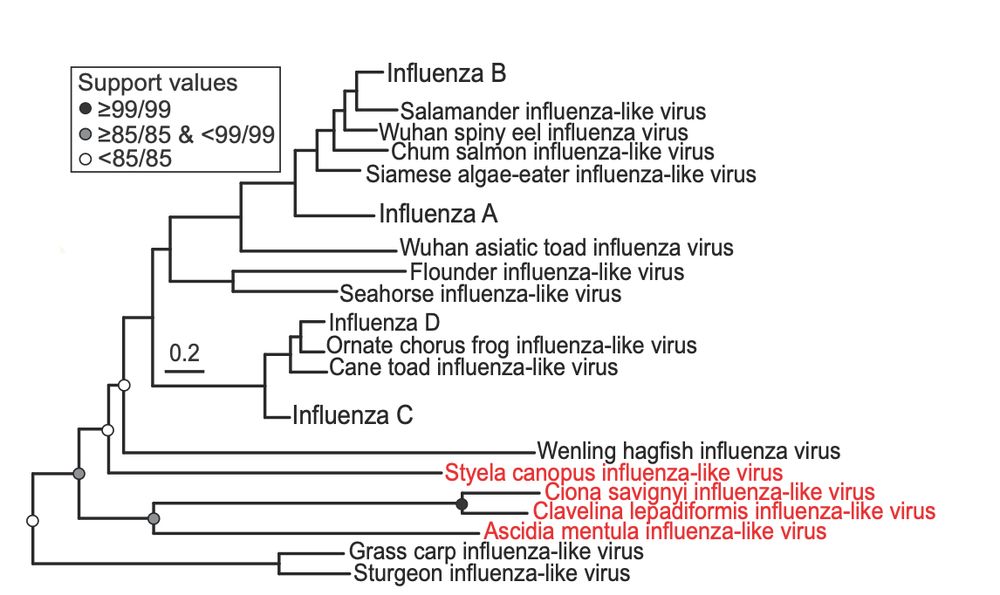
We found multiple instances of influenza-like viruses in tunicate metatranscriptomes (shown in red) that fell towards the base of the clade. Here is the phylogeny for PB1, but the pattern held up for the other segments, too.
We found multiple instances of influenza-like viruses in tunicate metatranscriptomes (shown in red) that fell towards the base of the clade. Here is the phylogeny for PB1, but the pattern held up for the other segments, too.
December 17, 2024 at 4:10 AM
Answer: yes, and we think so.
We found multiple instances of influenza-like viruses in tunicate metatranscriptomes (shown in red) that fell towards the base of the clade. Here is the phylogeny for PB1, but the pattern held up for the other segments, too.
We found multiple instances of influenza-like viruses in tunicate metatranscriptomes (shown in red) that fell towards the base of the clade. Here is the phylogeny for PB1, but the pattern held up for the other segments, too.
They might not look like much on the outside, but these guys can have a full complement of organs (and even friends!) inside. Importantly, as larvae they are free-swimming “tadpoles” that have a notochord, which makes them basal chordates.
December 17, 2024 at 4:10 AM
They might not look like much on the outside, but these guys can have a full complement of organs (and even friends!) inside. Importantly, as larvae they are free-swimming “tadpoles” that have a notochord, which makes them basal chordates.
Some background. We, along with every other vertebrate, are members of the Chordata – we have a spinal cord. But not all chordates are vertebrates! Meet: tunicates, our closest invertebrate chordate relatives.

December 17, 2024 at 4:10 AM
Some background. We, along with every other vertebrate, are members of the Chordata – we have a spinal cord. But not all chordates are vertebrates! Meet: tunicates, our closest invertebrate chordate relatives.
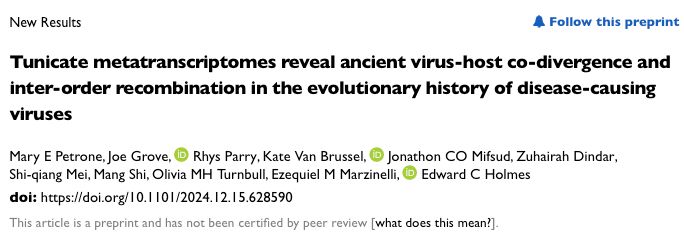
New preprint out now! The history of some RNA virus lineages that infect vertebrates might date back to our invertebrate ancestors.
Read more here: biorxiv.org/cgi/content/...
Read more here: biorxiv.org/cgi/content/...
December 17, 2024 at 4:10 AM
New preprint out now! The history of some RNA virus lineages that infect vertebrates might date back to our invertebrate ancestors.
Read more here: biorxiv.org/cgi/content/...
Read more here: biorxiv.org/cgi/content/...