



Hoda Kooshapour
@kooshapour.bsky.social
Reposted by Hoda Kooshapour

Looking for a new approach to studying or eliminating phages? Check out our study introducing anti-phage ASOs (antisense oligos) out in @Nature today. nature.com/articles/s4158…

September 10, 2025 at 3:40 PM
Looking for a new approach to studying or eliminating phages? Check out our study introducing anti-phage ASOs (antisense oligos) out in @Nature today. nature.com/articles/s4158…
Reposted by Hoda Kooshapour

Congrats to Ann-Sophie Rüttiger who successfully defended her PhD this week! 🎓
She focused on global RNA-binding proteins in Bacteroides—bacteria lacking Hfq, ProQ, CsrA, Khp—culminating in the discovery of a post-transcriptional network governed by RbpB (www.nature.com/articles/s41467-024-55383-8).
She focused on global RNA-binding proteins in Bacteroides—bacteria lacking Hfq, ProQ, CsrA, Khp—culminating in the discovery of a post-transcriptional network governed by RbpB (www.nature.com/articles/s41467-024-55383-8).

September 25, 2025 at 10:06 AM
Congrats to Ann-Sophie Rüttiger who successfully defended her PhD this week! 🎓
She focused on global RNA-binding proteins in Bacteroides—bacteria lacking Hfq, ProQ, CsrA, Khp—culminating in the discovery of a post-transcriptional network governed by RbpB (www.nature.com/articles/s41467-024-55383-8).
She focused on global RNA-binding proteins in Bacteroides—bacteria lacking Hfq, ProQ, CsrA, Khp—culminating in the discovery of a post-transcriptional network governed by RbpB (www.nature.com/articles/s41467-024-55383-8).
Reposted by Hoda Kooshapour
New preprint from the lab, in collaboration with Wenhan Zhu (U Vanderbilt): using dual RNA-seq during B. theta colonization of the host mucous layer, we identify IroR--an iron-response sRNA that tunes capsule expression and facilitates adaptation to iron limitation.
doi.org/10.1101/2025.09.08.672848
doi.org/10.1101/2025.09.08.672848

An RNA regulates iron homeostasis and host mucus colonization in Bacteroides thetaiotaomicron
Symbiotic bacteria in the human intestinal microbiota provide many pivotal functions to human health and occupy distinct biogeographic niches within the gut. Yet the molecular basis underlying niche-s...
doi.org
September 9, 2025 at 7:49 AM
New preprint from the lab, in collaboration with Wenhan Zhu (U Vanderbilt): using dual RNA-seq during B. theta colonization of the host mucous layer, we identify IroR--an iron-response sRNA that tunes capsule expression and facilitates adaptation to iron limitation.
doi.org/10.1101/2025.09.08.672848
doi.org/10.1101/2025.09.08.672848
Reposted by Hoda Kooshapour

Absolutely delighted to share the labs latest work. We identify and characterise two pathways for D-ribulose utilisation in pathogenic EHEC and Citrobacter.
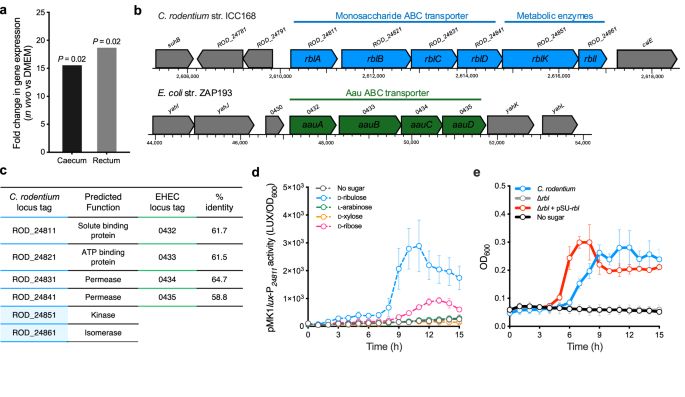
Convergent evolution of distinct D-ribulose utilisation pathways in attaching and effacing pathogens - Nature Communications
Cottam et al. identify distinct pathways for D-ribulose utilisation in pathogenic Escherichia coli and Citrobacter rodentium, providing mechanistic details and suggesting convergent evolution towards ...
www.nature.com
July 30, 2025 at 9:24 AM
Absolutely delighted to share the labs latest work. We identify and characterise two pathways for D-ribulose utilisation in pathogenic EHEC and Citrobacter.
Reposted by Hoda Kooshapour
Latest preprint from the lab: doi.org/10.1101/2025...
In this study lead by @lenaamend.bsky.social from the group, we explore carbon cross-feeding between a gut commensal and an enteropathogen. Can we counter infection by cutting sugar supply to pathogens?
In this study lead by @lenaamend.bsky.social from the group, we explore carbon cross-feeding between a gut commensal and an enteropathogen. Can we counter infection by cutting sugar supply to pathogens?
Ablation of polysaccharide breakdown in Bacteroides thetaiotaomicron prevents cross-feeding and growth of Salmonella Typhimurium in the mouse gut
Pathogens invading the intestine compete for nutrients with the resident microbiota. However, there is evidence that commensal members of the gut also provide nutritional resources to enteropathogens ...
doi.org
August 17, 2025 at 6:13 AM
Latest preprint from the lab: doi.org/10.1101/2025...
In this study lead by @lenaamend.bsky.social from the group, we explore carbon cross-feeding between a gut commensal and an enteropathogen. Can we counter infection by cutting sugar supply to pathogens?
In this study lead by @lenaamend.bsky.social from the group, we explore carbon cross-feeding between a gut commensal and an enteropathogen. Can we counter infection by cutting sugar supply to pathogens?
Reposted by Hoda Kooshapour

Bullying is rife in academia. But in Germany, structural and legal systems enable and embolden a few bad eggs who choose to abuse their power.
Shining a light on these problems is painful for those affected, but is an important step on the long road to reform 🧪
www.nature.com/articles/d41...
Shining a light on these problems is painful for those affected, but is an important step on the long road to reform 🧪
www.nature.com/articles/d41...

Can Germany rein in its academic bullying problem?
Researchers and administrators are exploring ways to restructure a rigid hierarchy that can breed power abuses.
www.nature.com
June 16, 2025 at 3:51 PM
Bullying is rife in academia. But in Germany, structural and legal systems enable and embolden a few bad eggs who choose to abuse their power.
Shining a light on these problems is painful for those affected, but is an important step on the long road to reform 🧪
www.nature.com/articles/d41...
Shining a light on these problems is painful for those affected, but is an important step on the long road to reform 🧪
www.nature.com/articles/d41...
Reposted by Hoda Kooshapour
Some say, important sRNAs can be recognized by having their own “sponge” 🧽. Well, here comes InvS: a sponge of PinT (and vice versa). Congrats to @kooshapour.bsky.social and @ginlaca.bsky.social on their great work! doi.org/10.1101/2025...
Intramacrophage RIL-seq uncovers an RNA antagonist of the Salmonella virulence-associated small RNA PinT
Salmonella virulence chiefly relies upon two major pathogenicity islands, SPI-1 and SPI-2, which enable host cell invasion and intracellular survival, respectively. There has been increasing evidence ...
doi.org
April 10, 2025 at 8:06 AM
Some say, important sRNAs can be recognized by having their own “sponge” 🧽. Well, here comes InvS: a sponge of PinT (and vice versa). Congrats to @kooshapour.bsky.social and @ginlaca.bsky.social on their great work! doi.org/10.1101/2025...
Reposted by Hoda Kooshapour

A new RIL-seq experiment, now to study host-pathigen interactions! Congrats to the @westermannlab.bsky.social and colleagues!
Intramacrophage RIL-seq uncovers an RNA antagonist of the Salmonella virulence-associated small RNA PinT https://www.biorxiv.org/content/10.1101/2025.04.07.647523v1
April 9, 2025 at 10:14 AM
A new RIL-seq experiment, now to study host-pathigen interactions! Congrats to the @westermannlab.bsky.social and colleagues!
Reposted by Hoda Kooshapour
I am thrilled to share this new preprint from our lab!
We find (>800!) 30S binding sites in hundreds of 5'UTRs, but also new dynamic steps of translation initiation.
www.biorxiv.org/content/10.1...
Congrats to all co-authors at the RNA control of gene expression lab, IBPC CNRS
(Thread, 1/6)
We find (>800!) 30S binding sites in hundreds of 5'UTRs, but also new dynamic steps of translation initiation.
www.biorxiv.org/content/10.1...
Congrats to all co-authors at the RNA control of gene expression lab, IBPC CNRS
(Thread, 1/6)

30S-seq redefines the bacterial Ribosome Binding Site
The translation initiation step is rate limiting for the efficiency of gene expression in all organisms. However, the mechanism of ribosome recruitment to mRNA start sites strikingly differs between e...
www.biorxiv.org
April 6, 2025 at 7:53 AM
I am thrilled to share this new preprint from our lab!
We find (>800!) 30S binding sites in hundreds of 5'UTRs, but also new dynamic steps of translation initiation.
www.biorxiv.org/content/10.1...
Congrats to all co-authors at the RNA control of gene expression lab, IBPC CNRS
(Thread, 1/6)
We find (>800!) 30S binding sites in hundreds of 5'UTRs, but also new dynamic steps of translation initiation.
www.biorxiv.org/content/10.1...
Congrats to all co-authors at the RNA control of gene expression lab, IBPC CNRS
(Thread, 1/6)
Reposted by Hoda Kooshapour

New preprint from @westermannlab.bsky.social about a pair of antagonistic #Salmonella sRNAs. Check it out 👇🏻
Intramacrophage RIL-seq uncovers an RNA antagonist of the Salmonella virulence-associated small RNA PinT https://www.biorxiv.org/content/10.1101/2025.04.07.647523v1
April 8, 2025 at 5:04 AM
New preprint from @westermannlab.bsky.social about a pair of antagonistic #Salmonella sRNAs. Check it out 👇🏻
Reposted by Hoda Kooshapour
If you want to do single-cell RNA-seq on your favourite bacterium, here‘s our detailed Nature Protocol for microbial MATQ-seq. It profiles up to 600 genes in a single bacterial cell!
www.nature.com/articles/s41...
www.nature.com/articles/s41...
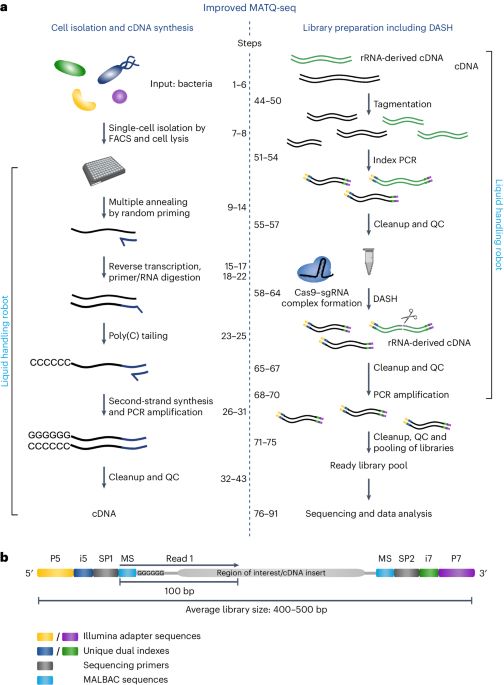
Transcriptomic profiling of individual bacteria by MATQ-seq - Nature Protocols
Bacterial single-cell sequencing via MATQ-seq combines index sorting, random priming and rRNA depletion, and offers high cell retention and transcript capture rates, making it ideal for experiments wi...
www.nature.com
April 9, 2025 at 9:15 AM
If you want to do single-cell RNA-seq on your favourite bacterium, here‘s our detailed Nature Protocol for microbial MATQ-seq. It profiles up to 600 genes in a single bacterial cell!
www.nature.com/articles/s41...
www.nature.com/articles/s41...
Reposted by Hoda Kooshapour

Intramacrophage RIL-seq uncovers an RNA antagonist of the Salmonella virulence-associated small RNA PinT https://www.biorxiv.org/content/10.1101/2025.04.07.647523v1
April 8, 2025 at 4:20 AM
Intramacrophage RIL-seq uncovers an RNA antagonist of the Salmonella virulence-associated small RNA PinT https://www.biorxiv.org/content/10.1101/2025.04.07.647523v1