



Jianxun Ren
@jianxunren.bsky.social
PI @ Changping Lab.
Personalized functional mapping, Personalized neuromodulation, Neuroimage processing techs
Find me: https://scholar.google.com/citations?user=izroYk
https://www.pbfslab.com/team
Personalized functional mapping, Personalized neuromodulation, Neuroimage processing techs
Find me: https://scholar.google.com/citations?user=izroYk
https://www.pbfslab.com/team
Pinned
Jianxun Ren
@jianxunren.bsky.social
· Jul 19
Still not using DeepPrep? It’s been downloaded 15k+ times (7k on DockerHub alone) in just 5 months after launch — helping labs speed through fMRI preprocessing 10x faster than conventional pipelines.
see doc: deepprep.readthedocs.io/en/latest/
see doc: deepprep.readthedocs.io/en/latest/
Reposted by Jianxun Ren

Why do brain networks vary? Do these differences shape behavior? If every 🧠 is unique, how can we detect common features of brain organization?
@rodbraga.bsky.social and I dig in, in @annualreviews.bsky.social (ahead of print):
go.illinois.edu/Gratton2025-...
#neuroskyence #psychscisky #MedSky
🧵👇
@rodbraga.bsky.social and I dig in, in @annualreviews.bsky.social (ahead of print):
go.illinois.edu/Gratton2025-...
#neuroskyence #psychscisky #MedSky
🧵👇

Dense Phenotyping of Human Brain Network Organization Using Precision fMRI
The advent of noninvasive imaging methods like functional magnetic resonance imaging (fMRI) transformed cognitive neuroscience, providing insights into large-scale brain networks and their link to cog...
go.illinois.edu
October 16, 2025 at 3:00 PM
Why do brain networks vary? Do these differences shape behavior? If every 🧠 is unique, how can we detect common features of brain organization?
@rodbraga.bsky.social and I dig in, in @annualreviews.bsky.social (ahead of print):
go.illinois.edu/Gratton2025-...
#neuroskyence #psychscisky #MedSky
🧵👇
@rodbraga.bsky.social and I dig in, in @annualreviews.bsky.social (ahead of print):
go.illinois.edu/Gratton2025-...
#neuroskyence #psychscisky #MedSky
🧵👇
Reposted by Jianxun Ren

Nature research paper: Vicarious body maps bridge vision and touch in the human brain
go.nature.com/4839zaL
go.nature.com/4839zaL

Vicarious body maps bridge vision and touch in the human brain - Nature
A mode of brain organization that connects visual and bodily reference frames may translate raw sensory impressions into more abstract formats that are useful for action, social cognition and semantic processing.
go.nature.com
November 27, 2025 at 8:36 PM
Nature research paper: Vicarious body maps bridge vision and touch in the human brain
go.nature.com/4839zaL
go.nature.com/4839zaL
Reposted by Jianxun Ren
Obituary: Chen-Ning Yang (1922-2025) Nobel prizewinner who helped to improve scientific relations between China and the United States
go.nature.com/4772cyB
go.nature.com/4772cyB

Chen-Ning Yang obituary: intuitive physicist whose theories on broken symmetries were proved right
Nobel prizewinner who helped to improve scientific relations between China and the United States.
go.nature.com
October 24, 2025 at 4:46 PM
Obituary: Chen-Ning Yang (1922-2025) Nobel prizewinner who helped to improve scientific relations between China and the United States
go.nature.com/4772cyB
go.nature.com/4772cyB
Reposted by Jianxun Ren

How did rumors related to the peasant insurrections in revolutionary France (1789) spread? Researchers used epidemiological models to provide a quantitative answer, marking - to my knowledge - the first quantitative history paper that @nature.com has published www.nature.com/articles/s41...

Epidemiology models explain rumour spreading during France’s Great Fear of 1789 - Nature
Epidemiological methods are used to show that the Great Fear of 1789, a series of peasant insurrections in rural revolutionary France, was driven by deliberate political action rather than spontaneous...
www.nature.com
October 27, 2025 at 6:40 PM
How did rumors related to the peasant insurrections in revolutionary France (1789) spread? Researchers used epidemiological models to provide a quantitative answer, marking - to my knowledge - the first quantitative history paper that @nature.com has published www.nature.com/articles/s41...
Reposted by Jianxun Ren
OpenNeuro @openneuro.bsky.social just hit a huge milestone: 1500 datasets! Congrats to the team on making this project so successful over the last 7 years.

October 13, 2025 at 11:35 PM
OpenNeuro @openneuro.bsky.social just hit a huge milestone: 1500 datasets! Congrats to the team on making this project so successful over the last 7 years.
Reposted by Jianxun Ren
Ever wondered if your interesting brain-behavior correlation was over- or under-estimated due to head motion, but were afraid to ask? We’ve created a motion impact score for detecting spurious brain-behavior associations, now available in Nature Communications!
doi.org/10.1038/s414...
doi.org/10.1038/s414...

September 30, 2025 at 7:39 PM
Ever wondered if your interesting brain-behavior correlation was over- or under-estimated due to head motion, but were afraid to ask? We’ve created a motion impact score for detecting spurious brain-behavior associations, now available in Nature Communications!
doi.org/10.1038/s414...
doi.org/10.1038/s414...
Reposted by Jianxun Ren
Hormonal milieu influences whole-brain structural dynamics across the menstrual cycle using dense sampling in multiple individuals
@carinaheller.bsky.social, @uni-jena.de,
@umn-midb.bsky.social, @icsantabarbara.bsky.social
www.nature.com/articles/s41...
@carinaheller.bsky.social, @uni-jena.de,
@umn-midb.bsky.social, @icsantabarbara.bsky.social
www.nature.com/articles/s41...

Hormonal milieu influences whole-brain structural dynamics across the menstrual cycle using dense sampling in multiple individuals - Nature Neuroscience
Heller et al. showed dense longitudinal imaging in four females, including one with endometriosis and one using oral contraceptives, and the finding that different hormonal milieus influence widespread brain volume changes linked to progesterone or estradiol.
www.nature.com
October 2, 2025 at 1:56 PM
Hormonal milieu influences whole-brain structural dynamics across the menstrual cycle using dense sampling in multiple individuals
@carinaheller.bsky.social, @uni-jena.de,
@umn-midb.bsky.social, @icsantabarbara.bsky.social
www.nature.com/articles/s41...
@carinaheller.bsky.social, @uni-jena.de,
@umn-midb.bsky.social, @icsantabarbara.bsky.social
www.nature.com/articles/s41...
Reposted by Jianxun Ren
One of "my" recent @nature.com papers showed how delegating tasks to AI/LLMs can increase dishonest behavior... and I'm delighted to say that it was picked up by @sciam.bsky.social. Read more in their story here: www.scientificamerican.com/article/peop...

People Are More Likely to Cheat When They Use AI
Participants in a new study were more likely to cheat when delegating to AI—especially if they could encourage machines to break rules without explicitly asking for it
www.scientificamerican.com
October 3, 2025 at 6:57 PM
One of "my" recent @nature.com papers showed how delegating tasks to AI/LLMs can increase dishonest behavior... and I'm delighted to say that it was picked up by @sciam.bsky.social. Read more in their story here: www.scientificamerican.com/article/peop...
Reposted by Jianxun Ren

New paper in Nature Biomedical Engineering by @timonmerk.bsky.social !
We built a platform that unites AI-based brain signal decoding with connectomics across 123 hours of recordings from 73 patients. A step toward adaptive, network-level neurotechnology.
www.nature.com/articles/s41...
We built a platform that unites AI-based brain signal decoding with connectomics across 123 hours of recordings from 73 patients. A step toward adaptive, network-level neurotechnology.
www.nature.com/articles/s41...

Invasive neurophysiology and whole brain connectomics for neural decoding in patients with brain implants - Nature Biomedical Engineering
A modularized open-source pipeline for invasive brain signal decoding bridges the gap between closed-loop neuromodulation and clinical brain–computer interface approaches in a large patient cohort.
www.nature.com
September 24, 2025 at 12:01 PM
New paper in Nature Biomedical Engineering by @timonmerk.bsky.social !
We built a platform that unites AI-based brain signal decoding with connectomics across 123 hours of recordings from 73 patients. A step toward adaptive, network-level neurotechnology.
www.nature.com/articles/s41...
We built a platform that unites AI-based brain signal decoding with connectomics across 123 hours of recordings from 73 patients. A step toward adaptive, network-level neurotechnology.
www.nature.com/articles/s41...
Reposted by Jianxun Ren
I feel very proud to be part of @nature.com, and to have colleagues who handled this excellent #DeepSeek paper that describes DeepSeek-R1, because it's the first widely used commercial LLM that has been published in a peer-reviewed journal 🧪 www.nature.com/articles/s41...

DeepSeek-R1 incentivizes reasoning in LLMs through reinforcement learning - Nature
A new artificial intelligence model, DeepSeek-R1, is introduced, demonstrating that the reasoning abilities of large language models can be incentivized through pure reinforcement learning, removing t...
www.nature.com
September 22, 2025 at 6:12 PM
I feel very proud to be part of @nature.com, and to have colleagues who handled this excellent #DeepSeek paper that describes DeepSeek-R1, because it's the first widely used commercial LLM that has been published in a peer-reviewed journal 🧪 www.nature.com/articles/s41...
Reposted by Jianxun Ren
What is the update for skin biopsies to differentiate Parkinson's vs. MSA? Spoiler alert: under confocal microscope, skin biopsies look different in PD vs MSA. Donadio and colleagues describe in a new paper in Brain the uses of intraneural phosphorylated α-synuclein. @parkinsondotorg.bsky.social

September 21, 2025 at 1:59 PM
What is the update for skin biopsies to differentiate Parkinson's vs. MSA? Spoiler alert: under confocal microscope, skin biopsies look different in PD vs MSA. Donadio and colleagues describe in a new paper in Brain the uses of intraneural phosphorylated α-synuclein. @parkinsondotorg.bsky.social
Reposted by Jianxun Ren
I feel like this should go without saying, but repeated hits to the head can only be bad: A recent @nature.com paper describes the neuron los and inflammation caused by repeated head trauma in young athletes 🧪 www.nature.com/articles/s41...

Repeated head trauma causes neuron loss and inflammation in young athletes - Nature
Repetitive head impacts from contact sports are associated with brain inflammation, vascular damage and neuron loss that are independent of hyperphosphorylated tau pathology.
www.nature.com
September 21, 2025 at 2:21 PM
I feel like this should go without saying, but repeated hits to the head can only be bad: A recent @nature.com paper describes the neuron los and inflammation caused by repeated head trauma in young athletes 🧪 www.nature.com/articles/s41...
Reposted by Jianxun Ren
Precision Functional Mapping (PFM). 8 yrs ago some told us it wasn't interesting. Now it's helping cure depression as part of PACE (Personalized Adaptive Cortical Electro-stimulation), ... commercialized by @turingmedical.bsky.social.
osf.io/preprints/ps...
www.cell.com/neuron/comme...
osf.io/preprints/ps...
www.cell.com/neuron/comme...

August 12, 2025 at 1:54 AM
Precision Functional Mapping (PFM). 8 yrs ago some told us it wasn't interesting. Now it's helping cure depression as part of PACE (Personalized Adaptive Cortical Electro-stimulation), ... commercialized by @turingmedical.bsky.social.
osf.io/preprints/ps...
www.cell.com/neuron/comme...
osf.io/preprints/ps...
www.cell.com/neuron/comme...
Reposted by Jianxun Ren

👇🏾👇🏾👇🏾👇🏾
A man who had severe depression for more than 30 years has "experienced joy" after undergoing bespoke brain stimulation.

Brain implant lets man 'experience joy' for the first time in decades
A device that has been likened to a pacemaker for the brain has given a man with severe depression great relief
www.newscientist.com
August 20, 2025 at 12:23 PM
👇🏾👇🏾👇🏾👇🏾
Reposted by Jianxun Ren

A man who had severe depression for more than 30 years has "experienced joy" after undergoing bespoke brain stimulation.
Brain implant lets man 'experience joy' for the first time in decades
A device that has been likened to a pacemaker for the brain has given a man with severe depression great relief
www.newscientist.com
August 20, 2025 at 8:52 AM
A man who had severe depression for more than 30 years has "experienced joy" after undergoing bespoke brain stimulation.
Reposted by Jianxun Ren

Two, please
A man who had severe depression for more than 30 years has "experienced joy" after undergoing bespoke brain stimulation.
Brain implant lets man 'experience joy' for the first time in decades
A device that has been likened to a pacemaker for the brain has given a man with severe depression great relief
www.newscientist.com
August 20, 2025 at 9:08 AM
Two, please
Reposted by Jianxun Ren

When powering fMRI studies, sample size is king, but scan duration can also be a powerful tool, improving phenotypic prediction and cost-efficiency, a new analysis shows
By @claudia-lopez.bsky.social
#neuroskyence
www.thetransmitter.org/fmri/longer-...
By @claudia-lopez.bsky.social
#neuroskyence
www.thetransmitter.org/fmri/longer-...

Longer fMRI brain scans boost reliability—but only to a point
Around 30 minutes of imaging per person seems to be the “sweet spot” for linking functional connectivity differences to traits in an accurate and cost-effective way.
www.thetransmitter.org
August 20, 2025 at 2:17 PM
When powering fMRI studies, sample size is king, but scan duration can also be a powerful tool, improving phenotypic prediction and cost-efficiency, a new analysis shows
By @claudia-lopez.bsky.social
#neuroskyence
www.thetransmitter.org/fmri/longer-...
By @claudia-lopez.bsky.social
#neuroskyence
www.thetransmitter.org/fmri/longer-...
Reposted by Jianxun Ren
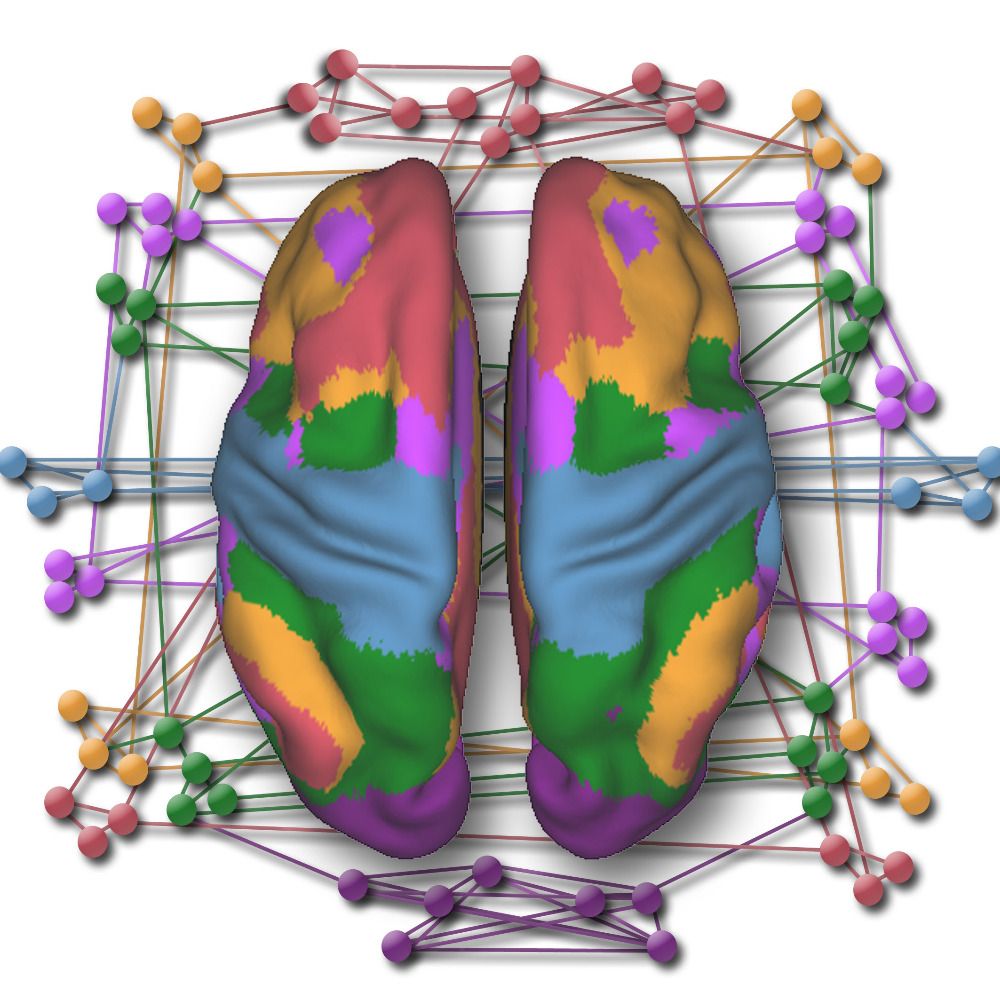
Great write up of our @nature.com study by @claudia-lopez.bsky.social
When powering fMRI studies, sample size is king, but scan duration can also be a powerful tool, improving phenotypic prediction and cost-efficiency, a new analysis shows
By @claudia-lopez.bsky.social
#neuroskyence
www.thetransmitter.org/fmri/longer-...
By @claudia-lopez.bsky.social
#neuroskyence
www.thetransmitter.org/fmri/longer-...
Longer fMRI brain scans boost reliability—but only to a point
Around 30 minutes of imaging per person seems to be the “sweet spot” for linking functional connectivity differences to traits in an accurate and cost-effective way.
www.thetransmitter.org
August 21, 2025 at 1:22 PM
Great write up of our @nature.com study by @claudia-lopez.bsky.social
Reposted by Jianxun Ren

🚨 New paper alert!
Excited to share our latest work in Movement Disorders:
“Somato-Cognitive Action Network in Focal Dystonia”
👉 doi.org/10.1002/mds....
We found asynchrony between SCAN and cerebellum in different dystonia subtypes. Thread below.
#dystonia #fMRI #PrecisionFunctionalMapping #neuro
Excited to share our latest work in Movement Disorders:
“Somato-Cognitive Action Network in Focal Dystonia”
👉 doi.org/10.1002/mds....
We found asynchrony between SCAN and cerebellum in different dystonia subtypes. Thread below.
#dystonia #fMRI #PrecisionFunctionalMapping #neuro

Somato‐Cognitive Action Network in Focal Dystonia
Background The central pathology causing idiopathic focal dystonia remains unclear. The recently identified somato-cognitive action network (SCAN) has been implicated. Objective We tested whether ...
doi.org
August 28, 2025 at 4:41 PM
🚨 New paper alert!
Excited to share our latest work in Movement Disorders:
“Somato-Cognitive Action Network in Focal Dystonia”
👉 doi.org/10.1002/mds....
We found asynchrony between SCAN and cerebellum in different dystonia subtypes. Thread below.
#dystonia #fMRI #PrecisionFunctionalMapping #neuro
Excited to share our latest work in Movement Disorders:
“Somato-Cognitive Action Network in Focal Dystonia”
👉 doi.org/10.1002/mds....
We found asynchrony between SCAN and cerebellum in different dystonia subtypes. Thread below.
#dystonia #fMRI #PrecisionFunctionalMapping #neuro
Reposted by Jianxun Ren
A new study in Movement Disorders highlights the role of the somato-cognitive action network or SCAN in focal dystonia. Today marks the start of the DBS Tank and I will be asking Nico Dosenbach: When you keynoted the DBS Think Tank a few short years ago, did you imagine the impact of SCAN imaging?

September 2, 2025 at 1:28 PM
A new study in Movement Disorders highlights the role of the somato-cognitive action network or SCAN in focal dystonia. Today marks the start of the DBS Tank and I will be asking Nico Dosenbach: When you keynoted the DBS Think Tank a few short years ago, did you imagine the impact of SCAN imaging?
Reposted by Jianxun Ren
People explore unfamiliar options more when deciding how to avoid losses than when seeking gains, shows a recent paper published in @nature.com 🧪 www.nature.com/articles/s41...

Rate and noise in human amygdala drive increased exploration in aversive learning - Nature
Human exploration is driven by two distinct neural mechanisms, a valence-independent rate signal and a valence-dependent global noise signal.
www.nature.com
September 5, 2025 at 8:09 PM
People explore unfamiliar options more when deciding how to avoid losses than when seeking gains, shows a recent paper published in @nature.com 🧪 www.nature.com/articles/s41...
Reposted by Jianxun Ren
Want to know the behind the scenes of the "Disuse-driven plasticity in the human thalamus and
putamen" paper? discover @ndosenbach.bsky.social and I interview by @cp-cellreports.bsky.social
www.cell.com/cell-reports...
putamen" paper? discover @ndosenbach.bsky.social and I interview by @cp-cellreports.bsky.social
www.cell.com/cell-reports...

Q&A with Nico U.F. Dosenbach and Roselyne Chauvin
Nico U.F. Dosenbach and Roselyne Chauvin spoke with Cell Reports about their recent
paper, in which they observed subcortical plasticity in humans following a 2-week
arm/hand-casting paradigm with dai...
www.cell.com
September 9, 2025 at 3:38 PM
Want to know the behind the scenes of the "Disuse-driven plasticity in the human thalamus and
putamen" paper? discover @ndosenbach.bsky.social and I interview by @cp-cellreports.bsky.social
www.cell.com/cell-reports...
putamen" paper? discover @ndosenbach.bsky.social and I interview by @cp-cellreports.bsky.social
www.cell.com/cell-reports...
Reposted by Jianxun Ren
Chronic pain is one of the most under-recognized burdens for folks with Parkinson’s disease. It is time we bring chronic pain in PD out of the shadows and address it as a central part of a care plan. Ogonowski and colleagues tackle this topic head on in a new article in Annals CTN.

September 9, 2025 at 12:32 PM
Chronic pain is one of the most under-recognized burdens for folks with Parkinson’s disease. It is time we bring chronic pain in PD out of the shadows and address it as a central part of a care plan. Ogonowski and colleagues tackle this topic head on in a new article in Annals CTN.
Reposted by Jianxun Ren
Pesticides are drifting above us, and for diseases like Parkinson’s and Alzheimer’s, drifting 'chemical filled clouds' will be bad news for everyone. A new study revealed that pesticides are not just in the soil and water, they are traveling long distances and accumulating in cloud water.

September 14, 2025 at 1:51 PM
Pesticides are drifting above us, and for diseases like Parkinson’s and Alzheimer’s, drifting 'chemical filled clouds' will be bad news for everyone. A new study revealed that pesticides are not just in the soil and water, they are traveling long distances and accumulating in cloud water.
Reposted by Jianxun Ren
Just dropped in @natcomms.nature.com: we show that re-engaging a thalamic–ventral tegmental circuit with deep brain stimulation can reignite consciousness in patients with severe brain injury. Work led by Aaron Warren, with @andreashorn.org @foxmdphd.bsky.social @ others! tinyurl.com/4kz8j89b
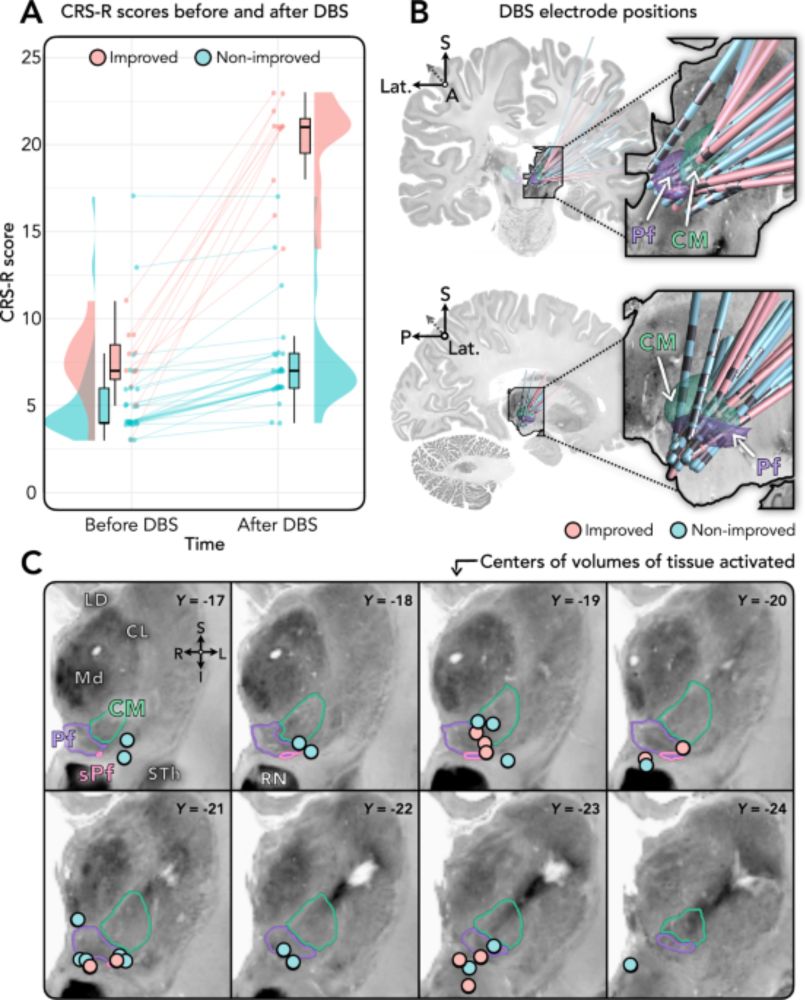
A human brain network linked to restoration of consciousness after deep brain stimulation - Nature Communications
In people with severe brain injuries, stimulation restored consciousness by engaging a deep brain circuit for wakefulness—revealing a target that may also guide treatment in stroke and epilepsy.
www.nature.com
July 21, 2025 at 9:39 PM
Just dropped in @natcomms.nature.com: we show that re-engaging a thalamic–ventral tegmental circuit with deep brain stimulation can reignite consciousness in patients with severe brain injury. Work led by Aaron Warren, with @andreashorn.org @foxmdphd.bsky.social @ others! tinyurl.com/4kz8j89b