



Shady Sayed
@husseinyy.bsky.social
Genome editor using #CRISPR systems to study cancer driver mutations #KRAS #TP53 #Organoids | He/him 🇪🇬🇩🇪
Read the full study here:
rdcu.be/exqtH
Lastly, this wouldn't have been possible without a fantastic team of co-authors ☺️ Truly grateful to everyone who contributed and supported the work along the way.
#BaseEditing #PrecisionOncology #TP53 #CRISPR
rdcu.be/exqtH
Lastly, this wouldn't have been possible without a fantastic team of co-authors ☺️ Truly grateful to everyone who contributed and supported the work along the way.
#BaseEditing #PrecisionOncology #TP53 #CRISPR
A base editing platform for the correction of cancer driver mutations unmasks conserved p53 transcription programs
rdcu.be
August 3, 2025 at 1:24 PM
Read the full study here:
rdcu.be/exqtH
Lastly, this wouldn't have been possible without a fantastic team of co-authors ☺️ Truly grateful to everyone who contributed and supported the work along the way.
#BaseEditing #PrecisionOncology #TP53 #CRISPR
rdcu.be/exqtH
Lastly, this wouldn't have been possible without a fantastic team of co-authors ☺️ Truly grateful to everyone who contributed and supported the work along the way.
#BaseEditing #PrecisionOncology #TP53 #CRISPR
TL;DR:
✅ Base editing can reverse oncogenic phenotypes
✅ Repairing TP53 hotspots restores a conserved p53 regulatory network
✅ Our platform is applicable to other mutations
✅ Precision editing + transcriptomics = powerful combo
✅ Base editing can reverse oncogenic phenotypes
✅ Repairing TP53 hotspots restores a conserved p53 regulatory network
✅ Our platform is applicable to other mutations
✅ Precision editing + transcriptomics = powerful combo
August 3, 2025 at 1:24 PM
TL;DR:
✅ Base editing can reverse oncogenic phenotypes
✅ Repairing TP53 hotspots restores a conserved p53 regulatory network
✅ Our platform is applicable to other mutations
✅ Precision editing + transcriptomics = powerful combo
✅ Base editing can reverse oncogenic phenotypes
✅ Repairing TP53 hotspots restores a conserved p53 regulatory network
✅ Our platform is applicable to other mutations
✅ Precision editing + transcriptomics = powerful combo
Next up:
🏥 Patient-derived organoids
🧬 Multi-omics profiling
🧫 Single cells profiling
Our platform opens the door to a deeper, mutation-level understanding of cancer dependencies and vulnerabilities.
🏥 Patient-derived organoids
🧬 Multi-omics profiling
🧫 Single cells profiling
Our platform opens the door to a deeper, mutation-level understanding of cancer dependencies and vulnerabilities.
August 3, 2025 at 1:24 PM
Next up:
🏥 Patient-derived organoids
🧬 Multi-omics profiling
🧫 Single cells profiling
Our platform opens the door to a deeper, mutation-level understanding of cancer dependencies and vulnerabilities.
🏥 Patient-derived organoids
🧬 Multi-omics profiling
🧫 Single cells profiling
Our platform opens the door to a deeper, mutation-level understanding of cancer dependencies and vulnerabilities.
Why does this matter?
It’s a step toward precision oncology grounded in functional genetics - not just correlational genomics.
We now have a way to test which mutations matter and how they reshape cellular programs.
It’s a step toward precision oncology grounded in functional genetics - not just correlational genomics.
We now have a way to test which mutations matter and how they reshape cellular programs.
August 3, 2025 at 1:24 PM
Why does this matter?
It’s a step toward precision oncology grounded in functional genetics - not just correlational genomics.
We now have a way to test which mutations matter and how they reshape cellular programs.
It’s a step toward precision oncology grounded in functional genetics - not just correlational genomics.
We now have a way to test which mutations matter and how they reshape cellular programs.
By combining base editing with transcriptomic profiling, we established a scalable framework to:
🧬 Correct mutations
📊 Measure downstream gene expression
💡 Reveal functional consequences
All in endogenous contexts.
🧬 Correct mutations
📊 Measure downstream gene expression
💡 Reveal functional consequences
All in endogenous contexts.

August 3, 2025 at 1:24 PM
By combining base editing with transcriptomic profiling, we established a scalable framework to:
🧬 Correct mutations
📊 Measure downstream gene expression
💡 Reveal functional consequences
All in endogenous contexts.
🧬 Correct mutations
📊 Measure downstream gene expression
💡 Reveal functional consequences
All in endogenous contexts.
🧫 Our platform can be extended to other cancer driver mutations
Repairing mutations in KRAS, PTEN or SMAD4, we found gene-specific differences in how mutations drive cancer cell fitness
Reinstating brakes (TP53) seems more effective than releasing a pedal stuck on gas (KRAS)
Repairing mutations in KRAS, PTEN or SMAD4, we found gene-specific differences in how mutations drive cancer cell fitness
Reinstating brakes (TP53) seems more effective than releasing a pedal stuck on gas (KRAS)


August 3, 2025 at 1:24 PM
🧫 Our platform can be extended to other cancer driver mutations
Repairing mutations in KRAS, PTEN or SMAD4, we found gene-specific differences in how mutations drive cancer cell fitness
Reinstating brakes (TP53) seems more effective than releasing a pedal stuck on gas (KRAS)
Repairing mutations in KRAS, PTEN or SMAD4, we found gene-specific differences in how mutations drive cancer cell fitness
Reinstating brakes (TP53) seems more effective than releasing a pedal stuck on gas (KRAS)
These effects were:
✔️ Consistent across tissue types
✔️ Independent of co-occurring mutations
✔️ Uniform across TP53 mutations (R273H vs R175H)
That suggests a conserved, mutation-independent p53 regulatory network that controls cancer cells. 🧬🛡️
✔️ Consistent across tissue types
✔️ Independent of co-occurring mutations
✔️ Uniform across TP53 mutations (R273H vs R175H)
That suggests a conserved, mutation-independent p53 regulatory network that controls cancer cells. 🧬🛡️

August 3, 2025 at 1:24 PM
These effects were:
✔️ Consistent across tissue types
✔️ Independent of co-occurring mutations
✔️ Uniform across TP53 mutations (R273H vs R175H)
That suggests a conserved, mutation-independent p53 regulatory network that controls cancer cells. 🧬🛡️
✔️ Consistent across tissue types
✔️ Independent of co-occurring mutations
✔️ Uniform across TP53 mutations (R273H vs R175H)
That suggests a conserved, mutation-independent p53 regulatory network that controls cancer cells. 🧬🛡️
🔬 What did we find?
🎯 Cancer cells are dependent on the mutant TP53 allele for survival.
When we corrected these mutations, we saw:
✅ Loss of oncogenic proliferation
✅ Reactivation of tumor suppressive transcriptional programs
🎯 Cancer cells are dependent on the mutant TP53 allele for survival.
When we corrected these mutations, we saw:
✅ Loss of oncogenic proliferation
✅ Reactivation of tumor suppressive transcriptional programs


August 3, 2025 at 1:24 PM
🔬 What did we find?
🎯 Cancer cells are dependent on the mutant TP53 allele for survival.
When we corrected these mutations, we saw:
✅ Loss of oncogenic proliferation
✅ Reactivation of tumor suppressive transcriptional programs
🎯 Cancer cells are dependent on the mutant TP53 allele for survival.
When we corrected these mutations, we saw:
✅ Loss of oncogenic proliferation
✅ Reactivation of tumor suppressive transcriptional programs
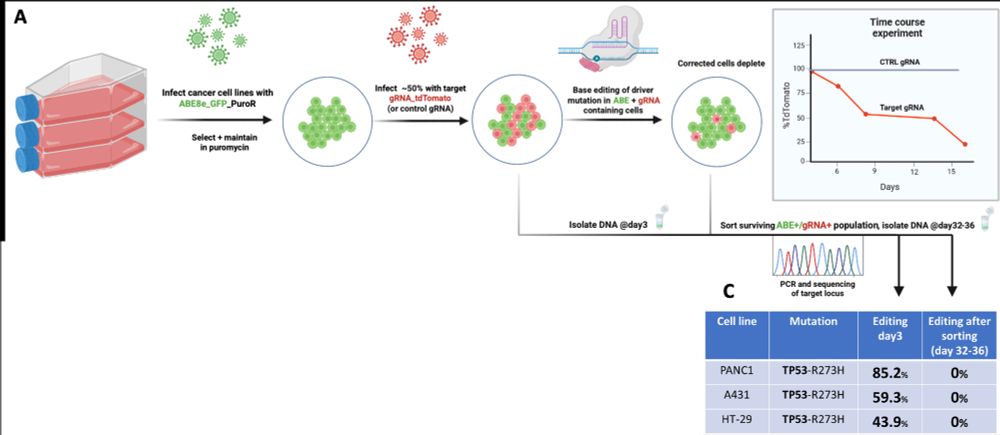
Using adenine base editing (ABE), we precisely corrected TP53 hotspot mutations in a range of human cancer cell lines from different tissues.
No overexpression. No exogenous DNA. Just editing the native genome.
No overexpression. No exogenous DNA. Just editing the native genome.
August 3, 2025 at 1:24 PM
Using adenine base editing (ABE), we precisely corrected TP53 hotspot mutations in a range of human cancer cell lines from different tissues.
No overexpression. No exogenous DNA. Just editing the native genome.
No overexpression. No exogenous DNA. Just editing the native genome.