



Hugo Vaysset
@hugovaysset.bsky.social
PhD student in bioinformatics/genomics @mdmlab.bsky.social, Institut Pasteur, Paris.
Reposted by Hugo Vaysset
I’m happy to share our new preprint! We uncovered the full diversity of bacterial TIR-based antiviral immune signaling, massively expanded the known diversity of Thoeris systems, and revealed conservation of TIR-derived immune signals across the tree of life.
www.biorxiv.org/content/10.6...
www.biorxiv.org/content/10.6...

Systematic discovery of TIR-based immune signaling systems in bacteria
Toll/interleukin-1 receptor (TIR) domains are important for immune signaling across humans, plants and bacteria. These domains were recently found to produce immune signaling molecules in plant immuni...
www.biorxiv.org
December 4, 2025 at 9:25 AM
I’m happy to share our new preprint! We uncovered the full diversity of bacterial TIR-based antiviral immune signaling, massively expanded the known diversity of Thoeris systems, and revealed conservation of TIR-derived immune signals across the tree of life.
www.biorxiv.org/content/10.6...
www.biorxiv.org/content/10.6...
Reposted by Hugo Vaysset

Very happy to share our collaborative project on FAM118 proteins - noncanonical sirtuins that form filaments and process NAD in human and other vertebrate cells.

Filament formation and NAD processing by noncanonical human FAM118 sirtuins
Nature Structural & Molecular Biology - Baretić and Missoury et al. identify vertebrate proteins FAM118B and FAM118A as sirtuins similar to bacterial antiphage enzymes and show that...
rdcu.be
November 17, 2025 at 11:37 AM
Very happy to share our collaborative project on FAM118 proteins - noncanonical sirtuins that form filaments and process NAD in human and other vertebrate cells.
Reposted by Hugo Vaysset
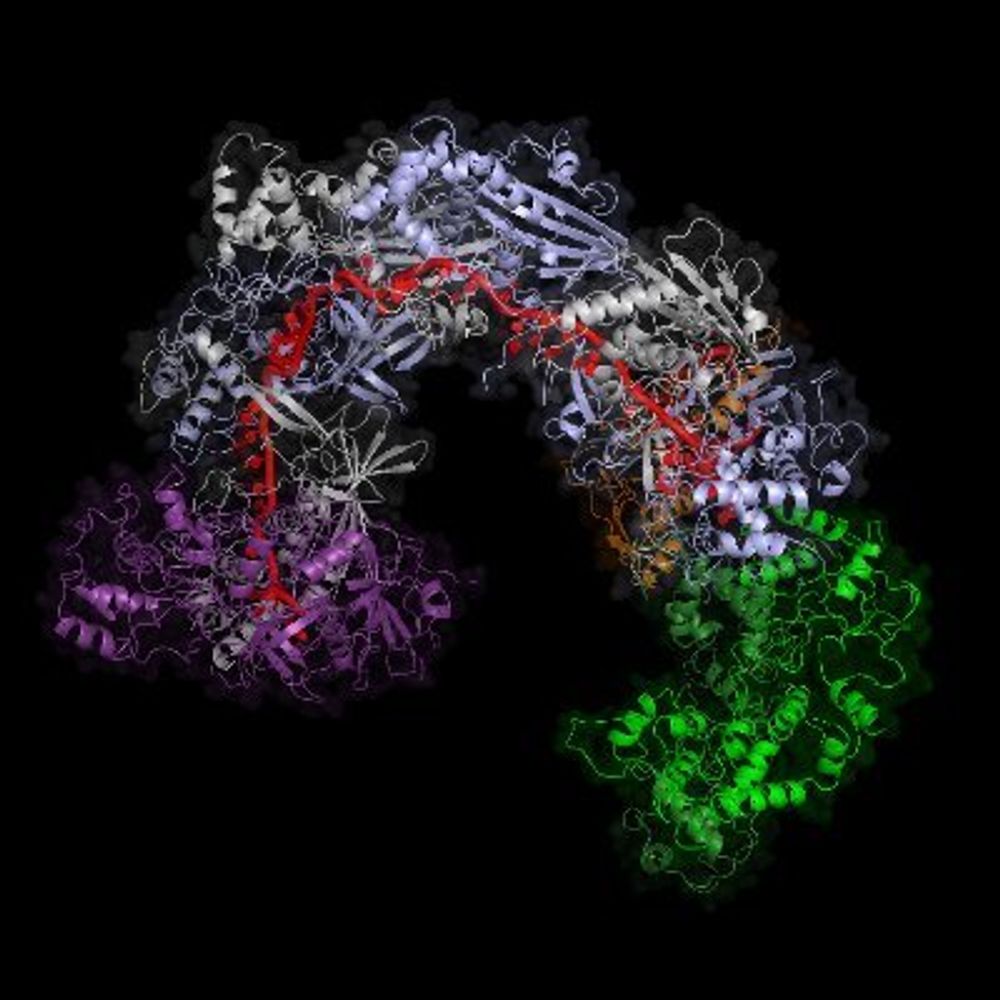
1/9 Metagenomics lets us read microbiomes in nature without cultivation, but writing (editing) them in their native context is still a major challenge.
Meet MetaEdit: a platform for pathway-scale metagenomic editing inside the gut microbiome. science.org/doi/10.1126/...
Meet MetaEdit: a platform for pathway-scale metagenomic editing inside the gut microbiome. science.org/doi/10.1126/...

Metagenomic editing of commensal bacteria in vivo using CRISPR-associated transposases
Although metagenomic sequencing has revealed a rich microbial biodiversity in the mammalian gut, methods to genetically alter specific species in the microbiome are highly limited. Here, we introduce ...
science.org
November 14, 2025 at 2:25 PM
1/9 Metagenomics lets us read microbiomes in nature without cultivation, but writing (editing) them in their native context is still a major challenge.
Meet MetaEdit: a platform for pathway-scale metagenomic editing inside the gut microbiome. science.org/doi/10.1126/...
Meet MetaEdit: a platform for pathway-scale metagenomic editing inside the gut microbiome. science.org/doi/10.1126/...
Reposted by Hugo Vaysset

📖Latest from the lab:
Evo. characterization #antiviral #SAMD9/9L across #kingdoms🚶♀️🦍🦠🧫🖥️: ancient #convergence + #adaptations @natecoevo.nature.com
Led by amazing Alexandre Legrand +major contributions by Rémi Demeure & Amandine Chantharath @ciri-lyon.bsky.social 1/n
www.nature.com/articles/s41...
Evo. characterization #antiviral #SAMD9/9L across #kingdoms🚶♀️🦍🦠🧫🖥️: ancient #convergence + #adaptations @natecoevo.nature.com
Led by amazing Alexandre Legrand +major contributions by Rémi Demeure & Amandine Chantharath @ciri-lyon.bsky.social 1/n
www.nature.com/articles/s41...

Evolutionary characterization of antiviral SAMD9/9L across kingdoms supports ancient convergence and lineage-specific adaptations - Nature Ecology & Evolution
A search for analogues of the human SAMD9/9L antiviral genes identifies convergent evolution of this gene family in the bacterial and animal kingdoms, with species-specific and recent genomic signatur...
www.nature.com
November 12, 2025 at 5:55 PM
📖Latest from the lab:
Evo. characterization #antiviral #SAMD9/9L across #kingdoms🚶♀️🦍🦠🧫🖥️: ancient #convergence + #adaptations @natecoevo.nature.com
Led by amazing Alexandre Legrand +major contributions by Rémi Demeure & Amandine Chantharath @ciri-lyon.bsky.social 1/n
www.nature.com/articles/s41...
Evo. characterization #antiviral #SAMD9/9L across #kingdoms🚶♀️🦍🦠🧫🖥️: ancient #convergence + #adaptations @natecoevo.nature.com
Led by amazing Alexandre Legrand +major contributions by Rémi Demeure & Amandine Chantharath @ciri-lyon.bsky.social 1/n
www.nature.com/articles/s41...
Reposted by Hugo Vaysset
After 5 years of waiting, the new #CRISPR classification by Makarova et al. is out @natmicrobiol.nature.com www.nature.com/articles/s41...

An updated evolutionary classification of CRISPR–Cas systems including rare variants - Nature Microbiology
An exploration of previously undescribed variants from the long tail of the CRISPR–Cas distribution.
www.nature.com
November 6, 2025 at 1:49 PM
After 5 years of waiting, the new #CRISPR classification by Makarova et al. is out @natmicrobiol.nature.com www.nature.com/articles/s41...
Reposted by Hugo Vaysset
Bacteria can sense when a virus starts shredding their genome — by detecting methylated mononucleotides.
Here’s the story of how we discovered the Metis defense system 👇
www.biorxiv.org/content/10.1...
Here’s the story of how we discovered the Metis defense system 👇
www.biorxiv.org/content/10.1...

November 6, 2025 at 5:00 AM
Bacteria can sense when a virus starts shredding their genome — by detecting methylated mononucleotides.
Here’s the story of how we discovered the Metis defense system 👇
www.biorxiv.org/content/10.1...
Here’s the story of how we discovered the Metis defense system 👇
www.biorxiv.org/content/10.1...
Reposted by Hugo Vaysset
Our new preprint is out 🥳🥳🥳
Henipaviruses, like Nipah and Hendra, package their genomes inside helical shells built by thousands of nucleoproteins. These nucleocapsids are essential to protect the viral RNA, but how do they ever let the polymerase in to read the sequence?
👇
Henipaviruses, like Nipah and Hendra, package their genomes inside helical shells built by thousands of nucleoproteins. These nucleocapsids are essential to protect the viral RNA, but how do they ever let the polymerase in to read the sequence?
👇

November 3, 2025 at 12:26 PM
Our new preprint is out 🥳🥳🥳
Henipaviruses, like Nipah and Hendra, package their genomes inside helical shells built by thousands of nucleoproteins. These nucleocapsids are essential to protect the viral RNA, but how do they ever let the polymerase in to read the sequence?
👇
Henipaviruses, like Nipah and Hendra, package their genomes inside helical shells built by thousands of nucleoproteins. These nucleocapsids are essential to protect the viral RNA, but how do they ever let the polymerase in to read the sequence?
👇
Reposted by Hugo Vaysset

Excited to share: DNA glycosylases are diverse antiviral effectors. They recognize phage base modifications and initiate genome destruction. A structure‑guided approach made the scope of this discovery possible! 🧪 #phagesky doi.org/10.1101/2025... #phage #microbiology

Antiviral Defence is a Conserved Function of Diverse DNA Glycosylases
Bacteria are frequently attacked by viruses, known as phages, and rely on diverse defence systems like restriction endonucleases and CRISPR-Cas to survive. While phages can evade these defences by cov...
doi.org
October 30, 2025 at 12:16 PM
Excited to share: DNA glycosylases are diverse antiviral effectors. They recognize phage base modifications and initiate genome destruction. A structure‑guided approach made the scope of this discovery possible! 🧪 #phagesky doi.org/10.1101/2025... #phage #microbiology
Reposted by Hugo Vaysset
@prczhaoyansong.bsky.social’s deep dive into the dark matter of compost communities is now out 🎉 Genomic islands hijack jumbo phages—whose capsids enable transfer of large tracts of DNA—shedding new light on the scale & scope of phage-mediated gene flow 😎
www.pnas.org/doi/10.1073/...
www.pnas.org/doi/10.1073/...

Jumbo phage–mediated transduction of genomic islands | PNAS
Bacteria acquire new genes by horizontal gene transfer, typically mediated by mobile
genetic elements (MGEs). While plasmids, bacteriophages, and c...
www.pnas.org
October 28, 2025 at 6:36 PM
@prczhaoyansong.bsky.social’s deep dive into the dark matter of compost communities is now out 🎉 Genomic islands hijack jumbo phages—whose capsids enable transfer of large tracts of DNA—shedding new light on the scale & scope of phage-mediated gene flow 😎
www.pnas.org/doi/10.1073/...
www.pnas.org/doi/10.1073/...
Reposted by Hugo Vaysset
OpenFold3-preview (OF3p) is out: a sneak peek of our AF3-based structure prediction model. Our aim for OF3 is full AF3-parity for every modality. We now believe we have a clear path towards this goal and are releasing OF3p to enable building in the OF3 ecosystem. More👇
October 28, 2025 at 6:30 PM
OpenFold3-preview (OF3p) is out: a sneak peek of our AF3-based structure prediction model. Our aim for OF3 is full AF3-parity for every modality. We now believe we have a clear path towards this goal and are releasing OF3p to enable building in the OF3 ecosystem. More👇
Reposted by Hugo Vaysset
Lab’s first paper is out!! We show the first structures of #Asgard #chromatin by #cryo-EM 🧬❄️
Asgard histones form closed and open hypernucleosomes. Closed are conserved across #Archaea, while open resemble eukaryotic H3–H4 octasomes and are Asgard-specific. More here: www.cell.com/molecular-ce...
Asgard histones form closed and open hypernucleosomes. Closed are conserved across #Archaea, while open resemble eukaryotic H3–H4 octasomes and are Asgard-specific. More here: www.cell.com/molecular-ce...

October 28, 2025 at 3:07 PM
Lab’s first paper is out!! We show the first structures of #Asgard #chromatin by #cryo-EM 🧬❄️
Asgard histones form closed and open hypernucleosomes. Closed are conserved across #Archaea, while open resemble eukaryotic H3–H4 octasomes and are Asgard-specific. More here: www.cell.com/molecular-ce...
Asgard histones form closed and open hypernucleosomes. Closed are conserved across #Archaea, while open resemble eukaryotic H3–H4 octasomes and are Asgard-specific. More here: www.cell.com/molecular-ce...
Reposted by Hugo Vaysset

Many antiphage systems use NAD+, in many ways.
@hugovaysset.bsky.social reviewed them all!
Read to know more about all their molecular mechanisms, how phages counteract them, their distribution in bacteria and their conservation in eukaryotic immunity!
www.cell.com/molecular-ce...
@hugovaysset.bsky.social reviewed them all!
Read to know more about all their molecular mechanisms, how phages counteract them, their distribution in bacteria and their conservation in eukaryotic immunity!
www.cell.com/molecular-ce...

The multifaceted roles of NAD+ in bacterial immunity
In this review, Vaysset and Bernheim examine how nicotinamide adenine dinucleotide
(NAD+) is a key player in diverse and widespread bacterial antiphage defense systems
and phage counterdefense. The au...
www.cell.com
October 17, 2025 at 5:55 PM
Many antiphage systems use NAD+, in many ways.
@hugovaysset.bsky.social reviewed them all!
Read to know more about all their molecular mechanisms, how phages counteract them, their distribution in bacteria and their conservation in eukaryotic immunity!
www.cell.com/molecular-ce...
@hugovaysset.bsky.social reviewed them all!
Read to know more about all their molecular mechanisms, how phages counteract them, their distribution in bacteria and their conservation in eukaryotic immunity!
www.cell.com/molecular-ce...
Reposted by Hugo Vaysset
Hello BlueSky! Inaugural post here from the Sternberg Lab. We're excited to share our latest work, in which we teamed up with the @WiedenheftLab to study how DRT9 reverse transcriptases provide antiviral immunity. Here’s what we found: www.biorxiv.org/content/10.1...

Protein-primed DNA homopolymer synthesis by an antiviral reverse transcriptase
Bacteria defend themselves from viral predation using diverse immune systems, many of which sense and target foreign DNA for degradation. Defense-associated reverse transcriptase (DRT) systems provide...
www.biorxiv.org
March 26, 2025 at 10:13 PM
Hello BlueSky! Inaugural post here from the Sternberg Lab. We're excited to share our latest work, in which we teamed up with the @WiedenheftLab to study how DRT9 reverse transcriptases provide antiviral immunity. Here’s what we found: www.biorxiv.org/content/10.1...
Reposted by Hugo Vaysset
Today in @nature.com , we highlight how a cousin of CRISPR-Cas10, mCpol, establishes an evolutionary trap in anti-phage immune systems.
Check out @erinedoherty.bsky.social and my work from @doudna-lab.bsky.social lab here:
www.nature.com/articles/s41...
Check out @erinedoherty.bsky.social and my work from @doudna-lab.bsky.social lab here:
www.nature.com/articles/s41...

A miniature CRISPR–Cas10 enzyme confers immunity by inhibitory signalling - Nature
Panoptes, an anti-phage defence system against virus-mediated immune suppression, is revealed.
www.nature.com
October 1, 2025 at 5:57 PM
Today in @nature.com , we highlight how a cousin of CRISPR-Cas10, mCpol, establishes an evolutionary trap in anti-phage immune systems.
Check out @erinedoherty.bsky.social and my work from @doudna-lab.bsky.social lab here:
www.nature.com/articles/s41...
Check out @erinedoherty.bsky.social and my work from @doudna-lab.bsky.social lab here:
www.nature.com/articles/s41...
Reposted by Hugo Vaysset
Our story describing the Panoptes bacterial immune defense system is now finally peer-reviewed and published today! www.nature.com/articles/s41...

The Panoptes system uses decoy cyclic nucleotides to defend against phage - Nature
The Panoptes antiphage system defends bacteria by detecting phage-encoded counter-defences that sequester cyclic nucleotide signals, triggering membrane disruption and highlighting a broader strategy of sensing immune evasion through second-messenger surveillance.
www.nature.com
October 1, 2025 at 4:05 PM
Our story describing the Panoptes bacterial immune defense system is now finally peer-reviewed and published today! www.nature.com/articles/s41...
Reposted by Hugo Vaysset

🧬🌉Online @science.org Megabase-scale human #genome rearrangement with programmable bridge recombinases | Science www.science.org/doi/10.1126/...

Megabase-scale human genome rearrangement with programmable bridge recombinases
Bridge recombinases are naturally occurring RNA-guided DNA recombinases that we previously demonstrated can programmably insert, excise, and invert DNA in vitro and in Escherichia coli. In this study,...
www.science.org
September 29, 2025 at 10:01 PM
🧬🌉Online @science.org Megabase-scale human #genome rearrangement with programmable bridge recombinases | Science www.science.org/doi/10.1126/...
Reposted by Hugo Vaysset

YprA family helicases provide the missing link between diverse prokaryotic immune systems https://www.biorxiv.org/content/10.1101/2025.09.15.676423v1
September 16, 2025 at 6:17 AM
YprA family helicases provide the missing link between diverse prokaryotic immune systems https://www.biorxiv.org/content/10.1101/2025.09.15.676423v1
Reposted by Hugo Vaysset

A new theme issue of #PhilTransB examines the evolutionary history of bacterial immune systems, their modes of action, and the patterns how different bacterial immune systems are distributed across different ecosystems. Read: buff.ly/Z4qdxY1

September 5, 2025 at 4:01 PM
A new theme issue of #PhilTransB examines the evolutionary history of bacterial immune systems, their modes of action, and the patterns how different bacterial immune systems are distributed across different ecosystems. Read: buff.ly/Z4qdxY1
Reposted by Hugo Vaysset

How do bacteria choose what type of defences to use against phages? We explored that question in the last paper I worked on as a postdoc at the Uni of Exeter @uniofexeteresi.bsky.social with Stineke van Houte, Stefano Pagliara and Edze Westra (not on Bluesky)
doi.org/10.1098/rstb...
doi.org/10.1098/rstb...

Phage provoke growth delays and SOS response induction despite CRISPR-Cas protection | Philosophical Transactions of the Royal Society B: Biological Sciences
Bacteria evolve resistance against their phage foes with a wide range of resistance
strategies whose costs and benefits depend on the level of protection they confer
and on the costs for maintainance....
doi.org
September 4, 2025 at 4:02 PM
How do bacteria choose what type of defences to use against phages? We explored that question in the last paper I worked on as a postdoc at the Uni of Exeter @uniofexeteresi.bsky.social with Stineke van Houte, Stefano Pagliara and Edze Westra (not on Bluesky)
doi.org/10.1098/rstb...
doi.org/10.1098/rstb...
Reposted by Hugo Vaysset

📢 New preprint alert!
We designed synthetic proteins that can block bacterial immune systems, allowing phages + plasmids to overcome natural defenses.
This could transform phage therapy + genetic engineering.
Here’s what we found 🧵
Preprint🔗: www.biorxiv.org/content/10.1...
We designed synthetic proteins that can block bacterial immune systems, allowing phages + plasmids to overcome natural defenses.
This could transform phage therapy + genetic engineering.
Here’s what we found 🧵
Preprint🔗: www.biorxiv.org/content/10.1...

Synthetically designed anti-defense proteins overcome barriers to bacterial transformation and phage infection
Bacterial defense systems present considerable barriers to both phage infection and plasmid transformation. These systems target mobile genetic elements, limiting the efficacy of bacteriophage-based t...
www.biorxiv.org
September 2, 2025 at 7:36 AM
📢 New preprint alert!
We designed synthetic proteins that can block bacterial immune systems, allowing phages + plasmids to overcome natural defenses.
This could transform phage therapy + genetic engineering.
Here’s what we found 🧵
Preprint🔗: www.biorxiv.org/content/10.1...
We designed synthetic proteins that can block bacterial immune systems, allowing phages + plasmids to overcome natural defenses.
This could transform phage therapy + genetic engineering.
Here’s what we found 🧵
Preprint🔗: www.biorxiv.org/content/10.1...
Reposted by Hugo Vaysset

👏 Huge congrats to @audeber.bsky.social, group leader and head of our Molecular Diversity of Microbes lab, on being named a 2025 Vallee Scholar! Her pioneering work on ancestral immunity opens new perspectives for biomedical innovation. 🔬🌍
@valleefoundation.bsky.social
#Science #Immunity
@valleefoundation.bsky.social
#Science #Immunity

September 2, 2025 at 9:44 AM
👏 Huge congrats to @audeber.bsky.social, group leader and head of our Molecular Diversity of Microbes lab, on being named a 2025 Vallee Scholar! Her pioneering work on ancestral immunity opens new perspectives for biomedical innovation. 🔬🌍
@valleefoundation.bsky.social
#Science #Immunity
@valleefoundation.bsky.social
#Science #Immunity
Reposted by Hugo Vaysset

Preprint: De-novo design of proteins that inhibit bacterial defenses
Our approach allows silencing defense systems of choice. We show how this approach enables programming of “untransformable” bacteria, and how it can enhance phage therapy applications
Congrats Jeremy Garb!
tinyurl.com/Syttt
🧵
Our approach allows silencing defense systems of choice. We show how this approach enables programming of “untransformable” bacteria, and how it can enhance phage therapy applications
Congrats Jeremy Garb!
tinyurl.com/Syttt
🧵

Synthetically designed anti-defense proteins overcome barriers to bacterial transformation and phage infection
Bacterial defense systems present considerable barriers to both phage infection and plasmid transformation. These systems target mobile genetic elements, limiting the efficacy of bacteriophage-based t...
www.biorxiv.org
September 2, 2025 at 10:48 AM
Preprint: De-novo design of proteins that inhibit bacterial defenses
Our approach allows silencing defense systems of choice. We show how this approach enables programming of “untransformable” bacteria, and how it can enhance phage therapy applications
Congrats Jeremy Garb!
tinyurl.com/Syttt
🧵
Our approach allows silencing defense systems of choice. We show how this approach enables programming of “untransformable” bacteria, and how it can enhance phage therapy applications
Congrats Jeremy Garb!
tinyurl.com/Syttt
🧵
Reposted by Hugo Vaysset
Congratulations Rotem Sorek @soreklab.bsky.social on receiving the Gruber prize today in Stockholm

August 23, 2025 at 9:24 AM
Congratulations Rotem Sorek @soreklab.bsky.social on receiving the Gruber prize today in Stockholm
Reposted by Hugo Vaysset

#News&Views
Bacterial prions form amyloids in response to phage infection and induce cell death to prevent viral replication, similar to the processes in fungi and across the tree of life.
#MicroSky
www.nature.com/articles/s41...
Bacterial prions form amyloids in response to phage infection and induce cell death to prevent viral replication, similar to the processes in fungi and across the tree of life.
#MicroSky
www.nature.com/articles/s41...

Amyloids in bacterial antiphage defence - Nature Microbiology
Bacterial prions form amyloids in response to phage infection and induce cell death to prevent viral replication, similar to the processes in fungi and across the tree of life.
www.nature.com
August 21, 2025 at 5:47 PM
#News&Views
Bacterial prions form amyloids in response to phage infection and induce cell death to prevent viral replication, similar to the processes in fungi and across the tree of life.
#MicroSky
www.nature.com/articles/s41...
Bacterial prions form amyloids in response to phage infection and induce cell death to prevent viral replication, similar to the processes in fungi and across the tree of life.
#MicroSky
www.nature.com/articles/s41...
Reposted by Hugo Vaysset

Stoked to finally have a preprint out for Phold, our tool that uses protein structural information to enhance phage genome annotation #phagesky 1/n
www.biorxiv.org/content/10.1...
www.biorxiv.org/content/10.1...

Protein Structure Informed Bacteriophage Genome Annotation with Phold
Bacteriophage (phage) genome annotation is essential for understanding their functional potential and suitability for use as therapeutic agents. Here we introduce Phold, an annotation framework utilis...
www.biorxiv.org
August 8, 2025 at 7:11 AM
Stoked to finally have a preprint out for Phold, our tool that uses protein structural information to enhance phage genome annotation #phagesky 1/n
www.biorxiv.org/content/10.1...
www.biorxiv.org/content/10.1...