



Meet our #September feature Hannah Büttner in this year’s #calendar 2025! 👩🏻🔬 She explored fungal-bacterial symbiosis, loves both music & art, and carries science in her bag wherever she goes. 🎒🏜️ Read her interview here: lmy.de/FUIJC 🎙️
#FacesOfScience #LeibnizHKI
#FacesOfScience #LeibnizHKI


September 19, 2025 at 8:48 AM
Reposted

The huge minerals collection “terra mineralia” in Freiberg/Sachsen, Germany, is certainly one of the most respected minerals museums worldwide, a true gem and must-have-been for any lover of minerals. Besides, the small town Freiberg is a good place for a stay.


September 7, 2025 at 8:18 PM
The huge minerals collection “terra mineralia” in Freiberg/Sachsen, Germany, is certainly one of the most respected minerals museums worldwide, a true gem and must-have-been for any lover of minerals. Besides, the small town Freiberg is a good place for a stay.
🌱 Did you know fungi can host bacteria inside them? 🦠
Our new review reveals the hidden world of endofungal bacteria - microbes living within fungi that influence everything from plant health to human disease.
#NaturalProducts #Fungi #Bacteria #Endosymbiosis
academic.oup.com/ismej/articl...
Our new review reveals the hidden world of endofungal bacteria - microbes living within fungi that influence everything from plant health to human disease.
#NaturalProducts #Fungi #Bacteria #Endosymbiosis
academic.oup.com/ismej/articl...

Endofungal Bacteria as Hidden Facilitators of Biotic Interactions
Abstract. Fungi play pivotal roles in ecology and human health, driving nutrient cycling, supporting antibiotic production, and posing threats through toxi
academic.oup.com
July 14, 2025 at 11:35 PM
🌱 Did you know fungi can host bacteria inside them? 🦠
Our new review reveals the hidden world of endofungal bacteria - microbes living within fungi that influence everything from plant health to human disease.
#NaturalProducts #Fungi #Bacteria #Endosymbiosis
academic.oup.com/ismej/articl...
Our new review reveals the hidden world of endofungal bacteria - microbes living within fungi that influence everything from plant health to human disease.
#NaturalProducts #Fungi #Bacteria #Endosymbiosis
academic.oup.com/ismej/articl...
Reposted

Great #ISMEJournal review by Ingrid Richter, Hannah Büttner, Christian Hertweck @leibniz-hki.de @microverse.bsky.social
Endofungal Bacteria as Hidden Facilitators of Biotic Interactions
academic.oup.com/ismej/advanc...
Endofungal Bacteria as Hidden Facilitators of Biotic Interactions
academic.oup.com/ismej/advanc...
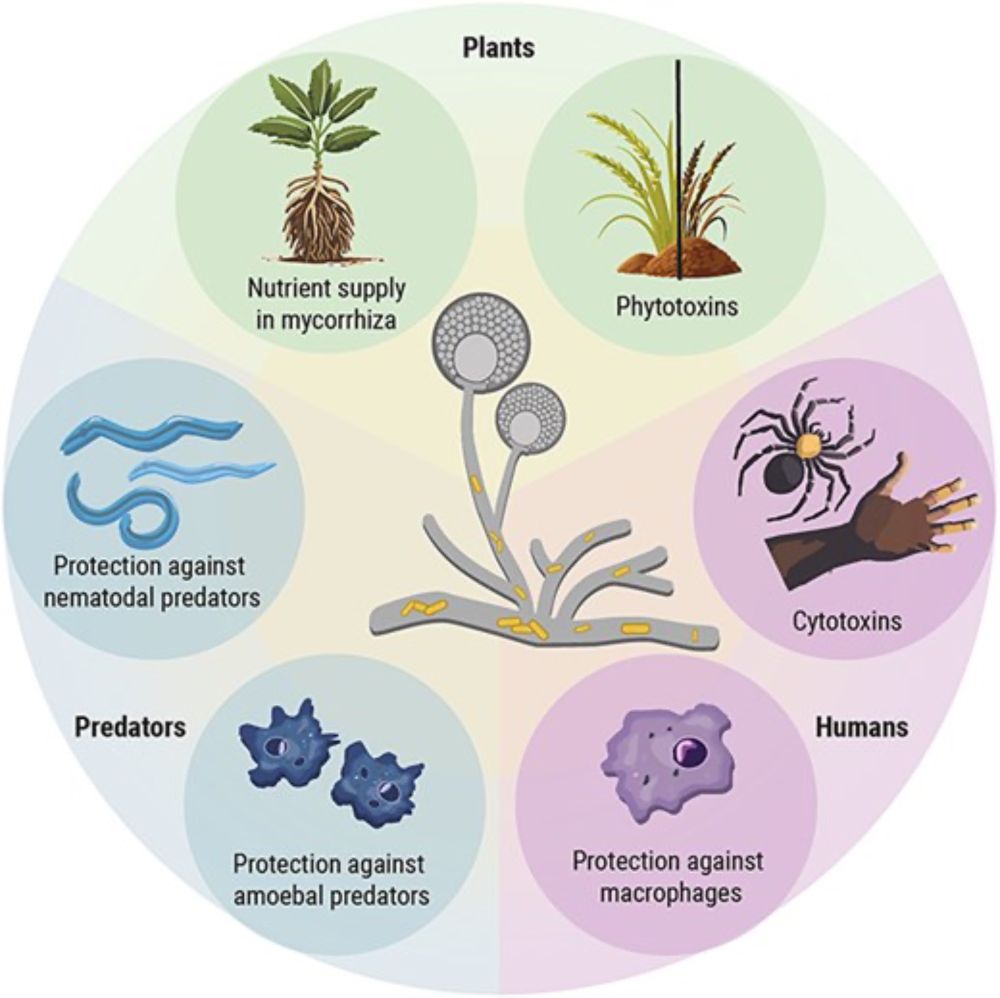
Endofungal Bacteria as Hidden Facilitators of Biotic Interactions
Abstract. Fungi play pivotal roles in ecology and human health, driving nutrient cycling, supporting antibiotic production, and posing threats through toxi
academic.oup.com
June 25, 2025 at 7:16 AM
Great #ISMEJournal review by Ingrid Richter, Hannah Büttner, Christian Hertweck @leibniz-hki.de @microverse.bsky.social
Endofungal Bacteria as Hidden Facilitators of Biotic Interactions
academic.oup.com/ismej/advanc...
Endofungal Bacteria as Hidden Facilitators of Biotic Interactions
academic.oup.com/ismej/advanc...
Reposted

Great news! 🏆🎉 A team led by Hannah Büttner won the Beutenberg Science Award for interdisciplinary collaboration! Their research on Mortierella alpina and its bioactive malpinins offers new possibilities for sustainable agriculture. 🌱🚜 Congrats also to Marianna Boccia for the best PhD thesis! 👏

April 4, 2025 at 12:50 PM
Great news! 🏆🎉 A team led by Hannah Büttner won the Beutenberg Science Award for interdisciplinary collaboration! Their research on Mortierella alpina and its bioactive malpinins offers new possibilities for sustainable agriculture. 🌱🚜 Congrats also to Marianna Boccia for the best PhD thesis! 👏
Reposted
`Our findings provide valuable insight into the use of M. alpina as a biocontrol agent, emphasizing the ecologically significant role of malpinins as a protective trait... these findings have translational value for applications in agriculture.`
pubs.acs.org/doi/10.1021/...
pubs.acs.org/doi/10.1021/...

Beneficial Soil Fungus Kills Predatory Nematodes with Dehydropeptides Translocating into the Animal Gut
Mortierella alpina is a mold fungus that has gained attention for its positive correlation with soil health, plant growth, and applications as a crop biocontrol agent to suppress the threats of nematode pests. To date, the mechanisms underlying the protective traits of M. alpina against these plant parasites have remained elusive. Here we report that abundantly produced peptidic biosurfactants, malpinin A–D, exhibit robust inhibitory activity against nematodes. Nematode assays with malpinin congeners and chemically synthesized analogues revealed that the dehydro amino acid is critical for activity, whereas the N-terminal amino acid residues modulate the lipophilicity. Complementary imaging by fluorescence microscopy and Raman microspectroscopy, using externally fluorescence-labeled, semisynthetic malpinin or a biosynthetically alkyne-tagged probe generated by precursor-directed biosynthesis, visualized the translocation and enrichment of malpinin in the gut of the model nematode Caenorhabditis elegans. Our findings provide valuable insight into the use of M. alpina as a biocontrol agent, emphasizing the ecologically significant role of malpinins as a protective trait. In addition to solving a long-standing riddle, these findings have translational value for applications in agriculture.
pubs.acs.org
February 18, 2025 at 3:38 AM
`Our findings provide valuable insight into the use of M. alpina as a biocontrol agent, emphasizing the ecologically significant role of malpinins as a protective trait... these findings have translational value for applications in agriculture.`
pubs.acs.org/doi/10.1021/...
pubs.acs.org/doi/10.1021/...