



Hari Kalidindi
@harikalidindi.bsky.social
Research Fellow, Sensorimotor & Computational Neuroscience Donders Institute, Netherlands | Studying how brain produces movements
Reposted by Hari Kalidindi

1/ Why does RL struggle with social dilemmas? How can we ensure that AI learns to cooperate rather than compete?
Introducing our new framework: MUPI (Embedded Universal Predictive Intelligence) which provides a theoretical basis for new cooperative solutions in RL.
Preprint🧵👇
(Paper link below.)
Introducing our new framework: MUPI (Embedded Universal Predictive Intelligence) which provides a theoretical basis for new cooperative solutions in RL.
Preprint🧵👇
(Paper link below.)

December 3, 2025 at 7:19 PM
1/ Why does RL struggle with social dilemmas? How can we ensure that AI learns to cooperate rather than compete?
Introducing our new framework: MUPI (Embedded Universal Predictive Intelligence) which provides a theoretical basis for new cooperative solutions in RL.
Preprint🧵👇
(Paper link below.)
Introducing our new framework: MUPI (Embedded Universal Predictive Intelligence) which provides a theoretical basis for new cooperative solutions in RL.
Preprint🧵👇
(Paper link below.)
Reposted by Hari Kalidindi

Good piece by @kohitij.bsky.social on why neuroscientists use an "outdated" vision model. Neuroscience is different than AI and that's ok! medium.com/@kohitij_716...

Why AlexNet Died in AI but Lingers in Neuroscience — Through the Lens of Popper and Kuhn
When I talk to any of my machine learning researcher colleagues in 2025, they tell me that a model from 2023 is prehistoric. In AI, a year…
medium.com
December 3, 2025 at 2:53 PM
Good piece by @kohitij.bsky.social on why neuroscientists use an "outdated" vision model. Neuroscience is different than AI and that's ok! medium.com/@kohitij_716...
Reposted by Hari Kalidindi
The brain computes by processing information over time through interactions between connectivity and dynamics that are hard to model. Here we infer these interactions from data and find they better predict cognitive performance! www.nature.com/articles/s41... w/ @lindenmp.bsky.social

December 2, 2025 at 11:39 PM
The brain computes by processing information over time through interactions between connectivity and dynamics that are hard to model. Here we infer these interactions from data and find they better predict cognitive performance! www.nature.com/articles/s41... w/ @lindenmp.bsky.social
Reposted by Hari Kalidindi

Join us for Fall 2026. In our group, you can run studies from human behavior and neuroimaging, to large-scale NHP ephys, and join them up with a robust computational foundation. Bonus: you can help build the reading list.

The Sensorimotor Superlab with @gribblelab.org and @andpru.bsky.social is a unique place to work and learn. We are now accepting MSc and PhD applications for Fall 2026. Join our awesome team at Western University... For application instructions see diedrichsenlab.org and gribblelab.org/join.html!
Diedrichsenlab
diedrichsenlab.org
December 2, 2025 at 1:23 PM
Join us for Fall 2026. In our group, you can run studies from human behavior and neuroimaging, to large-scale NHP ephys, and join them up with a robust computational foundation. Bonus: you can help build the reading list.
European universities leading the way
Thread of French and Dutch research institutes slowly unsubscribing from web of science (and thence impact factors).
December 3, 2025 at 8:41 AM
European universities leading the way
Reposted by Hari Kalidindi

Thread of French and Dutch research institutes slowly unsubscribing from web of science (and thence impact factors).
December 3, 2025 at 6:53 AM
Thread of French and Dutch research institutes slowly unsubscribing from web of science (and thence impact factors).
Reposted by Hari Kalidindi

0/10 Thanks for the interest in our preprint. Some takes say it negates or fully supports the “manifold hypothesis”, neither quite right. Our results show that if you only focus on the manifold capturing most of task-related variance, you could miss important dynamics that actually drive behavior.
“Our findings challenge the conventional focus on low-dimensional coding subspaces as a sufficient framework for understanding neural computations, demonstrating that dimensions previously considered task-irrelevant and accounting for little variance can have a critical role in driving behavior.”

Neural dynamics outside task-coding dimensions drive decision trajectories through transient amplification
Most behaviors involve neural dynamics in high-dimensional activity spaces. A common approach is to extract dimensions that capture task-related variability, such as those separating stimuli or choice...
www.biorxiv.org
December 2, 2025 at 7:48 AM
0/10 Thanks for the interest in our preprint. Some takes say it negates or fully supports the “manifold hypothesis”, neither quite right. Our results show that if you only focus on the manifold capturing most of task-related variance, you could miss important dynamics that actually drive behavior.
Reposted by Hari Kalidindi

How I contributed to rejecting one of my favorite papers of all times, Yes, I teach it to students daily, and refer to it in lots of papers. Sorry. open.substack.com/pub/kording/...

How I contributed to rejecting one of my favorite papers of all time
I believe we should talk about the mistakes we make.
open.substack.com
December 2, 2025 at 1:27 AM
How I contributed to rejecting one of my favorite papers of all times, Yes, I teach it to students daily, and refer to it in lots of papers. Sorry. open.substack.com/pub/kording/...
Reposted by Hari Kalidindi
Unlike current AI systems, animals can quickly and flexibly adapt to changing environments.
This is the topic of our new perspective in Nature MI (rdcu.be/eSeif), where we relate dynamical and plasticity mechanisms in the brain to in-context and continual learning in AI. #NeuroAI
This is the topic of our new perspective in Nature MI (rdcu.be/eSeif), where we relate dynamical and plasticity mechanisms in the brain to in-context and continual learning in AI. #NeuroAI
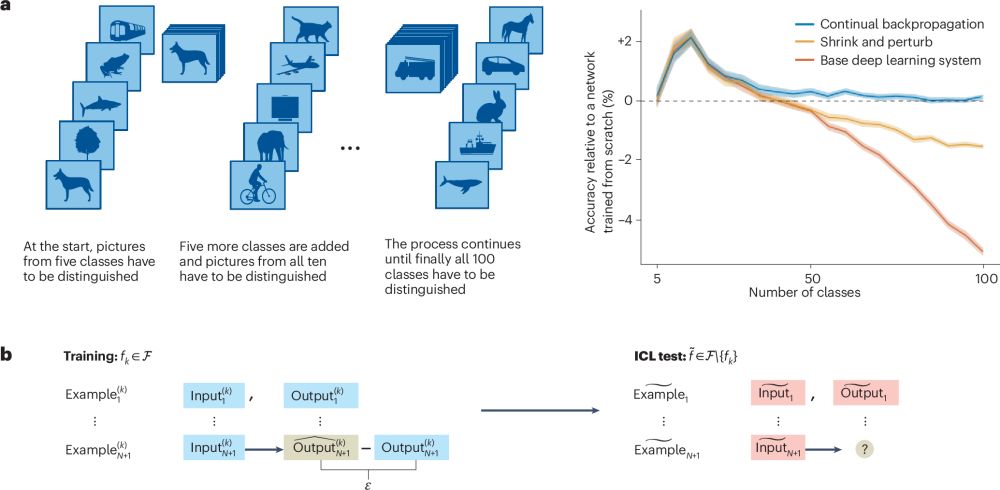
What neuroscience can tell AI about learning in continuously changing environments
Nature Machine Intelligence - Durstewitz et al. explore what artificial intelligence can learn from the brain’s ability to adjust quickly to changing environments. By linking neuroscience...
rdcu.be
November 29, 2025 at 9:24 AM
Unlike current AI systems, animals can quickly and flexibly adapt to changing environments.
This is the topic of our new perspective in Nature MI (rdcu.be/eSeif), where we relate dynamical and plasticity mechanisms in the brain to in-context and continual learning in AI. #NeuroAI
This is the topic of our new perspective in Nature MI (rdcu.be/eSeif), where we relate dynamical and plasticity mechanisms in the brain to in-context and continual learning in AI. #NeuroAI
Reposted by Hari Kalidindi

0/7 Excited to 📢 that our (@mkashefi.bsky.social @diedrichsenjorn.bsky.social @andpru.bsky.social) new preprint on sequence preparation and its effect on reaction time is now up: www.biorxiv.org/content/10.1...
Please get in touch if there is anything you'd like to discuss! Brief summary 🧵👇
Please get in touch if there is anything you'd like to discuss! Brief summary 🧵👇

Sequence preparation is not always associated with a reaction time cost
The extent to which a sequence of movements is prepared before initiating the first movement is a longstanding question in motor neuroscience. The observation that reaction time (RT) increases for lon...
www.biorxiv.org
November 13, 2025 at 11:49 PM
0/7 Excited to 📢 that our (@mkashefi.bsky.social @diedrichsenjorn.bsky.social @andpru.bsky.social) new preprint on sequence preparation and its effect on reaction time is now up: www.biorxiv.org/content/10.1...
Please get in touch if there is anything you'd like to discuss! Brief summary 🧵👇
Please get in touch if there is anything you'd like to discuss! Brief summary 🧵👇
Reposted by Hari Kalidindi

Nature Sci Rep publishes incoherent AI slop. eLife publishes a paper which the reviewers didn't agree with, making all the comments and responses public with thoughtful commentary. One of these journals got delisted by Web of Science for quality concerns from not doing peer review. Guess which one?

November 27, 2025 at 1:35 PM
Nature Sci Rep publishes incoherent AI slop. eLife publishes a paper which the reviewers didn't agree with, making all the comments and responses public with thoughtful commentary. One of these journals got delisted by Web of Science for quality concerns from not doing peer review. Guess which one?
Reposted by Hari Kalidindi

13/ 😀Feel free to reach out to discuss this work, or the application of it to your field of study. Or come swing by our poster at #NeurIPS2025. We’d love to chat!
📄 Paper: openreview.net/forum?id=I82...
💾 Code: github.com/adamjeisen/J...
📍 Poster: Thu 4 Dec 11am - 2pm PST (#2111)
📄 Paper: openreview.net/forum?id=I82...
💾 Code: github.com/adamjeisen/J...
📍 Poster: Thu 4 Dec 11am - 2pm PST (#2111)
Characterizing control between interacting subsystems with deep...
Biological function arises through the dynamical interactions of multiple subsystems, including those between brain areas, within gene regulatory networks, and more. A common approach to...
openreview.net
November 26, 2025 at 7:32 PM
13/ 😀Feel free to reach out to discuss this work, or the application of it to your field of study. Or come swing by our poster at #NeurIPS2025. We’d love to chat!
📄 Paper: openreview.net/forum?id=I82...
💾 Code: github.com/adamjeisen/J...
📍 Poster: Thu 4 Dec 11am - 2pm PST (#2111)
📄 Paper: openreview.net/forum?id=I82...
💾 Code: github.com/adamjeisen/J...
📍 Poster: Thu 4 Dec 11am - 2pm PST (#2111)
Very interesting work!
How do brain areas control each other? 🧠🎛️
✨In our NeurIPS 2025 Spotlight paper, we introduce a data-driven framework to answer this question using deep learning, nonlinear control, and differential geometry.🧵⬇️
✨In our NeurIPS 2025 Spotlight paper, we introduce a data-driven framework to answer this question using deep learning, nonlinear control, and differential geometry.🧵⬇️

November 26, 2025 at 9:04 PM
Very interesting work!
Reposted by Hari Kalidindi
How do brain areas control each other? 🧠🎛️
✨In our NeurIPS 2025 Spotlight paper, we introduce a data-driven framework to answer this question using deep learning, nonlinear control, and differential geometry.🧵⬇️
✨In our NeurIPS 2025 Spotlight paper, we introduce a data-driven framework to answer this question using deep learning, nonlinear control, and differential geometry.🧵⬇️
November 26, 2025 at 7:32 PM
How do brain areas control each other? 🧠🎛️
✨In our NeurIPS 2025 Spotlight paper, we introduce a data-driven framework to answer this question using deep learning, nonlinear control, and differential geometry.🧵⬇️
✨In our NeurIPS 2025 Spotlight paper, we introduce a data-driven framework to answer this question using deep learning, nonlinear control, and differential geometry.🧵⬇️
Reposted by Hari Kalidindi

I am not even sure it is a hypothesis.
I mean, it is a certainty that neural activity coding for a behavior is not using the full subspace of coding available.
It is interesting how many dimensions are in use.
But these are almost mathematically guaranteed.
Can you state the hypothesis?
I mean, it is a certainty that neural activity coding for a behavior is not using the full subspace of coding available.
It is interesting how many dimensions are in use.
But these are almost mathematically guaranteed.
Can you state the hypothesis?
November 26, 2025 at 3:17 PM
I am not even sure it is a hypothesis.
I mean, it is a certainty that neural activity coding for a behavior is not using the full subspace of coding available.
It is interesting how many dimensions are in use.
But these are almost mathematically guaranteed.
Can you state the hypothesis?
I mean, it is a certainty that neural activity coding for a behavior is not using the full subspace of coding available.
It is interesting how many dimensions are in use.
But these are almost mathematically guaranteed.
Can you state the hypothesis?
Reposted by Hari Kalidindi

"The inevitability and superfluousness of cell types in spatial cognition". Intuitive cell types are found in random artificial networks using the same selection criteria neuroscientists use with actual data. elifesciences.org/reviewed-pre... 1/2
elifesciences.org
November 25, 2025 at 7:29 PM
"The inevitability and superfluousness of cell types in spatial cognition". Intuitive cell types are found in random artificial networks using the same selection criteria neuroscientists use with actual data. elifesciences.org/reviewed-pre... 1/2
Reposted by Hari Kalidindi

In fact, in some recent work, we showed that transiently blocking some proprioceptive feedback *increases* the dimensionality of dynamics along a direction orthogonal to the task manifold, with only *weak* effects on behavioral trajectories.

Motor Cortical Output Integrates Distorted Proprioceptive Feedback
Proprioceptive feedback from muscles is essential for continuous monitoring and precise control of limb movement, yet how such peripheral feedback is integrated into ongoing descending motor cortical ...
www.biorxiv.org
November 24, 2025 at 1:16 AM
In fact, in some recent work, we showed that transiently blocking some proprioceptive feedback *increases* the dimensionality of dynamics along a direction orthogonal to the task manifold, with only *weak* effects on behavioral trajectories.
Reposted by Hari Kalidindi

“Our findings challenge the conventional focus on low-dimensional coding subspaces as a sufficient framework for understanding neural computations, demonstrating that dimensions previously considered task-irrelevant and accounting for little variance can have a critical role in driving behavior.”
Neural dynamics outside task-coding dimensions drive decision trajectories through transient amplification
Most behaviors involve neural dynamics in high-dimensional activity spaces. A common approach is to extract dimensions that capture task-related variability, such as those separating stimuli or choice...
www.biorxiv.org
November 23, 2025 at 1:38 PM
“Our findings challenge the conventional focus on low-dimensional coding subspaces as a sufficient framework for understanding neural computations, demonstrating that dimensions previously considered task-irrelevant and accounting for little variance can have a critical role in driving behavior.”
Reposted by Hari Kalidindi
Not directly related to @neurograce.bsky.social’s comment here but to the thread: I am baffled by the number of people who seem to think the claim is that all brain computation is low-d vs. the *emprical* finding that task-related neural activity is (linear) low-d in many (not all) cases.
This kind of stuff is why I say that I worry that the tools of neuroscience are not properly vetted
“Our findings challenge the conventional focus on low-dimensional coding subspaces as a sufficient framework for understanding neural computations, demonstrating that dimensions previously considered task-irrelevant and accounting for little variance can have a critical role in driving behavior.”
November 24, 2025 at 1:16 AM
Not directly related to @neurograce.bsky.social’s comment here but to the thread: I am baffled by the number of people who seem to think the claim is that all brain computation is low-d vs. the *emprical* finding that task-related neural activity is (linear) low-d in many (not all) cases.
Reposted by Hari Kalidindi
This work is so, so good. Really elegant demonstration of why low-dimensional neural dynamics in movement may follow from simple control principles. Highly complementary to arguments from Peiran Gao and @suryaganguli.bsky.social.
Fred Crevecoeur
@fredericcrevec1
🚨preprint time by @harikalidindi.bsky.social
for our work on neural population dynamics: we show that features of neural population activity during reaching emerge from a simple linear body-network system 🧵👇
biorxiv.org/content/10.1...
@fredericcrevec1
🚨preprint time by @harikalidindi.bsky.social
for our work on neural population dynamics: we show that features of neural population activity during reaching emerge from a simple linear body-network system 🧵👇
biorxiv.org/content/10.1...
November 13, 2025 at 7:35 PM
This work is so, so good. Really elegant demonstration of why low-dimensional neural dynamics in movement may follow from simple control principles. Highly complementary to arguments from Peiran Gao and @suryaganguli.bsky.social.
Reposted by Hari Kalidindi

Reposted by Hari Kalidindi


July 12, 2025 at 7:36 PM
Reposted by Hari Kalidindi
1/3) This may be a very important paper, it suggests that there are no prediction error encoding neurons in sensory areas of cortex:
www.biorxiv.org/content/10.1...
I personally am a big fan of the idea that cortical regions (allo and neo) are doing sequence prediction.
But...
🧠📈 🧪
www.biorxiv.org/content/10.1...
I personally am a big fan of the idea that cortical regions (allo and neo) are doing sequence prediction.
But...
🧠📈 🧪

Sensory responses of visual cortical neurons are not prediction errors
Predictive coding is theorized to be a ubiquitous cortical process to explain sensory responses. It asserts that the brain continuously predicts sensory information and imposes those predictions on lo...
www.biorxiv.org
July 11, 2025 at 3:45 PM
1/3) This may be a very important paper, it suggests that there are no prediction error encoding neurons in sensory areas of cortex:
www.biorxiv.org/content/10.1...
I personally am a big fan of the idea that cortical regions (allo and neo) are doing sequence prediction.
But...
🧠📈 🧪
www.biorxiv.org/content/10.1...
I personally am a big fan of the idea that cortical regions (allo and neo) are doing sequence prediction.
But...
🧠📈 🧪
Reposted by Hari Kalidindi

When we reach for an object, we adapt to unexpected dynamics and respond to disturbances. These two mechanisms work online, and when you perturb them at the right time, you can see interference...
Full story ➡️ www.biorxiv.org/content/10.1...
Full story ➡️ www.biorxiv.org/content/10.1...

Interference between flexible and adaptive reaching control
Humans rapidly update the control of an ongoing movement following changes in contextual parameters. This involves adjusting the controller to exploit redundancy in the movement goal, such as when rea...
www.biorxiv.org
July 1, 2025 at 7:45 AM
When we reach for an object, we adapt to unexpected dynamics and respond to disturbances. These two mechanisms work online, and when you perturb them at the right time, you can see interference...
Full story ➡️ www.biorxiv.org/content/10.1...
Full story ➡️ www.biorxiv.org/content/10.1...
Reposted by Hari Kalidindi

Hot take: I like a lot of research on "digital twins" but I think it's kind of a lame name for a cognitive model!
I'm sorry I didn't say that in my paper: osf.io/preprints/ps...
I'm sorry I didn't say that in my paper: osf.io/preprints/ps...
OSF
osf.io
July 8, 2025 at 4:19 AM
Hot take: I like a lot of research on "digital twins" but I think it's kind of a lame name for a cognitive model!
I'm sorry I didn't say that in my paper: osf.io/preprints/ps...
I'm sorry I didn't say that in my paper: osf.io/preprints/ps...