



Gianluca Zambanini
@gianlucazamba.bsky.social
PhD candidate at MPI für molekulare Genetik in the Mundlos Group 🧬
Interested in:
Molecular Genetics,
Gene engineering,
Limb development (FGF8),
WNT signaling,
Relationship between DNA and TFs,
Big CUT&RUN enthusiast
Interested in:
Molecular Genetics,
Gene engineering,
Limb development (FGF8),
WNT signaling,
Relationship between DNA and TFs,
Big CUT&RUN enthusiast
Reposted by Gianluca Zambanini

Out now! 🎉 Check the thread & preprint to see why we think E–P specificity is real in mammals — and, well, a few other interesting things popped up too 👀
Huge thanks to @danielibrahim.bsky.social, @arnaudkr.bsky.social & @stemundi.bsky.social and fantastic people in their labs — what a journey! 🧪🔬
Huge thanks to @danielibrahim.bsky.social, @arnaudkr.bsky.social & @stemundi.bsky.social and fantastic people in their labs — what a journey! 🧪🔬
What is a promoter? And how does it work?
We very happy to share our latest work trying to understand enhancer-promoter compatibility.
I am very excited about the results of @blanka-majchrzycka.bsky.social, which changed the way I think about promoters
www.biorxiv.org/content/10.1...
We very happy to share our latest work trying to understand enhancer-promoter compatibility.
I am very excited about the results of @blanka-majchrzycka.bsky.social, which changed the way I think about promoters
www.biorxiv.org/content/10.1...

Enhancer-promoter compatibility is mediated by the promoter-proximal region
Gene promoters induce transcription in response to distal enhancers. How enhancers specifically activate their target promoter while bypassing other promoters remains unclear. Here, we find that the p...
www.biorxiv.org
October 17, 2025 at 5:50 AM
Out now! 🎉 Check the thread & preprint to see why we think E–P specificity is real in mammals — and, well, a few other interesting things popped up too 👀
Huge thanks to @danielibrahim.bsky.social, @arnaudkr.bsky.social & @stemundi.bsky.social and fantastic people in their labs — what a journey! 🧪🔬
Huge thanks to @danielibrahim.bsky.social, @arnaudkr.bsky.social & @stemundi.bsky.social and fantastic people in their labs — what a journey! 🧪🔬
Congrats to all for the great work!
And congrats to @annanordin.bsky.social like always impeccable work! 🎉🎉🎉
And congrats to @annanordin.bsky.social like always impeccable work! 🎉🎉🎉
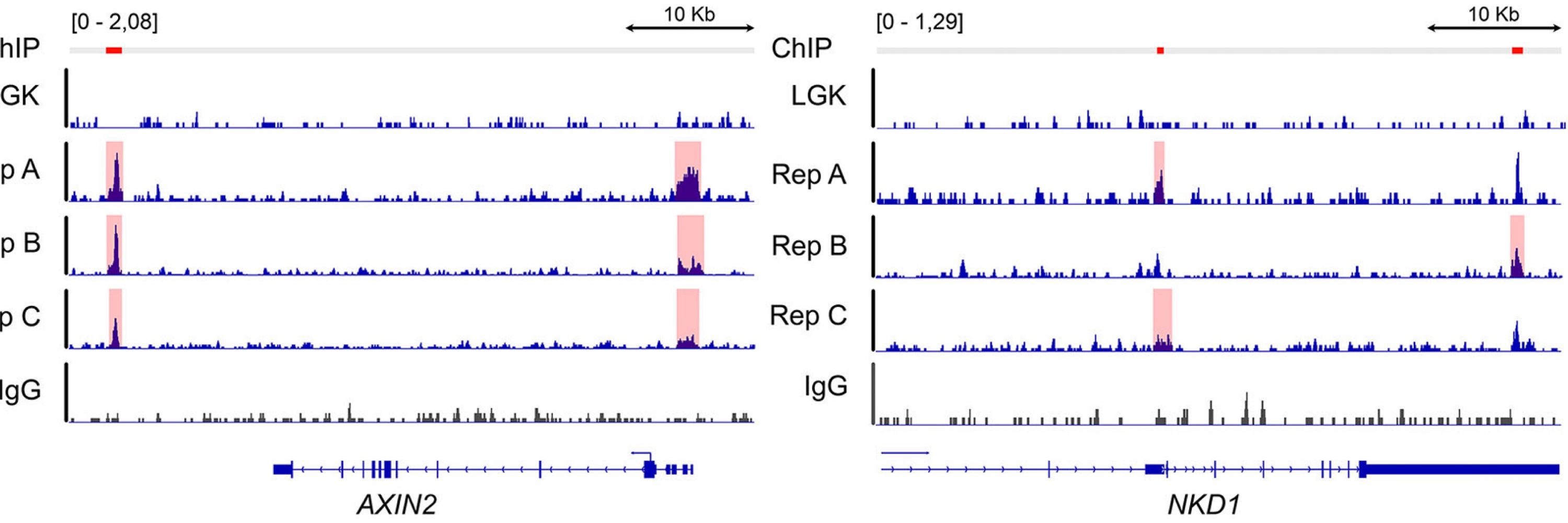
A 6-year long study from the Lab is finally out @genomeresearch.bsky.social
Mastered by @annanordin.bsky.social in collaboration with Chaitali Chakraborty from @remeseiro-lab.bsky.social
Why is our work Important? Discover it in the quick Bluetorial 👇
genome.cshlp.org/content/earl...
Mastered by @annanordin.bsky.social in collaboration with Chaitali Chakraborty from @remeseiro-lab.bsky.social
Why is our work Important? Discover it in the quick Bluetorial 👇
genome.cshlp.org/content/earl...
Wnt signaling activation induces CTCF binding and loop formation at cis-regulatory elements of target genes
An international, peer-reviewed genome sciences journal featuring outstanding original research that offers novel insights into the biology of all organisms
genome.cshlp.org
July 24, 2025 at 9:42 PM
Congrats to all for the great work!
And congrats to @annanordin.bsky.social like always impeccable work! 🎉🎉🎉
And congrats to @annanordin.bsky.social like always impeccable work! 🎉🎉🎉
Reposted by Gianluca Zambanini
Finally out! 🥳 Our paper showing how a transposable element (TE) insertion can cause developmental phenotypes is now published @natgenet.nature.com 🧬🦠🐁
Below is a brief description of the major findings. Check the full version of the paper for more details: www.nature.com/articles/s41588-025-02248-5
Below is a brief description of the major findings. Check the full version of the paper for more details: www.nature.com/articles/s41588-025-02248-5
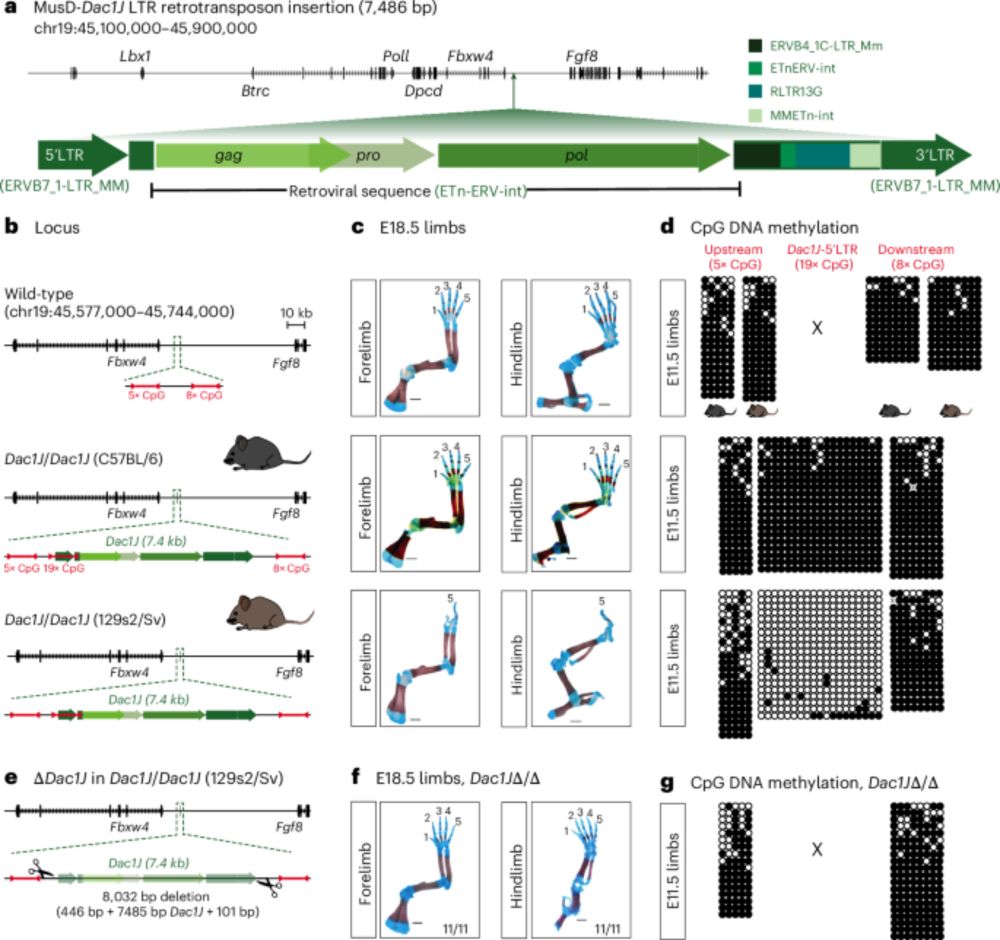
Enhancer adoption by an LTR retrotransposon generates viral-like particles, causing developmental limb phenotypes - Nature Genetics
Activation of an LTR retrotransposon inserted upstream of the Fgf8 gene produces viral-like particles in the mouse developing limb, triggering apoptosis and causing limb malformation. This phenotype c...
www.nature.com
July 9, 2025 at 10:05 AM
Finally out! 🥳 Our paper showing how a transposable element (TE) insertion can cause developmental phenotypes is now published @natgenet.nature.com 🧬🦠🐁
Below is a brief description of the major findings. Check the full version of the paper for more details: www.nature.com/articles/s41588-025-02248-5
Below is a brief description of the major findings. Check the full version of the paper for more details: www.nature.com/articles/s41588-025-02248-5
Reposted by Gianluca Zambanini
We had previously shown that TBX3 and #WNT cooperate in limb #DevBio
We now have a shocking finding, just published in @pnas.org
TBX3 physically engages with β-catenin to drive metastasis genes in #ColorectalCancer (CRC)
www.pnas.org/doi/epub/10....
We now have a shocking finding, just published in @pnas.org
TBX3 physically engages with β-catenin to drive metastasis genes in #ColorectalCancer (CRC)
www.pnas.org/doi/epub/10....
The developmental factor TBX3 engages with the Wnt/β-catenin transcriptional complex in colorectal cancer to regulate metastasis genes
www.pnas.org
May 12, 2025 at 7:33 AM
We had previously shown that TBX3 and #WNT cooperate in limb #DevBio
We now have a shocking finding, just published in @pnas.org
TBX3 physically engages with β-catenin to drive metastasis genes in #ColorectalCancer (CRC)
www.pnas.org/doi/epub/10....
We now have a shocking finding, just published in @pnas.org
TBX3 physically engages with β-catenin to drive metastasis genes in #ColorectalCancer (CRC)
www.pnas.org/doi/epub/10....
Reposted by Gianluca Zambanini

🚨 Preprint 🚨
Ever wondered how cells prepare their genomes to enable new cell-fates? In this team up with the Kind lab, we show that genes are repositioned in the nucleus to get ready for future activation and tissue formation. Read 🧵👇 to find out how and when this happens!
doi.org/10.1101/2025...
Ever wondered how cells prepare their genomes to enable new cell-fates? In this team up with the Kind lab, we show that genes are repositioned in the nucleus to get ready for future activation and tissue formation. Read 🧵👇 to find out how and when this happens!
doi.org/10.1101/2025...

Reconfiguration of genome-lamina interactions marks the commissioning of limb cell-fates
Diverse forms of heterochromatin block inappropriate transcription and safeguard differentiation and cell identity. Yet, how and when heterochromatin is reconfigured to facilitate changes in cell-fate...
www.biorxiv.org
May 8, 2025 at 9:43 AM
🚨 Preprint 🚨
Ever wondered how cells prepare their genomes to enable new cell-fates? In this team up with the Kind lab, we show that genes are repositioned in the nucleus to get ready for future activation and tissue formation. Read 🧵👇 to find out how and when this happens!
doi.org/10.1101/2025...
Ever wondered how cells prepare their genomes to enable new cell-fates? In this team up with the Kind lab, we show that genes are repositioned in the nucleus to get ready for future activation and tissue formation. Read 🧵👇 to find out how and when this happens!
doi.org/10.1101/2025...
A bit late on this but happy to share one of the last project I participated in the Cantù lab!
Thanks to @annanordin.bsky.social, @claudiocantu81.bsky.social and all the other people without whom this project would have not been possible.
Thanks to @annanordin.bsky.social, @claudiocantu81.bsky.social and all the other people without whom this project would have not been possible.
Our first release in the attempt to build the Transcription Factor Binding (TFB)-OMICS during #DevBio is now out in Development @dev-journal.bsky.social
doi.org/10.1242/dev....
👉We hope many will use our data, and some will want to help mapping their beloved gene regulators in their favorite tissue
doi.org/10.1242/dev....
👉We hope many will use our data, and some will want to help mapping their beloved gene regulators in their favorite tissue
We are using CUT&RUN-LoV-U to map effectors of Signaling Pathways across tissue and stages of Mouse #DevBio🐭🧬
Do you want to join forces and collaborate to build the future of the TranscriptionFactorBinding(TFB)-OMICS?
www.biorxiv.org/content/10.1...
Do you want to join forces and collaborate to build the future of the TranscriptionFactorBinding(TFB)-OMICS?
www.biorxiv.org/content/10.1...
April 15, 2025 at 8:56 AM
A bit late on this but happy to share one of the last project I participated in the Cantù lab!
Thanks to @annanordin.bsky.social, @claudiocantu81.bsky.social and all the other people without whom this project would have not been possible.
Thanks to @annanordin.bsky.social, @claudiocantu81.bsky.social and all the other people without whom this project would have not been possible.
Reposted by Gianluca Zambanini
🚨 Preprint alert 🚨
Excited to share our work on "Ab-trapping," an antibody artifact causing misleading peripheral ("rim") staining in imaging & genomics (IF, CUT&Tag, CUT&RUN). Antibodies fail to penetrate structures, accumulating at the periphery. A 🧵👇
doi.org/10.1101/2025...
Excited to share our work on "Ab-trapping," an antibody artifact causing misleading peripheral ("rim") staining in imaging & genomics (IF, CUT&Tag, CUT&RUN). Antibodies fail to penetrate structures, accumulating at the periphery. A 🧵👇
doi.org/10.1101/2025...
Ab-trapping - a peripheral staining artifact in antibody-based microscopy and genomics
Antibodies (Ab) are essential for detecting specific epitopes in microscopy and genomics, but can produce artifacts leading to erroneous interpretations. Here, we characterize a novel artifact, Ab-tra...
doi.org
April 14, 2025 at 8:08 PM
🚨 Preprint alert 🚨
Excited to share our work on "Ab-trapping," an antibody artifact causing misleading peripheral ("rim") staining in imaging & genomics (IF, CUT&Tag, CUT&RUN). Antibodies fail to penetrate structures, accumulating at the periphery. A 🧵👇
doi.org/10.1101/2025...
Excited to share our work on "Ab-trapping," an antibody artifact causing misleading peripheral ("rim") staining in imaging & genomics (IF, CUT&Tag, CUT&RUN). Antibodies fail to penetrate structures, accumulating at the periphery. A 🧵👇
doi.org/10.1101/2025...