



Gage R. Coon
@gagecoon.bsky.social
Geobiology, geochemistry, environmental microbiology – PhD student @MIT, Bosak lab
Reposted by Gage R. Coon

Cycling of sulfur redox intermediates drives microbial activity in the sulfate-methane transition zone of cold methane seeps www.biorxiv.org/content/10.6... #jcampubs
December 3, 2025 at 5:18 PM
Cycling of sulfur redox intermediates drives microbial activity in the sulfate-methane transition zone of cold methane seeps www.biorxiv.org/content/10.6... #jcampubs
Reposted by Gage R. Coon
Great new article about the cool stuff we're finding (improbably) alive deep inside Earth's crust! Nice work, @laurapoppick.bsky.social at @quantamagazine.bsky.social www.quantamagazine.org/the-pursuit-...

The Pursuit of Life Where It Seems Unimaginable | Quanta Magazine
A decade ago, Karen Lloyd discovered single-celled microbes living beneath the seafloor. Now she studies how they can survive in Earth’s crust, possibly for hundreds or thousands of years, and push li...
www.quantamagazine.org
August 20, 2025 at 7:54 PM
Great new article about the cool stuff we're finding (improbably) alive deep inside Earth's crust! Nice work, @laurapoppick.bsky.social at @quantamagazine.bsky.social www.quantamagazine.org/the-pursuit-...
Honored to be named a MIT–GE Vernova Energy and Climate Alliance fellow for my work on wastewater methane mitigation and geological hydrogen production 🌎
August 13, 2025 at 2:40 AM
Honored to be named a MIT–GE Vernova Energy and Climate Alliance fellow for my work on wastewater methane mitigation and geological hydrogen production 🌎
Reposted by Gage R. Coon

Check this nice first first-author paper by Ning Hall—now out in Nature Geoscience! Our team had a blast supporting Ning on the isolation workflow, and a few of the standout Methanococcoides strains even trace back to our Danish waters. 🌊
www.nature.com/articles/s41...
www.nature.com/articles/s41...
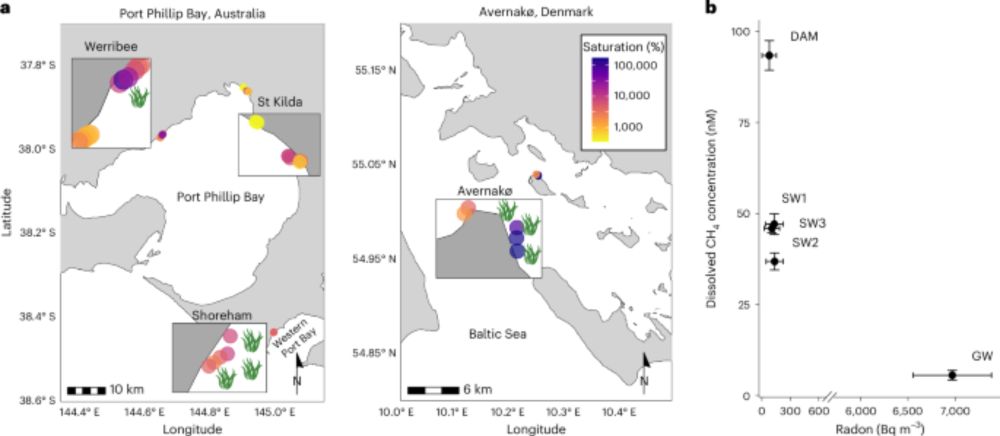
Coastal methane emissions driven by aerotolerant methanogens using seaweed and seagrass metabolites - Nature Geoscience
Experiments suggest aerotolerant archaea produce methane in the surface layers of coastal sandy sediments and that this activity is driven by seaweed and seagrass metabolites.
www.nature.com
August 7, 2025 at 9:14 AM
Check this nice first first-author paper by Ning Hall—now out in Nature Geoscience! Our team had a blast supporting Ning on the isolation workflow, and a few of the standout Methanococcoides strains even trace back to our Danish waters. 🌊
www.nature.com/articles/s41...
www.nature.com/articles/s41...
Reposted by Gage R. Coon
The latest minireview from my lab, “Cell‑surface differences within the genus Methanosarcina shape interactions with the extracellular environment,” is now online in the Journal of Bacteriology. Read the open‑access article here: journals.asm.org/doi/10.1128/....

Cell surface differences within the genus Methanosarcina shape interactions with the extracellular environment | Journal of Bacteriology
Methanogenic archaea, including Methanosarcina, play crucial roles in biotechnology and climate processes, impacting wastewater
treatment, carbon capture, and greenhouse gas emissions. Methanosarcina ...
journals.asm.org
July 30, 2025 at 2:29 AM
The latest minireview from my lab, “Cell‑surface differences within the genus Methanosarcina shape interactions with the extracellular environment,” is now online in the Journal of Bacteriology. Read the open‑access article here: journals.asm.org/doi/10.1128/....
Reposted by Gage R. Coon
Great to see @annajwallenius.bsky.social et al 2025 on line at @femsmicro.org A ubiquitous and diverse methanogenic community drives microbial #methane cycling in eutrophic coastal sediments supported by @erc.europa.eu synergy #MARIX @ribesresearch.bsky.social academic.oup.com/femsec/advan...


July 12, 2025 at 3:50 PM
Great to see @annajwallenius.bsky.social et al 2025 on line at @femsmicro.org A ubiquitous and diverse methanogenic community drives microbial #methane cycling in eutrophic coastal sediments supported by @erc.europa.eu synergy #MARIX @ribesresearch.bsky.social academic.oup.com/femsec/advan...
Reposted by Gage R. Coon

TIR: Lapham et al (2024), arguing that anaerobic methane oxidation in sediments doesn't necessarily act as a "lid" preventing CH4 produced in deeper seds from escaping to seawater.
www.nature.com/articles/s41...
www.nature.com/articles/s41...

Methane leakage through the sulfate–methane transition zone of the Baltic seabed - Nature Geoscience
Inhibition of anaerobic methane oxidation in organic-rich marine sediments causes widespread methane leakage from the seabed, according to an analysis of sediment cores from the Baltic Sea.
www.nature.com
December 14, 2024 at 4:51 PM
TIR: Lapham et al (2024), arguing that anaerobic methane oxidation in sediments doesn't necessarily act as a "lid" preventing CH4 produced in deeper seds from escaping to seawater.
www.nature.com/articles/s41...
www.nature.com/articles/s41...
Reposted by Gage R. Coon
Control of hydrogen concentrations by microbial sulfate reduction in two contrasting anoxic coastal sediments #USC_earth #USC_MEB #ResearchAtUSC www.frontiersin.org/journals/mic... #jcampubs
November 13, 2024 at 2:03 PM
Control of hydrogen concentrations by microbial sulfate reduction in two contrasting anoxic coastal sediments #USC_earth #USC_MEB #ResearchAtUSC www.frontiersin.org/journals/mic... #jcampubs