



Eline Van Geert
@elinevg.bsky.social
Visual perception, psychology, aesthetics, open science! Postdoctoral researcher @gestaltrevision.bsky.social. Creator of the #octatoolbox
Web: http://evg.ulyssis.be/evg/
Twitter: https://twitter.com/Eline__VG
Mastodon: https://fosstodon.org/@ElineVG
Web: http://evg.ulyssis.be/evg/
Twitter: https://twitter.com/Eline__VG
Mastodon: https://fosstodon.org/@ElineVG
Last week I had the pleasure of visiting the Centre for Brain Research at the Jagiellonian University in Krakau, and giving a talk at the Institute of Psychology! Thank you very much @marekpedziwi.bsky.social and @antoniafranaszek.bsky.social for the invite and interesting discussions!


November 14, 2025 at 11:27 AM
Last week I had the pleasure of visiting the Centre for Brain Research at the Jagiellonian University in Krakau, and giving a talk at the Institute of Psychology! Thank you very much @marekpedziwi.bsky.social and @antoniafranaszek.bsky.social for the invite and interesting discussions!
Here some other beautiful submissions! Thanks everyone for participating (including @janpdehaan.bsky.social)!
For more info on OCTA and QIP:
ℹ️https://elinevg.github.io/OCTA/
ℹ️https://aesthetics-toolbox.streamlit.app/
@gestaltrevision.bsky.social
For more info on OCTA and QIP:
ℹ️https://elinevg.github.io/OCTA/
ℹ️https://aesthetics-toolbox.streamlit.app/
@gestaltrevision.bsky.social



September 23, 2025 at 11:03 AM
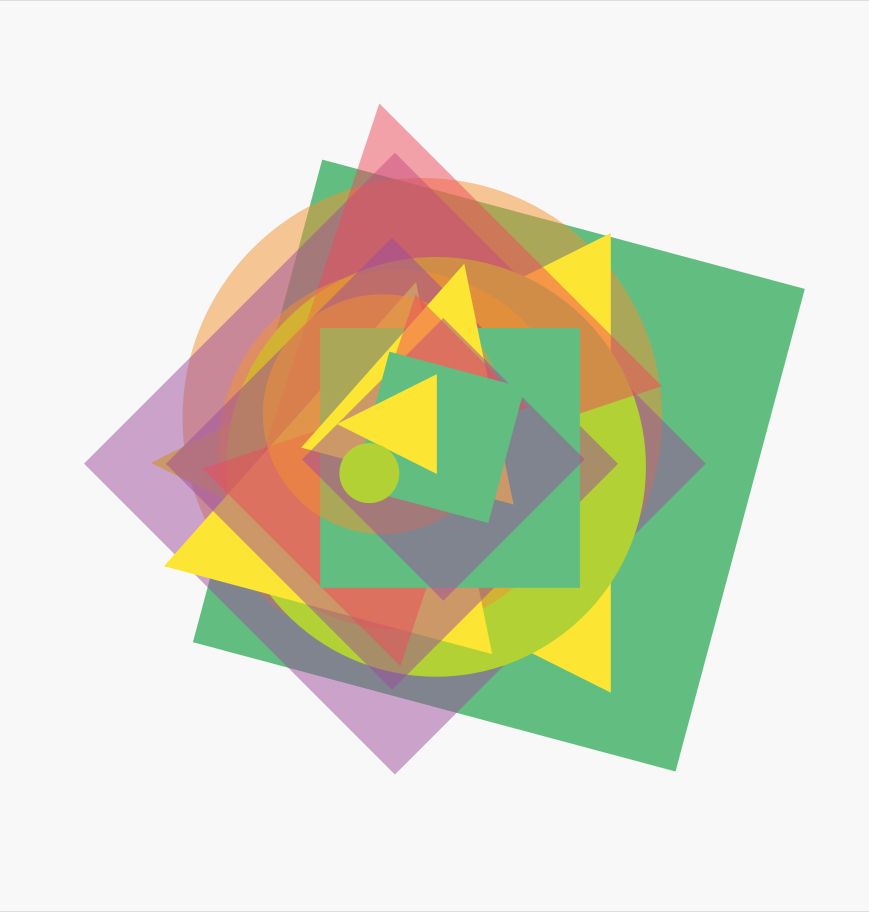
Here some other beautiful submissions! Thanks everyone for participating (including @janpdehaan.bsky.social)!
For more info on OCTA and QIP:
ℹ️https://elinevg.github.io/OCTA/
ℹ️https://aesthetics-toolbox.streamlit.app/
@gestaltrevision.bsky.social
For more info on OCTA and QIP:
ℹ️https://elinevg.github.io/OCTA/
ℹ️https://aesthetics-toolbox.streamlit.app/
@gestaltrevision.bsky.social
The contest for the least balanced OCTA image was won by Anosha & Milena (balance score: 32.45)! Congrats!

September 23, 2025 at 11:03 AM
The contest for the least balanced OCTA image was won by Anosha & Milena (balance score: 32.45)! Congrats!
The winning submission for the HOG complexity contest was created by Barbara (HOG complexity score: 5.72). Congratulations!

September 23, 2025 at 11:03 AM
The winning submission for the HOG complexity contest was created by Barbara (HOG complexity score: 5.72). Congratulations!
It was a pleasure presenting my open-source toolbox OCTA for reproducible stimulus generation along the QIP machine from the Aesthetics Toolbox for computing quantitative image properties!
Explore OCTA here: elinevg.github.io/OCTA/
Explore OCTA here: elinevg.github.io/OCTA/

August 27, 2025 at 3:10 PM
It was a pleasure presenting my open-source toolbox OCTA for reproducible stimulus generation along the QIP machine from the Aesthetics Toolbox for computing quantitative image properties!
Explore OCTA here: elinevg.github.io/OCTA/
Explore OCTA here: elinevg.github.io/OCTA/
Last week I officially received the three-yearly ASL Research Award for Human Sciences. Thanks to Academische Stichting Leuven for granting me this important recognition for my PhD research. As winner I was invited to ASL's podcast, have a listen here: open.spotify.com/episode/07Zu...

June 10, 2025 at 7:41 AM
Last week I officially received the three-yearly ASL Research Award for Human Sciences. Thanks to Academische Stichting Leuven for granting me this important recognition for my PhD research. As winner I was invited to ASL's podcast, have a listen here: open.spotify.com/episode/07Zu...
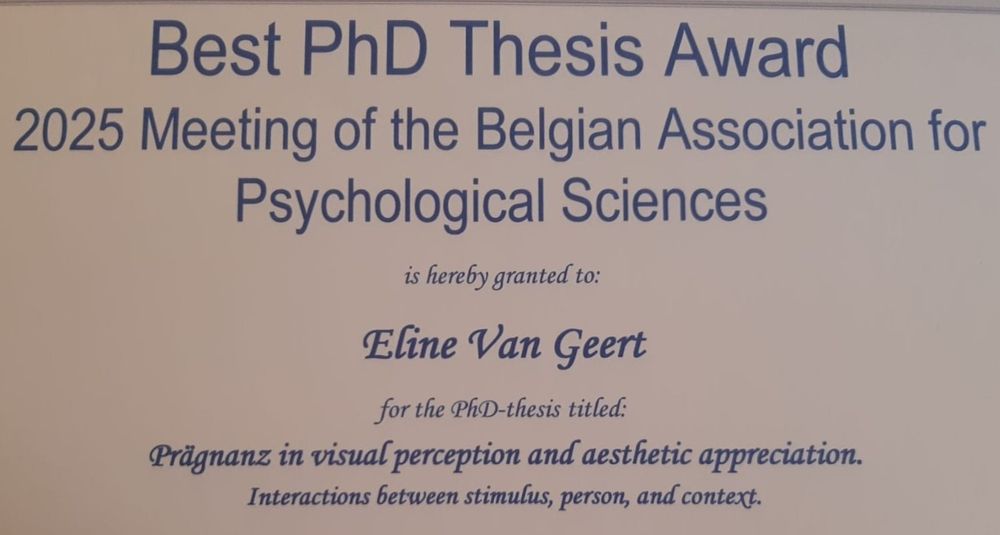
At the 2025 Meeting of the Belgian Association for Psychological Sciences this week, I received the Best PhD Thesis Award 2025. I am very grateful for this recognition of my research combining theory and experimentation and of my commitment to open and reproducible science!
@bapsciences.bsky.social
@bapsciences.bsky.social
May 29, 2025 at 6:22 PM
At the 2025 Meeting of the Belgian Association for Psychological Sciences this week, I received the Best PhD Thesis Award 2025. I am very grateful for this recognition of my research combining theory and experimentation and of my commitment to open and reproducible science!
@bapsciences.bsky.social
@bapsciences.bsky.social
It was an honor to be interviewed about my doctoral research by @bdalile.bsky.social for #KarakterCast! This interview happened on the occasion of me receiving the ASL research award for Human Sciences for my PhD work.
Check it out on Spotify: open.spotify.com/episode/07Zu...
Check it out on Spotify: open.spotify.com/episode/07Zu...
May 5, 2025 at 1:24 PM
It was an honor to be interviewed about my doctoral research by @bdalile.bsky.social for #KarakterCast! This interview happened on the occasion of me receiving the ASL research award for Human Sciences for my PhD work.
Check it out on Spotify: open.spotify.com/episode/07Zu...
Check it out on Spotify: open.spotify.com/episode/07Zu...
Spotted any posters of ReproducibiliTea Leuven at a @kuleuvenuniversity.bsky.social campus? I did!
Join us for our next session to reflect on quantity vs. quality in science!
ℹ️https://forms.office.com/e/0vt4v0Du3C
📆Wednesday 26 March 2025, 16:00-17:00
📍VHI 03.65
Dekenstraat 2, 3000 Leuven
Join us for our next session to reflect on quantity vs. quality in science!
ℹ️https://forms.office.com/e/0vt4v0Du3C
📆Wednesday 26 March 2025, 16:00-17:00
📍VHI 03.65
Dekenstraat 2, 3000 Leuven

March 4, 2025 at 8:15 AM
Spotted any posters of ReproducibiliTea Leuven at a @kuleuvenuniversity.bsky.social campus? I did!
Join us for our next session to reflect on quantity vs. quality in science!
ℹ️https://forms.office.com/e/0vt4v0Du3C
📆Wednesday 26 March 2025, 16:00-17:00
📍VHI 03.65
Dekenstraat 2, 3000 Leuven
Join us for our next session to reflect on quantity vs. quality in science!
ℹ️https://forms.office.com/e/0vt4v0Du3C
📆Wednesday 26 March 2025, 16:00-17:00
📍VHI 03.65
Dekenstraat 2, 3000 Leuven
On November 27th, ReproducibiliTea Leuven organizes a journal club on Generative AI and Open Science! Join us for an interesting discussion, 16:00-17:00, VHI 01.40, Dekenstraat 2, Leuven.
📎 Read: doi.org/10.31235/osf...
🤖 Register: icts.kuleuven.be/apps/onebutt...
@reproducibilitea.bsky.social
📎 Read: doi.org/10.31235/osf...
🤖 Register: icts.kuleuven.be/apps/onebutt...
@reproducibilitea.bsky.social

October 24, 2024 at 9:11 PM
On November 27th, ReproducibiliTea Leuven organizes a journal club on Generative AI and Open Science! Join us for an interesting discussion, 16:00-17:00, VHI 01.40, Dekenstraat 2, Leuven.
📎 Read: doi.org/10.31235/osf...
🤖 Register: icts.kuleuven.be/apps/onebutt...
@reproducibilitea.bsky.social
📎 Read: doi.org/10.31235/osf...
🤖 Register: icts.kuleuven.be/apps/onebutt...
@reproducibilitea.bsky.social
ReproducibiliTea Leuven organizes a next journal club on Oct.9, 16-17, featuring KU Leuven researcher Magdalena Kozula of the #OSIRIS project! Read the paper (here: osf.io/b64q8) and join us for an interesting discussion accompanied with tea and snacks!
@BelRepro @KULeuvenOpenScience
@BelRepro @KULeuvenOpenScience

September 24, 2024 at 9:34 AM
ReproducibiliTea Leuven organizes a next journal club on Oct.9, 16-17, featuring KU Leuven researcher Magdalena Kozula of the #OSIRIS project! Read the paper (here: osf.io/b64q8) and join us for an interesting discussion accompanied with tea and snacks!
@BelRepro @KULeuvenOpenScience
@BelRepro @KULeuvenOpenScience
I enjoyed giving an @ecvp.bsky.social tutorial on the OCTA toolbox yesterday, the open source Python toolbox and online app I created to generate high-quality, reproducible multi-element stimuli! More info on elinevg.github.io/OCTA/ and the workshop materials on github.com/ElineVG/OCTA_workshop

August 26, 2024 at 9:56 PM
I enjoyed giving an @ecvp.bsky.social tutorial on the OCTA toolbox yesterday, the open source Python toolbox and online app I created to generate high-quality, reproducible multi-element stimuli! More info on elinevg.github.io/OCTA/ and the workshop materials on github.com/ElineVG/OCTA_workshop
We replicated positive relations for order-pleasantness, complexity-interest, and pleasantness-interest. Relations for complexity-pleasantness and order-interest differed, as complexity could get more room to be appreciated in the simple and ordered stimulus spaces used here.

May 15, 2024 at 4:07 PM
We replicated positive relations for order-pleasantness, complexity-interest, and pleasantness-interest. Relations for complexity-pleasantness and order-interest differed, as complexity could get more room to be appreciated in the simple and ordered stimulus spaces used here.
Both absolute values (i.e., particular colors, shapes, or sizes) and difference values (e.g., similarity in size between odd and even elements) played a role in the evaluations. For more details, check out our preprint!

May 15, 2024 at 4:07 PM
Both absolute values (i.e., particular colors, shapes, or sizes) and difference values (e.g., similarity in size between odd and even elements) played a role in the evaluations. For more details, check out our preprint!
In Exp. 2, we introduced additional complexity by allowing participants to vary the absolute color, shape, and size of odd and even elements in the image independently.

May 15, 2024 at 4:07 PM
In Exp. 2, we introduced additional complexity by allowing participants to vary the absolute color, shape, and size of odd and even elements in the image independently.
Different color, shape, and size combinations showed up as particularly ordered, complex, pleasant, or interesting. For more details, please consult our preprint!

May 15, 2024 at 4:07 PM
Different color, shape, and size combinations showed up as particularly ordered, complex, pleasant, or interesting. For more details, please consult our preprint!
In this Figure, every white dot indicates a chosen color-shape combination with pleasantness as criterion. We calculated the density of responses at each combination. Local maxima occur for blue, familiar shapes (diamonds, squares, circles), in line with previous research.

May 15, 2024 at 4:06 PM
In this Figure, every white dot indicates a chosen color-shape combination with pleasantness as criterion. We calculated the density of responses at each combination. Local maxima occur for blue, familiar shapes (diamonds, squares, circles), in line with previous research.
We show how combining OCTA and GSP is a fruitful new approach to study visual aesthetics in a systematic, multidimensional manner. In Exp. 1, we investigated influences of absolute color, shape, and size on experienced order, complexity, pleasantness, and interest.

May 15, 2024 at 4:06 PM
We show how combining OCTA and GSP is a fruitful new approach to study visual aesthetics in a systematic, multidimensional manner. In Exp. 1, we investigated influences of absolute color, shape, and size on experienced order, complexity, pleasantness, and interest.
As the slider dimension varies across trials, GSP efficiently explores the full multidimensional space.

May 15, 2024 at 4:06 PM
As the slider dimension varies across trials, GSP efficiently explores the full multidimensional space.
Under the hood, we pass the stimulus with the shape value chosen by the participant to a next participant optimizing the stimulus for another dimension (e.g., color).

May 15, 2024 at 4:06 PM
Under the hood, we pass the stimulus with the shape value chosen by the participant to a next participant optimizing the stimulus for another dimension (e.g., color).
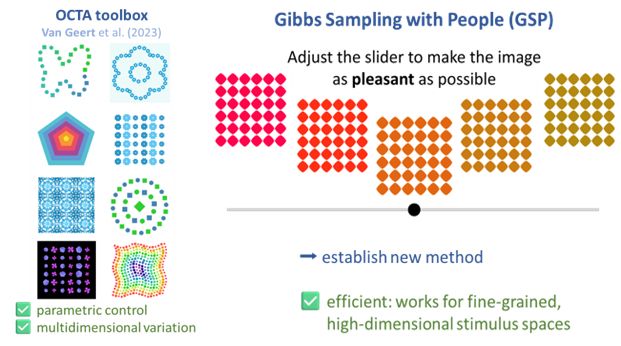
In Gibbs Sampling with People, participants explore a single stimulus dimension per trial (e.g., shape) and select the value on the dimension that maximizes a given criterion (e.g., pleasantness).

May 15, 2024 at 4:06 PM
In Gibbs Sampling with People, participants explore a single stimulus dimension per trial (e.g., shape) and select the value on the dimension that maximizes a given criterion (e.g., pleasantness).
Here we combine two recent developments to address this gap:
(1) the OCTA toolbox for generating multidimensional parametrically controlled stimuli
(2) Gibbs Sampling with People (GSP) for efficiently characterizing subjective evaluations in multidimensional stimulus space.
(1) the OCTA toolbox for generating multidimensional parametrically controlled stimuli
(2) Gibbs Sampling with People (GSP) for efficiently characterizing subjective evaluations in multidimensional stimulus space.
May 15, 2024 at 4:05 PM
Here we combine two recent developments to address this gap:
(1) the OCTA toolbox for generating multidimensional parametrically controlled stimuli
(2) Gibbs Sampling with People (GSP) for efficiently characterizing subjective evaluations in multidimensional stimulus space.
(1) the OCTA toolbox for generating multidimensional parametrically controlled stimuli
(2) Gibbs Sampling with People (GSP) for efficiently characterizing subjective evaluations in multidimensional stimulus space.
Most existing work studies appreciation using either parametrically controlled unidimensional stimuli, or using non-parametrically controlled multidimensional stimuli, preventing insight into the relative contribution of different stimulus dimensions to appreciation.

May 15, 2024 at 4:05 PM
Most existing work studies appreciation using either parametrically controlled unidimensional stimuli, or using non-parametrically controlled multidimensional stimuli, preventing insight into the relative contribution of different stimulus dimensions to appreciation.
Aesthetic appreciation is inherently multidimensional: many different stimulus dimensions (e.g., colors, shapes, sizes) may contribute to our aesthetic experience.

May 15, 2024 at 4:05 PM
Aesthetic appreciation is inherently multidimensional: many different stimulus dimensions (e.g., colors, shapes, sizes) may contribute to our aesthetic experience.
Excited to share “Using Gibbs Sampling with People to characterize perceptual and aesthetic evaluations in multidimensional visual stimulus space”, part of my 6-month research stay with @norijacoby @CompAudition @MPI_ae in Frankfurt #CogSci2024 🎉

May 15, 2024 at 4:04 PM
Excited to share “Using Gibbs Sampling with People to characterize perceptual and aesthetic evaluations in multidimensional visual stimulus space”, part of my 6-month research stay with @norijacoby @CompAudition @MPI_ae in Frankfurt #CogSci2024 🎉