



Eilat Glikman
@eilatg.bsky.social
Astrophysicist. Quasar enthusiast. Physics professor. Mother, etc. Misanthrope who loves humanity. Why can’t we get this thing right?
Waiting for tsunami…

July 30, 2025 at 4:59 AM
Waiting for tsunami…
Seen in Great Barrington. I had to share the LOL 😂

May 18, 2025 at 2:36 PM
Seen in Great Barrington. I had to share the LOL 😂
A little rainbow out my window…


May 8, 2025 at 3:42 AM
A little rainbow out my window…
Look what I found!

February 24, 2025 at 12:56 AM
Look what I found!
Apropos of nothing, today I learned about the impoundment control act.
![Title X of the Act, also known as the Impoundment Control Act of 1974, specifies that the president may request that Congress rescind appropriated funds. If both the Senate and the House of
Representatives have not approved a rescission proposal (by passing legislation) within forty-five days of continuous session, any funds being withheld must be made available for obligation. Congress is not required to vote on the request and has ignored most presidential requests. 41 In response, some lwho?] have called for a line item veto to
strengthen the rescission power and force Congress to vote on the disputed funds.](https://cdn.bsky.app/img/feed_thumbnail/plain/did:plc:nzzv5yvvbgj3hdm7exjneyqj/bafkreigmg6636cskxpei25d563p4ubrki6uhkm4ujjes33h4u2wcjvtofy@jpeg)
January 30, 2025 at 6:40 PM
Apropos of nothing, today I learned about the impoundment control act.
A little moulin rouge in the city.

January 19, 2025 at 2:30 AM
A little moulin rouge in the city.
May this new year be full of light and love 💞

January 1, 2025 at 11:56 PM
May this new year be full of light and love 💞
A non-religious photo I think of as holy.

November 21, 2024 at 2:05 PM
A non-religious photo I think of as holy.
F2M1507 shows an absorption features in its X-ray spectrum suggestive of an ultrafast outflow with speed 0.26c. The optical spectrum shows a second set of blue shifted Balmer emission lines in addition to the systemic broad line emission, also indicative of winds with a speed of 0.014c.


January 8, 2024 at 3:37 PM
F2M1507 shows an absorption features in its X-ray spectrum suggestive of an ultrafast outflow with speed 0.26c. The optical spectrum shows a second set of blue shifted Balmer emission lines in addition to the systemic broad line emission, also indicative of winds with a speed of 0.014c.
Two of the objects reveal very interesting spectra worthy of note in the appendix.
F2M1532 shows an Iron K-alpha line and is well fit be a MYTorus model in decoupled mode suggestive of significant amounts of gas in a global distribution in addition to obscuration along the line of sight.
F2M1532 shows an Iron K-alpha line and is well fit be a MYTorus model in decoupled mode suggestive of significant amounts of gas in a global distribution in addition to obscuration along the line of sight.

January 8, 2024 at 3:37 PM
Two of the objects reveal very interesting spectra worthy of note in the appendix.
F2M1532 shows an Iron K-alpha line and is well fit be a MYTorus model in decoupled mode suggestive of significant amounts of gas in a global distribution in addition to obscuration along the line of sight.
F2M1532 shows an Iron K-alpha line and is well fit be a MYTorus model in decoupled mode suggestive of significant amounts of gas in a global distribution in addition to obscuration along the line of sight.
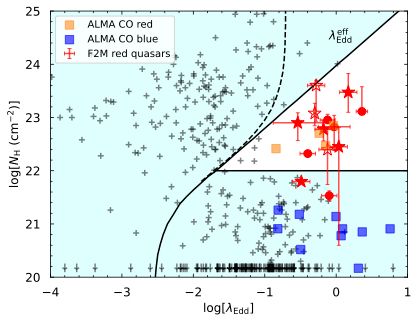
All the red quasars also have black hole mass estimates and Eddington ratios, which allows us to address the main goal of the paper. We find that in L/L_Edd vs. N_H space, all but one of the red quasars reside in the so-called blowout region indicative of them being in a transitional phase.
January 8, 2024 at 3:36 PM
All the red quasars also have black hole mass estimates and Eddington ratios, which allows us to address the main goal of the paper. We find that in L/L_Edd vs. N_H space, all but one of the red quasars reside in the so-called blowout region indicative of them being in a transitional phase.
The red quasars (red symbols) may also be under luminous in X-rays, similar to the Hot DOG quasars that are even more obscured and powerful in the infrared (blue hexagons).

January 8, 2024 at 3:36 PM
The red quasars (red symbols) may also be under luminous in X-rays, similar to the Hot DOG quasars that are even more obscured and powerful in the infrared (blue hexagons).
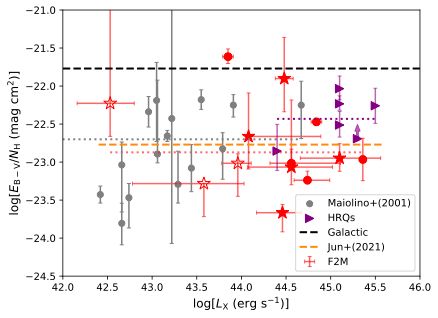
All the quasars have spectral fits allowing a measure of E(B-V). This, combined with the column density yields dust-to-gas ratios for the red quasars, which are lower than the Milky Way and consistent with (and slightly lower than) other AGN samples as well as other red quasar samples.
January 8, 2024 at 3:36 PM
All the quasars have spectral fits allowing a measure of E(B-V). This, combined with the column density yields dust-to-gas ratios for the red quasars, which are lower than the Milky Way and consistent with (and slightly lower than) other AGN samples as well as other red quasar samples.
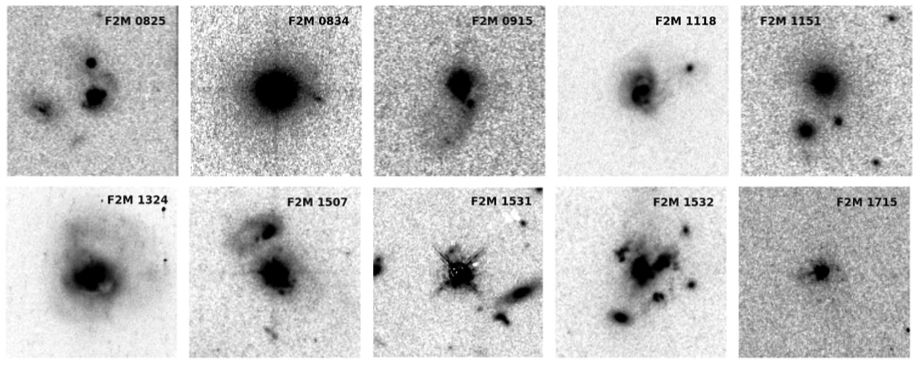
The purpose of this new paper was to broaden the sample to 10 more objects (plus another from the literature) for a total of 15 sources. All the new sources have HST imaging so their morphologies are known. 10 of the 15 are in obvious mergers.
January 8, 2024 at 3:34 PM
The purpose of this new paper was to broaden the sample to 10 more objects (plus another from the literature) for a total of 15 sources. All the new sources have HST imaging so their morphologies are known. 10 of the 15 are in obvious mergers.
Three of the four quasars reside in merging hosts (the fourth lacks imaging) and their accretion and obscuration properties indicate that they are in a gas blowout phase, which was presented in Glikman (2017).

January 8, 2024 at 3:34 PM
Three of the four quasars reside in merging hosts (the fourth lacks imaging) and their accretion and obscuration properties indicate that they are in a gas blowout phase, which was presented in Glikman (2017).
Saw this on the other place!

December 21, 2023 at 9:33 PM
Saw this on the other place!
As soon as I saw it I thought…


August 25, 2023 at 1:41 AM
As soon as I saw it I thought…
Repost with an iconic fictional band 😂

August 1, 2023 at 1:27 PM
Repost with an iconic fictional band 😂
Such beauty after wild thunderstorms! This picture doesn’t do it justice.

July 14, 2023 at 12:10 AM
Such beauty after wild thunderstorms! This picture doesn’t do it justice.
And there is nothing in the image that would indicate a galaxy at the expected lens position. There *is* some excess flux to the East that could be part of the host in the merging system. More, deeper, imaging data are needed to know for sure.

June 2, 2023 at 6:33 PM
And there is nothing in the image that would indicate a galaxy at the expected lens position. There *is* some excess flux to the East that could be part of the host in the merging system. More, deeper, imaging data are needed to know for sure.
But, the system is perplexing in some ways. The extreme similarity between the Mg II line widths opens up the possibility that the system is a gravitational lens. The lines are so similar that they basically divide out when we take a ratio of the spectra.

June 2, 2023 at 6:33 PM
But, the system is perplexing in some ways. The extreme similarity between the Mg II line widths opens up the possibility that the system is a gravitational lens. The lines are so similar that they basically divide out when we take a ratio of the spectra.
We also obtained spatially-resolved STIS spectroscopy that showed two quasar spectra at the same redshift. But, as the photometry also showed, one QSO was a lot more reddened than the other.

June 2, 2023 at 6:32 PM
We also obtained spatially-resolved STIS spectroscopy that showed two quasar spectra at the same redshift. But, as the photometry also showed, one QSO was a lot more reddened than the other.
Despite being selected in WISE+2MASS, this source (W2M J1220+1126) was detected in FIRST (20 cm) with an integrated flux density of 2.33 mJy. We obtained VLBA 20 cm imaging and confirmed two point sources (little gray dots) coincident with the HST positions (contours).

June 2, 2023 at 6:32 PM
Despite being selected in WISE+2MASS, this source (W2M J1220+1126) was detected in FIRST (20 cm) with an integrated flux density of 2.33 mJy. We obtained VLBA 20 cm imaging and confirmed two point sources (little gray dots) coincident with the HST positions (contours).
The image of this object clearly showed two distinct point sources separated by 0.26 arcsec, or 2.2 kpc in projection.


June 2, 2023 at 6:31 PM
The image of this object clearly showed two distinct point sources separated by 0.26 arcsec, or 2.2 kpc in projection.