



Department of Translational Genomics - University of Cologne
@dtg-cologne.bsky.social
www.translational-genomics.de
We gratefully acknowledge funding from the Deutsche Forschungsgemeinschaft (DFG) - German Research Foundation within the Collaborative Research Center SFB1399 and Deutsche Krebshilfe.
September 11, 2025 at 9:40 AM
We gratefully acknowledge funding from the Deutsche Forschungsgemeinschaft (DFG) - German Research Foundation within the Collaborative Research Center SFB1399 and Deutsche Krebshilfe.
📄The study was published in Springer Nature:
Read the full paper: www.nature.com/articles/s41...
👏 Congratulations to Dr. Filippo Beleggia, Prof. Christian Reinhardt, Dr. Elisa Motori, Prof. Matteo Bergami, and all collaborators for this important contribution to oncology and neuroscience!
Read the full paper: www.nature.com/articles/s41...
👏 Congratulations to Dr. Filippo Beleggia, Prof. Christian Reinhardt, Dr. Elisa Motori, Prof. Matteo Bergami, and all collaborators for this important contribution to oncology and neuroscience!

Functional synapses between neurons and small cell lung cancer - Nature
Small cell lung cancer cells form functional synapses with glutamatergic neurons, receiving synaptic transmissions and deriving a proliferative advantage from these interactions.
www.nature.com
September 11, 2025 at 9:39 AM
📄The study was published in Springer Nature:
Read the full paper: www.nature.com/articles/s41...
👏 Congratulations to Dr. Filippo Beleggia, Prof. Christian Reinhardt, Dr. Elisa Motori, Prof. Matteo Bergami, and all collaborators for this important contribution to oncology and neuroscience!
Read the full paper: www.nature.com/articles/s41...
👏 Congratulations to Dr. Filippo Beleggia, Prof. Christian Reinhardt, Dr. Elisa Motori, Prof. Matteo Bergami, and all collaborators for this important contribution to oncology and neuroscience!
💡 Why it matters:
This reveals an entirely new aspect of cancer biology: direct communication between cancer and the nervous system.
Targeting these neuron-cancer synapses could open up novel therapeutic strategies for one of the most aggressive forms of lung cancer.
This reveals an entirely new aspect of cancer biology: direct communication between cancer and the nervous system.
Targeting these neuron-cancer synapses could open up novel therapeutic strategies for one of the most aggressive forms of lung cancer.
September 11, 2025 at 9:39 AM
💡 Why it matters:
This reveals an entirely new aspect of cancer biology: direct communication between cancer and the nervous system.
Targeting these neuron-cancer synapses could open up novel therapeutic strategies for one of the most aggressive forms of lung cancer.
This reveals an entirely new aspect of cancer biology: direct communication between cancer and the nervous system.
Targeting these neuron-cancer synapses could open up novel therapeutic strategies for one of the most aggressive forms of lung cancer.
🧠 Key findings:
SCLC cells establish synaptic connections using glutamate and GABA signaling.
Interaction with sensory or cortical neurons enhances tumor progression.
Blocking glutamatergic signaling reduces tumor burden and improves survival in experimental models.
SCLC cells establish synaptic connections using glutamate and GABA signaling.
Interaction with sensory or cortical neurons enhances tumor progression.
Blocking glutamatergic signaling reduces tumor burden and improves survival in experimental models.
September 11, 2025 at 9:38 AM
🧠 Key findings:
SCLC cells establish synaptic connections using glutamate and GABA signaling.
Interaction with sensory or cortical neurons enhances tumor progression.
Blocking glutamatergic signaling reduces tumor burden and improves survival in experimental models.
SCLC cells establish synaptic connections using glutamate and GABA signaling.
Interaction with sensory or cortical neurons enhances tumor progression.
Blocking glutamatergic signaling reduces tumor burden and improves survival in experimental models.
Reposted by Department of Translational Genomics - University of Cologne

Die neue Methode übertrifft bestehende Methoden wie #ChIP-seq und #CUT&RUN in Bezug auf Sensitivität und Auflösung der Ergebnisse. 📈
Die Studie wurde in @natcomms.nature.com veröffentlicht👇
www.nature.com/articles/s41...
Die Studie wurde in @natcomms.nature.com veröffentlicht👇
www.nature.com/articles/s41...
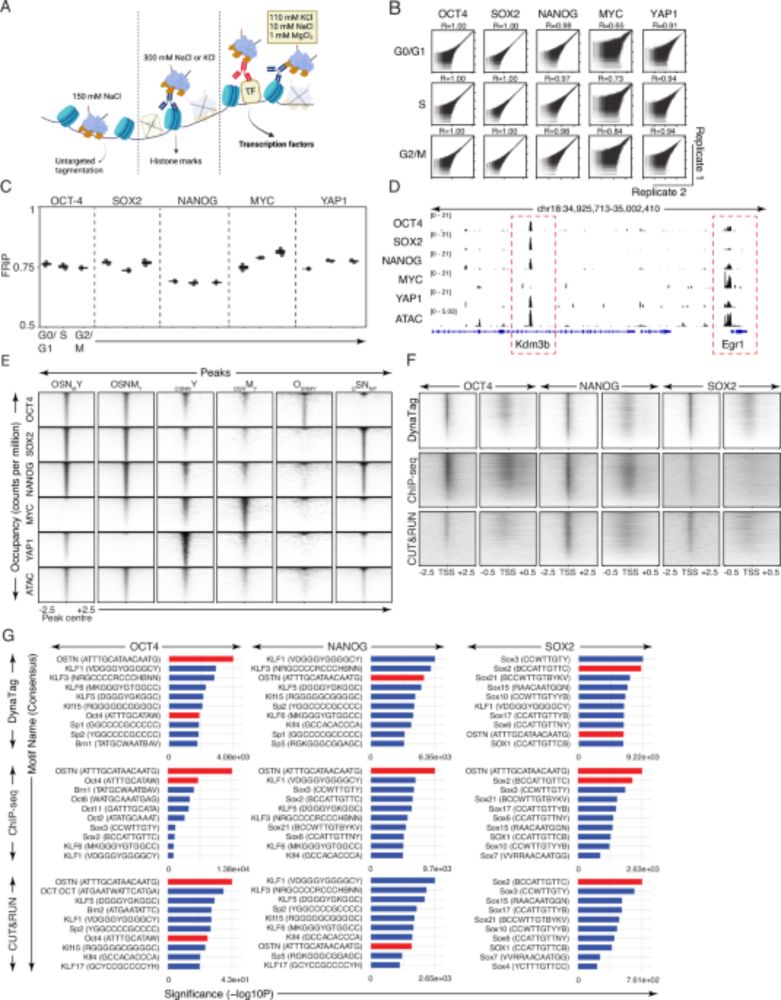
DynaTag for efficient mapping of transcription factors in low-input samples and at single-cell resolution - Nature Communications
Transcription factors shape cell identity, but mapping their genomic targets remains challenging. Here the authors present DynaTag, a modified CUT&Tag method for profiling TF occupancy in bulk and...
www.nature.com
July 28, 2025 at 9:45 AM
Die neue Methode übertrifft bestehende Methoden wie #ChIP-seq und #CUT&RUN in Bezug auf Sensitivität und Auflösung der Ergebnisse. 📈
Die Studie wurde in @natcomms.nature.com veröffentlicht👇
www.nature.com/articles/s41...
Die Studie wurde in @natcomms.nature.com veröffentlicht👇
www.nature.com/articles/s41...
Reposted by Department of Translational Genomics - University of Cologne
#DynaTag outperforms existing methods like #ChIP-seq and #CUT&RUN in terms of sensitivity and resolution. 📈 The study was published in @natcomms.nature.com 👇
www.nature.com/articles/s41...
www.nature.com/articles/s41...
DynaTag for efficient mapping of transcription factors in low-input samples and at single-cell resolution - Nature Communications
Transcription factors shape cell identity, but mapping their genomic targets remains challenging. Here the authors present DynaTag, a modified CUT&Tag method for profiling TF occupancy in bulk and...
www.nature.com
July 28, 2025 at 9:51 AM
#DynaTag outperforms existing methods like #ChIP-seq and #CUT&RUN in terms of sensitivity and resolution. 📈 The study was published in @natcomms.nature.com 👇
www.nature.com/articles/s41...
www.nature.com/articles/s41...