



Most days I do my science at the University, and my art at home. Sometimes, I get to bring the art with me to the University.
Great 2-day workshop with students from @ethz.ch and
@uzh-ch.bsky.social. I was amazed to see how naturally everyone was able to pick up watercolor techniques and vision.
Great 2-day workshop with students from @ethz.ch and
@uzh-ch.bsky.social. I was amazed to see how naturally everyone was able to pick up watercolor techniques and vision.


November 27, 2025 at 10:16 AM
Most days I do my science at the University, and my art at home. Sometimes, I get to bring the art with me to the University.
Great 2-day workshop with students from @ethz.ch and
@uzh-ch.bsky.social. I was amazed to see how naturally everyone was able to pick up watercolor techniques and vision.
Great 2-day workshop with students from @ethz.ch and
@uzh-ch.bsky.social. I was amazed to see how naturally everyone was able to pick up watercolor techniques and vision.
Interestingly, these patters were different for ITS plant marker and COI metazoan marker! How does the source organisms impact spatial and particle size distribution of their eDNA? Can we optimise our capture methods depending on the target group? More work to be done! (7/8)

February 21, 2025 at 9:56 AM
Interestingly, these patters were different for ITS plant marker and COI metazoan marker! How does the source organisms impact spatial and particle size distribution of their eDNA? Can we optimise our capture methods depending on the target group? More work to be done! (7/8)
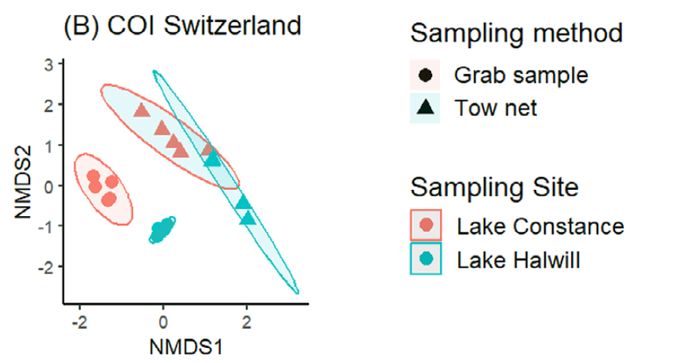
Not just the number but also the type of taxa differ. Beta diversity plots show samples cluster by location (as expected) but also by capture method ! Your choice of methods can dramatically impact your eDNA results ! (6/8)
February 21, 2025 at 9:56 AM
Not just the number but also the type of taxa differ. Beta diversity plots show samples cluster by location (as expected) but also by capture method ! Your choice of methods can dramatically impact your eDNA results ! (6/8)
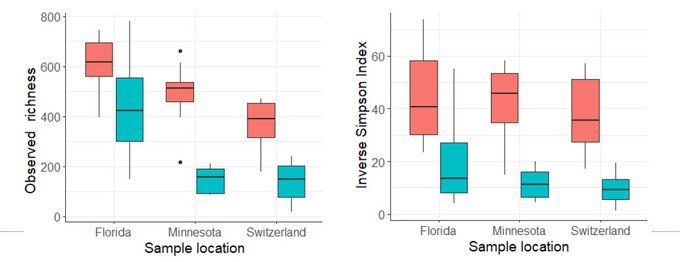
However, the metabarcoding results show more unintuitive patterns. Although the grab samples capture 100 times less DNA, the DNA it does capture represents significantly greater alpha diversity than that captured in tow nets. These results were consistent across all sites. (5/8)
February 21, 2025 at 9:56 AM
However, the metabarcoding results show more unintuitive patterns. Although the grab samples capture 100 times less DNA, the DNA it does capture represents significantly greater alpha diversity than that captured in tow nets. These results were consistent across all sites. (5/8)
We conducted the experiment in three different locations with varying water matrices: Switzerland, Montana, and Florida and found surprising consistent results ! First, we see that the tow nets (blue) captured ~100 times for DNA than grab sample filters (red). (4/8)

February 21, 2025 at 9:56 AM
We conducted the experiment in three different locations with varying water matrices: Switzerland, Montana, and Florida and found surprising consistent results ! First, we see that the tow nets (blue) captured ~100 times for DNA than grab sample filters (red). (4/8)
So here we tested whether increasing volume of water processed, indeed improved species diversity detection metabarcoding. We compared two extremes of volume-pore size combinations 1) 1L via 0.45 um filter and 2) 3500-7000 L filtered via 64 um tow net. (3/8)

February 21, 2025 at 9:56 AM
So here we tested whether increasing volume of water processed, indeed improved species diversity detection metabarcoding. We compared two extremes of volume-pore size combinations 1) 1L via 0.45 um filter and 2) 3500-7000 L filtered via 64 um tow net. (3/8)
The paper starts with a review of 300+ studies showing water volume depends on filter pore size. Thus, it may be intuitive to use larger pores to process more water and capture patchily distributed eDNA diversity. (2/8)

February 21, 2025 at 9:56 AM
The paper starts with a review of 300+ studies showing water volume depends on filter pore size. Thus, it may be intuitive to use larger pores to process more water and capture patchily distributed eDNA diversity. (2/8)
In this paper, we discuss how biologists using #eDNA in freshwater systems can benefit from integrating hydrological approaches to track the source of their eDNA, and how our understanding of water movement can be improved by using eDNA as a hydrological tracer (2/n)

February 18, 2025 at 10:15 AM
In this paper, we discuss how biologists using #eDNA in freshwater systems can benefit from integrating hydrological approaches to track the source of their eDNA, and how our understanding of water movement can be improved by using eDNA as a hydrological tracer (2/n)