



@davidccatling.bsky.social
Professor, Planetary Sciences, Astrobiology, Origin of Life
https://faculty.washington.edu/dcatling/people.html
https://faculty.washington.edu/dcatling/people.html
Earth was a frozen over, "Snowball Earth" twice between 720-635 m.y. ago. The 1st glaciation lasted a huge 56 m.y. (almost like the dinosaur extinction to us) but no one knows how. My group just published a mechanistic explanation. pubs.geoscienceworld.org/gsa/geology/...
Seafloor weathering can explain the disparate durations of Snowball glaciations | Geology | GeoScienceWorld
pubs.geoscienceworld.org
December 4, 2025 at 7:13 AM
Earth was a frozen over, "Snowball Earth" twice between 720-635 m.y. ago. The 1st glaciation lasted a huge 56 m.y. (almost like the dinosaur extinction to us) but no one knows how. My group just published a mechanistic explanation. pubs.geoscienceworld.org/gsa/geology/...
is impressed that 85+ climate scientists quickly wrote a 400-page report rebutting a lot of misleading info and misrepresentations in a recent DOE climate report attempting to downplay global heating from CO2 emissions. drive.google.com/file/d/1PwAR...
Climate_Experts_Review_of_DOE_CWG_Report.pdf
drive.google.com
September 7, 2025 at 9:25 PM
is impressed that 85+ climate scientists quickly wrote a 400-page report rebutting a lot of misleading info and misrepresentations in a recent DOE climate report attempting to downplay global heating from CO2 emissions. drive.google.com/file/d/1PwAR...
Commentary on an article by @sebastienviscardy.bsky.social, me and Kevin Zahnle arguing how Curiosity rover detections of methane are more likely methane contamination inside the rover than in the martian atmosphere.
bsky.app/profile/eos....
bsky.app/profile/eos....

Reports of methane emissions could indicate the presence of life on Mars, but some fear the detections are misleading. Scientists suggest an experiment that could lay the debate to rest.

Proposed Experiment Could Clarify Origin of Martian Methane - Eos
Curiosity’s detection of the gas, if atmospheric, could be an indicator of life on the Red Planet. But skeptics say further work is needed to rule out the rover itself as the source of the methane.
eos.org
May 14, 2025 at 2:55 AM
Commentary on an article by @sebastienviscardy.bsky.social, me and Kevin Zahnle arguing how Curiosity rover detections of methane are more likely methane contamination inside the rover than in the martian atmosphere.
bsky.app/profile/eos....
bsky.app/profile/eos....
Recent papers from coworkers & me:
1) Doubt that CH4 detections on Mars are really from its atmosphere. Viscardy, Catling, Zahnle '25: doi.org/10.1029/2024...
2) Enceladus plume particles will partially form glass, preserving organics better than crystals: Klenner+ '25 dx.doi.org/10.3847/PSJ/...
1) Doubt that CH4 detections on Mars are really from its atmosphere. Viscardy, Catling, Zahnle '25: doi.org/10.1029/2024...
2) Enceladus plume particles will partially form glass, preserving organics better than crystals: Klenner+ '25 dx.doi.org/10.3847/PSJ/...
Questioning the Reliability of Methane Detections on Mars by the Curiosity Rover
Methane levels in Curiosity's Tunable Laser Spectrometer foreoptics chamber are 3–4 orders of magnitude higher than in the sample cell Using a diffusion model, we propose a leakage scenario from ...
doi.org
April 28, 2025 at 7:18 PM
Recent papers from coworkers & me:
1) Doubt that CH4 detections on Mars are really from its atmosphere. Viscardy, Catling, Zahnle '25: doi.org/10.1029/2024...
2) Enceladus plume particles will partially form glass, preserving organics better than crystals: Klenner+ '25 dx.doi.org/10.3847/PSJ/...
1) Doubt that CH4 detections on Mars are really from its atmosphere. Viscardy, Catling, Zahnle '25: doi.org/10.1029/2024...
2) Enceladus plume particles will partially form glass, preserving organics better than crystals: Klenner+ '25 dx.doi.org/10.3847/PSJ/...
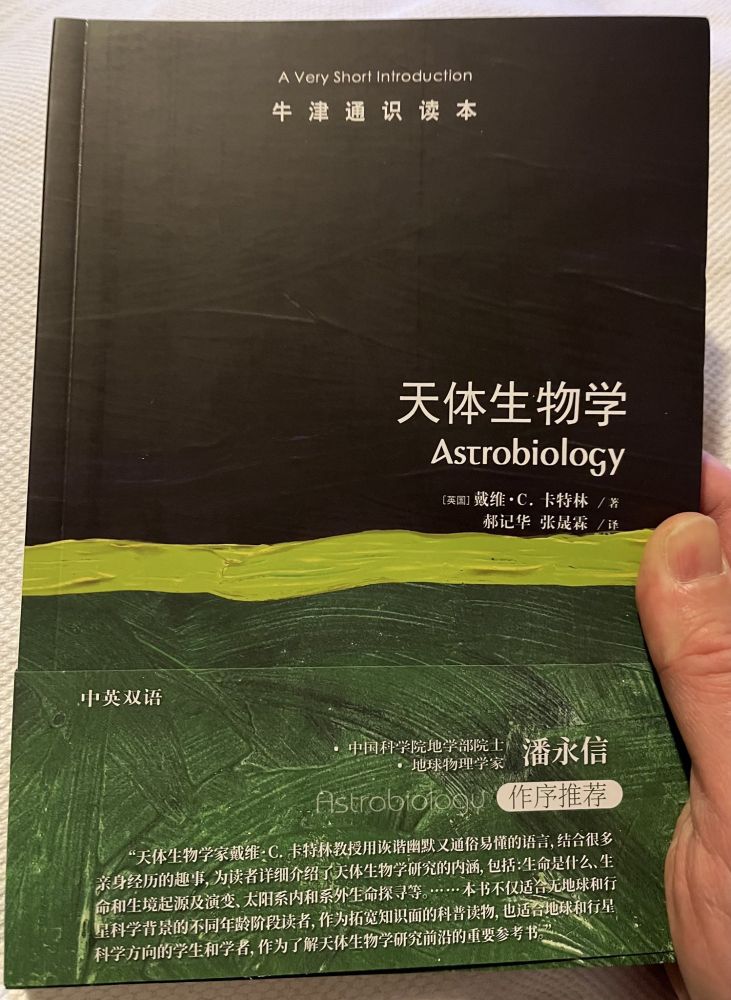
my book, “Astrobiology: A Very Short Introduction” is now published in Chinese and available to 1.2B people for whom Chinese is a 1st or 2nd language (1st Ed with updates, Yilin Press, Nanjing). Coming soon: 2nd Ed. (OUP) in English in 2026/7, with updates on planetary science, origin of life, etc.
April 28, 2025 at 7:07 PM
my book, “Astrobiology: A Very Short Introduction” is now published in Chinese and available to 1.2B people for whom Chinese is a 1st or 2nd language (1st Ed with updates, Yilin Press, Nanjing). Coming soon: 2nd Ed. (OUP) in English in 2026/7, with updates on planetary science, origin of life, etc.
Research by my colleagues and me (and others) covered in Science this week. www.science.org/content/arti...

Unusual ‘soda lakes’ may have kick-started life on Earth by concentrating key compounds
Phosphorus leached from volcanic rocks in warm waters could have triggered reactions needed to launch biochemistry
www.science.org
February 25, 2025 at 7:47 PM
Research by my colleagues and me (and others) covered in Science this week. www.science.org/content/arti...
My group's most recent paper: We quantified phosphorus fluxes in soda lakes, showing that without biology, soda lakes worldwide would have phosphate levels suitable for prebiotic synthesis of RNA. This answers a 70-year-old “phosphate problem of the origin of life”
doi.org/10.1016/j.gc...
doi.org/10.1016/j.gc...

February 17, 2025 at 3:24 AM
My group's most recent paper: We quantified phosphorus fluxes in soda lakes, showing that without biology, soda lakes worldwide would have phosphate levels suitable for prebiotic synthesis of RNA. This answers a 70-year-old “phosphate problem of the origin of life”
doi.org/10.1016/j.gc...
doi.org/10.1016/j.gc...