




Science of Health at Columbia University
@cusciofhealth.bsky.social
We aim to revolutionize biomedicine by understanding and measuring health at all scales, from biological to psychological to functional.
Website: tinyurl.com/y6khjbkf
See our recent paper: https://www.science.org/doi/10.1126/sciadv.adu8437
Website: tinyurl.com/y6khjbkf
See our recent paper: https://www.science.org/doi/10.1126/sciadv.adu8437
Live discussion in an X space on Intrinsic health featuring Alan Cohen and Martin Picard. Join us! x.com/i/spaces/1yp...

November 25, 2025 at 8:40 PM
Live discussion in an X space on Intrinsic health featuring Alan Cohen and Martin Picard. Join us! x.com/i/spaces/1yp...
I had a ton of fun recently doing a live comedy show on immortality with Dan Toomey at Good Work. See a clip here, then follow the link to the full 45-min video on Good Work's patreon.
October 25, 2025 at 3:37 PM
I had a ton of fun recently doing a live comedy show on immortality with Dan Toomey at Good Work. See a clip here, then follow the link to the full 45-min video on Good Work's patreon.
A beautiful profile of our work on intrinsic health, by David Craig at Columbia News. magazine.columbia.edu/article/secr...
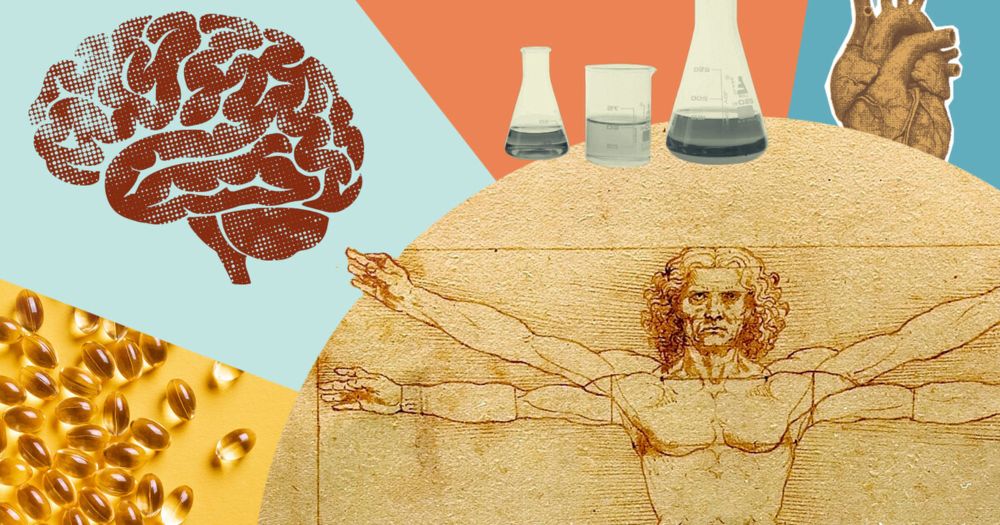
The Secret Science Behind Feeling Great
Columbia biologists propose a more holistic framework for measuring health — asking not what ails you, but what makes you thrive.
magazine.columbia.edu
August 11, 2025 at 3:35 PM
A beautiful profile of our work on intrinsic health, by David Craig at Columbia News. magazine.columbia.edu/article/secr...
1/4 Scientific theories make testable predictions. Our intrinsic health framework hypothesizes that energy, communication, and structure are sufficiently integrated that a common health construct can be reliably measured. 🧵
July 8, 2025 at 4:24 PM
1/4 Scientific theories make testable predictions. Our intrinsic health framework hypothesizes that energy, communication, and structure are sufficiently integrated that a common health construct can be reliably measured. 🧵
Peer review is breaking down. As an editor, it's nearly impossible to find reviewers. Editors end up needing to review articles themelves, outside their field. A flood of dubious-quality research is overwhelming the system.
July 7, 2025 at 6:42 PM
Peer review is breaking down. As an editor, it's nearly impossible to find reviewers. Editors end up needing to review articles themelves, outside their field. A flood of dubious-quality research is overwhelming the system.
1/5 What if aging isn't primarily about damage accumulation, but the declining capacity of your body's integrated health field? Our research introduces 'intrinsic health'—potentially revolutionizing how we understand and measure biological aging. #LongevityScience 🧵
July 4, 2025 at 5:49 PM
1/5 What if aging isn't primarily about damage accumulation, but the declining capacity of your body's integrated health field? Our research introduces 'intrinsic health'—potentially revolutionizing how we understand and measure biological aging. #LongevityScience 🧵
The Future of Aging Science 1/ 🚀 Breaking: The hallmarks of aging aren't as universal as we thought. Our 4-population study shows aging biology is far more flexible and context-dependent than textbooks suggest. 🧵
July 3, 2025 at 11:13 PM
The Future of Aging Science 1/ 🚀 Breaking: The hallmarks of aging aren't as universal as we thought. Our 4-population study shows aging biology is far more flexible and context-dependent than textbooks suggest. 🧵
The WEIRD Problem 1/ 🧵 Most aging research comes from WEIRD populations (Western, Educated, Industrialized, Rich, Democratic). Our new paper shows this creates massive blind spots in understanding human aging.
July 1, 2025 at 10:36 PM
The WEIRD Problem 1/ 🧵 Most aging research comes from WEIRD populations (Western, Educated, Industrialized, Rich, Democratic). Our new paper shows this creates massive blind spots in understanding human aging.
NEW PAPER: What if "inflammaging" isn't universal? Our new study shows Indigenous nonindustrialized populations with high infections but low chronic disease defy industrialized aging patterns. The hallmarks of aging might vary by environment and lifestyle. www.nature.com/articles/s43...

Nonuniversality of inflammaging across human populations - Nature Aging
Analyzing readouts of inflammaging across four cohorts, Franck and colleagues identify strong variation and observe that inflammaging, in its known form, primarily emerges in industrialized—but not no...
www.nature.com
June 30, 2025 at 7:21 PM
NEW PAPER: What if "inflammaging" isn't universal? Our new study shows Indigenous nonindustrialized populations with high infections but low chronic disease defy industrialized aging patterns. The hallmarks of aging might vary by environment and lifestyle. www.nature.com/articles/s43...
The 'disease-first' approach to medicine is like having mechanics who only know how to fix broken parts, but don't understand how the whole car works. Our new 'intrinsic health' framework changes that.
www.science.org/doi/10.1126/...
#ScienceOfHealth #SystemsThinking
www.science.org/doi/10.1126/...
#ScienceOfHealth #SystemsThinking
June 28, 2025 at 9:50 PM
The 'disease-first' approach to medicine is like having mechanics who only know how to fix broken parts, but don't understand how the whole car works. Our new 'intrinsic health' framework changes that.
www.science.org/doi/10.1126/...
#ScienceOfHealth #SystemsThinking
www.science.org/doi/10.1126/...
#ScienceOfHealth #SystemsThinking
1/4 The Paradigm Shift: For too long, medicine has defined health as "not sick." Our new paper in Science Advances proposes a revolutionary approach: "intrinsic health" as a measurable biological state that emerges from energy, communication & structure in our bodies. Read more…🧵
June 25, 2025 at 4:57 PM
1/4 The Paradigm Shift: For too long, medicine has defined health as "not sick." Our new paper in Science Advances proposes a revolutionary approach: "intrinsic health" as a measurable biological state that emerges from energy, communication & structure in our bodies. Read more…🧵
Complex systems theory meets evolutionary biology in our new paper on 'intrinsic health.' We propose a first-principles approach to understanding health as an emergent property with measurable dynamics.
www.science.org/doi/10.1126/...
www.science.org/doi/10.1126/...
June 23, 2025 at 5:04 PM
Complex systems theory meets evolutionary biology in our new paper on 'intrinsic health.' We propose a first-principles approach to understanding health as an emergent property with measurable dynamics.
www.science.org/doi/10.1126/...
www.science.org/doi/10.1126/...
Medicine treats your body like separate departments in a company. But what if it actually works more like a jazz ensemble—where harmony emerges from constant communication? Our new 'Science of Health' framework explains this revolutionary view.
www.science.org/doi/10.1126/...
www.science.org/doi/10.1126/...
June 22, 2025 at 5:44 PM
Medicine treats your body like separate departments in a company. But what if it actually works more like a jazz ensemble—where harmony emerges from constant communication? Our new 'Science of Health' framework explains this revolutionary view.
www.science.org/doi/10.1126/...
www.science.org/doi/10.1126/...
What if our traditional approach to health has been backward? Instead of cataloging diseases, we should measure the unified biological state that underpins the resilience, performance & sustainability of our bodies. Our new framework: #IntrinsicHealth Article: www.science.org/doi/10.1126/...
June 21, 2025 at 7:22 PM
What if our traditional approach to health has been backward? Instead of cataloging diseases, we should measure the unified biological state that underpins the resilience, performance & sustainability of our bodies. Our new framework: #IntrinsicHealth Article: www.science.org/doi/10.1126/...
1/5 JUST PUBLISHED: Our team has developed a first-principles framework for the #ScienceOfHealth based on complex systems & evolutionary biology. Here's why it matters... 🧵
June 20, 2025 at 6:20 PM
1/5 JUST PUBLISHED: Our team has developed a first-principles framework for the #ScienceOfHealth based on complex systems & evolutionary biology. Here's why it matters... 🧵
We intuitively know when we're healthy, yet science struggles to measure it. Our new paper bridges this gap by defining 'intrinsic health' as an emergent property of our biology. This could transform medicine & public health. #ParadigmShift
www.science.org/doi/10.1126/...
www.science.org/doi/10.1126/...

Intrinsic health as a foundation for a science of health
Intrinsic health is an objective, measurable construct describing the biological capacity of the organism to self-maintain.
www.science.org
June 18, 2025 at 6:20 PM
We intuitively know when we're healthy, yet science struggles to measure it. Our new paper bridges this gap by defining 'intrinsic health' as an emergent property of our biology. This could transform medicine & public health. #ParadigmShift
www.science.org/doi/10.1126/...
www.science.org/doi/10.1126/...
Reposted by Science of Health at Columbia University

One protein, two opposing roles: This ‘compelling’ study shows how the same signalling molecule can drive either protrusion or retraction in migrating cells depending on its concentration and activation dynamics.
buff.ly/pMGXJVM
buff.ly/pMGXJVM
June 13, 2025 at 1:59 PM
One protein, two opposing roles: This ‘compelling’ study shows how the same signalling molecule can drive either protrusion or retraction in migrating cells depending on its concentration and activation dynamics.
buff.ly/pMGXJVM
buff.ly/pMGXJVM
Whatever you think about RFK, this is unqualified good news. Not yet clear how big the health benefits will be, but more than nothing! www.nytimes.com/2025/06/17/b...

Kraft Heinz to Eliminate All Chemical Dyes Over Next 2 Years
www.nytimes.com
June 17, 2025 at 8:51 PM
Whatever you think about RFK, this is unqualified good news. Not yet clear how big the health benefits will be, but more than nothing! www.nytimes.com/2025/06/17/b...
Amazing new research from Diego Bassani: We can map networks of communities to see how ideas, diseases, and many other things spread. This produces a crucial new tool, SEEDNet, for public health research. So cool!
Our paper is now published on Nature Scientific Data. I wrote a blog about the story behind SEEDNet, and our vision for it. I'll put this all together in a thread later, but for now, here is the blog.

The Networked Population: Why Understanding Connections is Key to Global Health (Introducing SEEDNet)
What if we're missing something fundamental? What if populations are better understood not as static lists of individuals or arbitrary geographical units, but as complex systems?
SEEDNet tackles the b...
communities.springernature.com
June 12, 2025 at 8:57 PM
Amazing new research from Diego Bassani: We can map networks of communities to see how ideas, diseases, and many other things spread. This produces a crucial new tool, SEEDNet, for public health research. So cool!
Too much competition in science leads to worse science: we over-optimize the metrics of success (publications, funding, etc.) at the expense of actual good science. It's Goodhart's law (see this post I wrote years ago before I heard of Goodhart): maketheworldworkbetter.wordpress.com/2013/04/03/w...

What crime statistics, standardized tests, and scientific researchers have in common
I had thought about calling this post “Cohen’s law for predicting distortions in incentivized systems.” Tongue-in-cheek of course – it’s approximate, and thus not real…
maketheworldworkbetter.wordpress.com
June 3, 2025 at 10:47 PM
Too much competition in science leads to worse science: we over-optimize the metrics of success (publications, funding, etc.) at the expense of actual good science. It's Goodhart's law (see this post I wrote years ago before I heard of Goodhart): maketheworldworkbetter.wordpress.com/2013/04/03/w...
Meet our member Christine Kuryla, a Ph.D. student using wearable data to tap into complex systems and take personal health tracking to the next level.

May 31, 2025 at 4:15 PM
Meet our member Christine Kuryla, a Ph.D. student using wearable data to tap into complex systems and take personal health tracking to the next level.
Meet our member Dr. Berhane, a leading expert in longitudinal and trajectory modeling, uncovering how complex, evolving data patterns shape long-term health outcomes.

May 31, 2025 at 4:14 PM
Meet our member Dr. Berhane, a leading expert in longitudinal and trajectory modeling, uncovering how complex, evolving data patterns shape long-term health outcomes.
Meet our member Dr. Liu, a biostatistician at Peking University pioneering federated models to reveal how whole-proteome dynamics shift under stress in both health and disease.

May 31, 2025 at 4:14 PM
Meet our member Dr. Liu, a biostatistician at Peking University pioneering federated models to reveal how whole-proteome dynamics shift under stress in both health and disease.
There is a citation penalty for researchers who pivot fields, a(nother) clear example of Goodheart's Law. Over-structuring science and the competition that drives it often does more harm than good. We need to reduce competition to achieve more. www.nature.com/articles/d41...

Researchers who ‘pivot’ into new fields should not be given a citation penalty
The COVID-19 pandemic showed the value of changing direction in research. It should be incentivized, encouraged and celebrated.
www.nature.com
May 29, 2025 at 4:04 PM
There is a citation penalty for researchers who pivot fields, a(nother) clear example of Goodheart's Law. Over-structuring science and the competition that drives it often does more harm than good. We need to reduce competition to achieve more. www.nature.com/articles/d41...
Distinguishing correct from incorrect facts could be a problem for AI, but also for normal people. One of our biggest challenges as scientists is right-dosing our skepticism. Too little and we buy into nonsense. Too much and we are paralyzed.
A potential problem with AI is that it would have too much confidence in a “fact” from the literature which is actually not true, leading it to eliminate a potentially good idea. As Crick says to Watson in the "Life History" movie: "A wrong fact looks as hard as a right fact."
May 29, 2025 at 4:04 PM
Distinguishing correct from incorrect facts could be a problem for AI, but also for normal people. One of our biggest challenges as scientists is right-dosing our skepticism. Too little and we buy into nonsense. Too much and we are paralyzed.