


Junhong Choi
@choijunhong.bsky.social
PI at MSKCC. Synthetic (Developmental) Biology + Molecular Recording + Genomics Tech Dev. Words like physicality of information make my heart go a little faster.
Even after resetting spatial context, we saw persistent clonal biases—suggesting an intrinsic, heritable factor shaping fate decisions, independent of spatial cues like Wnt signaling. (11/13)

May 27, 2025 at 2:57 PM
Even after resetting spatial context, we saw persistent clonal biases—suggesting an intrinsic, heritable factor shaping fate decisions, independent of spatial cues like Wnt signaling. (11/13)
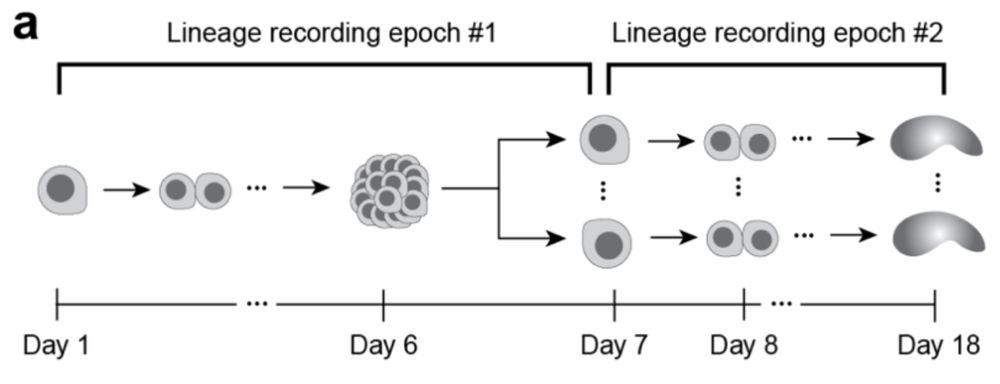
In this “tree-of-trees” experiment, we dissociated a monoclonal colony into single cells (resetting spatial context) and used them to generate separate gastruloids. (10/13)
May 27, 2025 at 2:57 PM
In this “tree-of-trees” experiment, we dissociated a monoclonal colony into single cells (resetting spatial context) and used them to generate separate gastruloids. (10/13)
Together, we found: Cell fates can diverge as early as the first cell division! Sister cells can follow drastically different paths—e.g., one lineage becomes mostly somites, another mostly neurons! (8/13)

May 27, 2025 at 2:57 PM
Together, we found: Cell fates can diverge as early as the first cell division! Sister cells can follow drastically different paths—e.g., one lineage becomes mostly somites, another mostly neurons! (8/13)
Once we knew monoclonal lineage recording worked, we teamed up with @cxqiu.bsky.social—an amazing and generous computational biologist—to dive into the lineage trees. (7/13)

May 27, 2025 at 2:57 PM
Once we knew monoclonal lineage recording worked, we teamed up with @cxqiu.bsky.social—an amazing and generous computational biologist—to dive into the lineage trees. (7/13)
To solve this, Sam developed a robust protocol to create “monoclonal gastruloids”—gastruloids seeded from a single cell. These were ideal for DNA Typewriter lineage reconstruction! (5/13)

May 27, 2025 at 2:57 PM
To solve this, Sam developed a robust protocol to create “monoclonal gastruloids”—gastruloids seeded from a single cell. These were ideal for DNA Typewriter lineage reconstruction! (5/13)
However, conventional gastruloids start with 300–500 cells, and that’s a problem for us—lineage tracing from 500 cells gives you 500 independent trees, masking clonal info from earlier developmental events. (4/13)

May 27, 2025 at 2:57 PM
However, conventional gastruloids start with 300–500 cells, and that’s a problem for us—lineage tracing from 500 cells gives you 500 independent trees, masking clonal info from earlier developmental events. (4/13)
Mouse 3D gastruloids seemed like the perfect testbed—they mimic key features of early mammalian development in both shape and cell types. (Image from Turner @gastruloids.bsky.social & Martinez Arias @amartinezarias.bsky.social : doi.org/10.1002/bies...) (3/13)

May 27, 2025 at 2:57 PM
Mouse 3D gastruloids seemed like the perfect testbed—they mimic key features of early mammalian development in both shape and cell types. (Image from Turner @gastruloids.bsky.social & Martinez Arias @amartinezarias.bsky.social : doi.org/10.1002/bies...) (3/13)