


Bhavya Singh
@bhavyasighs.bsky.social
PhD student in the Brown & Vabret Labs @ Mount Sinai Immunology, prev. at Weill Cornell Medicine and McMasterU 🥼| Cytokine signaling in pancreatic cancer, spatial biology, and repeat elements. | science is so cool!!
Reposted by Bhavya Singh

Check out our latest in @cp-trendscancer.bsky.social where rockstar PhD student @laurarosenberg.bsky.social reviews cancer therapies known to induce innate immune responses through the reactivation of Transposable Elements.


September 30, 2025 at 1:21 AM
Check out our latest in @cp-trendscancer.bsky.social where rockstar PhD student @laurarosenberg.bsky.social reviews cancer therapies known to induce innate immune responses through the reactivation of Transposable Elements.
Reposted by Bhavya Singh

🚨 New Publication!!!
I’m thrilled to share our latest study, “Clonotype-Enriched Somatic Hypermutations Drive Affinity Maturation of a Public Human Antibody Targeting an Occluded Sarbecovirus Epitope”.
www.cell.com/cell-reports... [1/4]
I’m thrilled to share our latest study, “Clonotype-Enriched Somatic Hypermutations Drive Affinity Maturation of a Public Human Antibody Targeting an Occluded Sarbecovirus Epitope”.
www.cell.com/cell-reports... [1/4]

Clonotype-enriched somatic hypermutations drive affinity maturation of a public human antibody targeting an occluded sarbecovirus epitope
Rao et al. demonstrate that convergent somatic hypermutations in the light chain,
enriched within a sarbecovirus-specific public antibody clonotype, drive affinity
maturation. This antibody targets a ...
www.cell.com
August 12, 2025 at 6:52 PM
🚨 New Publication!!!
I’m thrilled to share our latest study, “Clonotype-Enriched Somatic Hypermutations Drive Affinity Maturation of a Public Human Antibody Targeting an Occluded Sarbecovirus Epitope”.
www.cell.com/cell-reports... [1/4]
I’m thrilled to share our latest study, “Clonotype-Enriched Somatic Hypermutations Drive Affinity Maturation of a Public Human Antibody Targeting an Occluded Sarbecovirus Epitope”.
www.cell.com/cell-reports... [1/4]
Reposted by Bhavya Singh
7/ 🔗 “A single-cell transposable element atlas of human cell identity” Cell Reports Methods, 2025. doi.org/10.1016/j.cr...
TY: @bhavyasighs.bsky.social @hamarillo.bsky.social @3rduarte.bsky.social @weillcornell.bsky.social
🔄 RT to share with colleagues in #singlecell and #genomics!
TY: @bhavyasighs.bsky.social @hamarillo.bsky.social @3rduarte.bsky.social @weillcornell.bsky.social
🔄 RT to share with colleagues in #singlecell and #genomics!
July 22, 2025 at 2:47 PM
7/ 🔗 “A single-cell transposable element atlas of human cell identity” Cell Reports Methods, 2025. doi.org/10.1016/j.cr...
TY: @bhavyasighs.bsky.social @hamarillo.bsky.social @3rduarte.bsky.social @weillcornell.bsky.social
🔄 RT to share with colleagues in #singlecell and #genomics!
TY: @bhavyasighs.bsky.social @hamarillo.bsky.social @3rduarte.bsky.social @weillcornell.bsky.social
🔄 RT to share with colleagues in #singlecell and #genomics!
Reposted by Bhavya Singh
🧵1/ Introducing Stellarscope: an EM-based tool for quantifying locus-specific transposable element expression in single cells.
A single-cell transposable element atlas of human cell identity: Cell Reports Methods www.cell.com/cell-reports...
@hamarillo.bsky.social #TEHub #singlecell #genomics
A single-cell transposable element atlas of human cell identity: Cell Reports Methods www.cell.com/cell-reports...
@hamarillo.bsky.social #TEHub #singlecell #genomics
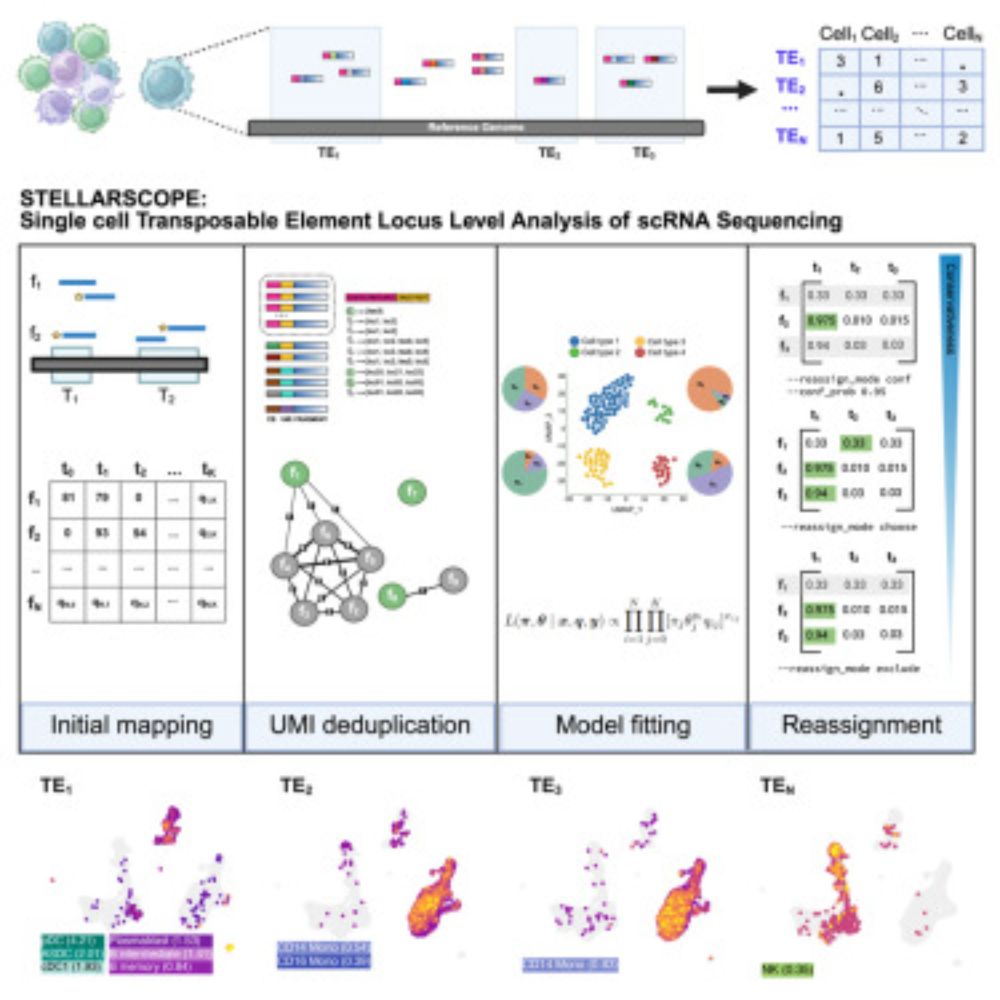
A single-cell transposable element atlas of human cell identity
Reyes-Gopar et al. introduce Stellarscope, a computational approach for quantifying
locus-specific transposable element expression in single-cell RNA sequencing data.
The authors profile human PBMCs a...
www.cell.com
July 22, 2025 at 2:47 PM
🧵1/ Introducing Stellarscope: an EM-based tool for quantifying locus-specific transposable element expression in single cells.
A single-cell transposable element atlas of human cell identity: Cell Reports Methods www.cell.com/cell-reports...
@hamarillo.bsky.social #TEHub #singlecell #genomics
A single-cell transposable element atlas of human cell identity: Cell Reports Methods www.cell.com/cell-reports...
@hamarillo.bsky.social #TEHub #singlecell #genomics
Reposted by Bhavya Singh

Nature research paper: The mutagenic forces shaping the genomes of lung cancer in never smokers
go.nature.com/4l5HkfD
go.nature.com/4l5HkfD

The mutagenic forces shaping the genomes of lung cancer in never smokers - Nature
An analysis of data from the Sherlock-Lung study provides insight into the mutational processes that contribute to lung cancer in never smokers, and looks at the possible role of factors such as air pollution and passive smoking.
go.nature.com
July 9, 2025 at 11:43 AM
Nature research paper: The mutagenic forces shaping the genomes of lung cancer in never smokers
go.nature.com/4l5HkfD
go.nature.com/4l5HkfD
Reposted by Bhavya Singh

🚨 Our new #preprint is out!
doi.org/10.1101/2025...
We used #PerturbMap spatial functional genomics in pancreatic cancer to track tumor clone dynamics and uncover how extracellular factors like Serpine1 and Serpinb2 drive immune evasion. 🧵 (1/8)
doi.org/10.1101/2025...
We used #PerturbMap spatial functional genomics in pancreatic cancer to track tumor clone dynamics and uncover how extracellular factors like Serpine1 and Serpinb2 drive immune evasion. 🧵 (1/8)
doi.org
June 18, 2025 at 1:29 PM
🚨 Our new #preprint is out!
doi.org/10.1101/2025...
We used #PerturbMap spatial functional genomics in pancreatic cancer to track tumor clone dynamics and uncover how extracellular factors like Serpine1 and Serpinb2 drive immune evasion. 🧵 (1/8)
doi.org/10.1101/2025...
We used #PerturbMap spatial functional genomics in pancreatic cancer to track tumor clone dynamics and uncover how extracellular factors like Serpine1 and Serpinb2 drive immune evasion. 🧵 (1/8)
Reposted by Bhavya Singh
Read the full story here:
doi.org/10.1016/j.is...
A special congratulations to FIRST AUTHOR @bhavyasighs.bsky.social
Thanks to an amazing team and collaborators! @ecesarman.bsky.social @heymannjonas.bsky.social @hamarillo.bsky.social @weillcornell.bsky.social
#lymphoma #HERV #bioinformatics
doi.org/10.1016/j.is...
A special congratulations to FIRST AUTHOR @bhavyasighs.bsky.social
Thanks to an amazing team and collaborators! @ecesarman.bsky.social @heymannjonas.bsky.social @hamarillo.bsky.social @weillcornell.bsky.social
#lymphoma #HERV #bioinformatics
May 20, 2025 at 8:44 PM
Read the full story here:
doi.org/10.1016/j.is...
A special congratulations to FIRST AUTHOR @bhavyasighs.bsky.social
Thanks to an amazing team and collaborators! @ecesarman.bsky.social @heymannjonas.bsky.social @hamarillo.bsky.social @weillcornell.bsky.social
#lymphoma #HERV #bioinformatics
doi.org/10.1016/j.is...
A special congratulations to FIRST AUTHOR @bhavyasighs.bsky.social
Thanks to an amazing team and collaborators! @ecesarman.bsky.social @heymannjonas.bsky.social @hamarillo.bsky.social @weillcornell.bsky.social
#lymphoma #HERV #bioinformatics
Reposted by Bhavya Singh
Bottom line: HERV expression can uncover hidden lymphoma biology 🧫
🧬 Inform classification
🧬 Refine prognosis
🧬 Suggest new therapeutic targets
A new frontier for cancer retrotranscriptomics!
7/
🧬 Inform classification
🧬 Refine prognosis
🧬 Suggest new therapeutic targets
A new frontier for cancer retrotranscriptomics!
7/
May 20, 2025 at 8:44 PM
Bottom line: HERV expression can uncover hidden lymphoma biology 🧫
🧬 Inform classification
🧬 Refine prognosis
🧬 Suggest new therapeutic targets
A new frontier for cancer retrotranscriptomics!
7/
🧬 Inform classification
🧬 Refine prognosis
🧬 Suggest new therapeutic targets
A new frontier for cancer retrotranscriptomics!
7/
Reposted by Bhavya Singh
Importantly, HERV-based subtypes predict prognosis.
Clusters enriched for plasma cell-like signatures had the poorest survival — a finding invisible in gene-only classifications.
6/
Clusters enriched for plasma cell-like signatures had the poorest survival — a finding invisible in gene-only classifications.
6/

May 20, 2025 at 8:44 PM
Importantly, HERV-based subtypes predict prognosis.
Clusters enriched for plasma cell-like signatures had the poorest survival — a finding invisible in gene-only classifications.
6/
Clusters enriched for plasma cell-like signatures had the poorest survival — a finding invisible in gene-only classifications.
6/
Reposted by Bhavya Singh
In DLBCL, we identified 7 distinct HERV-driven subtypes, refining the traditional 3-subtype COO model.
Some "unclassified" DLBCLs actually fit into new HERV-defined groups — with distinct survival outcomes! 📉📈
5/
Some "unclassified" DLBCLs actually fit into new HERV-defined groups — with distinct survival outcomes! 📉📈
5/


May 20, 2025 at 8:44 PM
In DLBCL, we identified 7 distinct HERV-driven subtypes, refining the traditional 3-subtype COO model.
Some "unclassified" DLBCLs actually fit into new HERV-defined groups — with distinct survival outcomes! 📉📈
5/
Some "unclassified" DLBCLs actually fit into new HERV-defined groups — with distinct survival outcomes! 📉📈
5/
Reposted by Bhavya Singh
Findings:
- Healthy B-cells show dynamic HERV activity during differentiation.
- Lymphomas retain HERV signatures from their cell of origin (COO).
- BL subtypes cluster by EBV status better with HERVs than with genes!
4/
- Healthy B-cells show dynamic HERV activity during differentiation.
- Lymphomas retain HERV signatures from their cell of origin (COO).
- BL subtypes cluster by EBV status better with HERVs than with genes!
4/


May 20, 2025 at 8:44 PM
Findings:
- Healthy B-cells show dynamic HERV activity during differentiation.
- Lymphomas retain HERV signatures from their cell of origin (COO).
- BL subtypes cluster by EBV status better with HERVs than with genes!
4/
- Healthy B-cells show dynamic HERV activity during differentiation.
- Lymphomas retain HERV signatures from their cell of origin (COO).
- BL subtypes cluster by EBV status better with HERVs than with genes!
4/
Reposted by Bhavya Singh
We created the first locus-specific map of HERV activity in:
- Healthy B cells (Naïve, Memory, Germinal Center subtypes)
- Diffuse large B-cell lymphoma (DLBCL)
- Follicular lymphoma (FL)
- Burkitt lymphoma (BL)
🎯 Using RNAseq + #Telescope quantification.
3/
- Healthy B cells (Naïve, Memory, Germinal Center subtypes)
- Diffuse large B-cell lymphoma (DLBCL)
- Follicular lymphoma (FL)
- Burkitt lymphoma (BL)
🎯 Using RNAseq + #Telescope quantification.
3/

May 20, 2025 at 8:44 PM
We created the first locus-specific map of HERV activity in:
- Healthy B cells (Naïve, Memory, Germinal Center subtypes)
- Diffuse large B-cell lymphoma (DLBCL)
- Follicular lymphoma (FL)
- Burkitt lymphoma (BL)
🎯 Using RNAseq + #Telescope quantification.
3/
- Healthy B cells (Naïve, Memory, Germinal Center subtypes)
- Diffuse large B-cell lymphoma (DLBCL)
- Follicular lymphoma (FL)
- Burkitt lymphoma (BL)
🎯 Using RNAseq + #Telescope quantification.
3/
Reposted by Bhavya Singh
Endogenous retroelements (EREs), like HERVs, make up ~8% of the human genome. Their expression is often overlooked — but we found they hold key information about B-cell identity, both in healthy germinal centers and in malignancy!
2/
2/

May 20, 2025 at 8:44 PM
Endogenous retroelements (EREs), like HERVs, make up ~8% of the human genome. Their expression is often overlooked — but we found they hold key information about B-cell identity, both in healthy germinal centers and in malignancy!
2/
2/
Reposted by Bhavya Singh
🚨 Excited to share our latest work: 🚨
@bhavyasighs.bsky.social et al. show that locus-specific #HERV expression can reveal the origins and heterogeneity of B-cell lymphomas!
Locus-specific human endogenous retroviruses reveal lymphoma subtypes www.cell.com/iscience/ful...
#TEsky #TEworldwide
1/
@bhavyasighs.bsky.social et al. show that locus-specific #HERV expression can reveal the origins and heterogeneity of B-cell lymphomas!
Locus-specific human endogenous retroviruses reveal lymphoma subtypes www.cell.com/iscience/ful...
#TEsky #TEworldwide
1/

Locus-specific human endogenous retroviruses reveal lymphoma subtypes
Genomics; Virology
www.cell.com
May 20, 2025 at 8:44 PM
🚨 Excited to share our latest work: 🚨
@bhavyasighs.bsky.social et al. show that locus-specific #HERV expression can reveal the origins and heterogeneity of B-cell lymphomas!
Locus-specific human endogenous retroviruses reveal lymphoma subtypes www.cell.com/iscience/ful...
#TEsky #TEworldwide
1/
@bhavyasighs.bsky.social et al. show that locus-specific #HERV expression can reveal the origins and heterogeneity of B-cell lymphomas!
Locus-specific human endogenous retroviruses reveal lymphoma subtypes www.cell.com/iscience/ful...
#TEsky #TEworldwide
1/
Thank you so, so much!! Still pinching myself.
🎉 Congrats to student extraordinaire @bhavyasighs.bsky.social who earned a scholarship from #CIHR AND got a paper accepted in the same week!

May 1, 2025 at 1:10 PM
Thank you so, so much!! Still pinching myself.
Reposted by Bhavya Singh
Read about her work on HERV expression in B-cell lymphomas here 👇
www.cell.com/iscience/ful...
www.cell.com/iscience/ful...

Locus specific human endogenous retroviruses reveal lymphoma subtypes
The heterogeneity of cancers is driven by diverse mechanisms underlying oncogenesis
such as differential ‘cell-of-origin’ progenitors, mutagenesis, and viral infections.
Classification of B-cell lymph...
www.cell.com
April 30, 2025 at 11:36 PM
Read about her work on HERV expression in B-cell lymphomas here 👇
www.cell.com/iscience/ful...
www.cell.com/iscience/ful...
Reposted by Bhavya Singh
🎉 Congrats to student extraordinaire @bhavyasighs.bsky.social who earned a scholarship from #CIHR AND got a paper accepted in the same week!
April 30, 2025 at 11:36 PM
🎉 Congrats to student extraordinaire @bhavyasighs.bsky.social who earned a scholarship from #CIHR AND got a paper accepted in the same week!
Reposted by Bhavya Singh

Super cool new preprint: FANCD2:FANCI is a sensor of open chromatin, independent of DNA damage, but further increased at double strand breaks.
www.biorxiv.org/content/10.1...
www.biorxiv.org/content/10.1...

The FANCD2-FANCI heterodimer coordinates chromatin openness and cell cycle progression throughout DNA double-strand break repair
The FANCD2-FANCI heterodimer contributes to DNA repair at interstrand crosslinks and sites of replication stress. This complex has been physically and mechanistically linked to double-strand break (DSB) repair, but its role in that process remains undefined. Here we show that the FANCD2-FANCI heterodimer dynamically interacts with open chromatin regions, including transient, DSB-induced open chromatin, where it can be stabilized by co-activation by the DNA repair kinase ATM and the Fanconi anemia core ubiquitin ligase. The loaded FANCD2-FANCI heterodimer stabilizes open chromatin and promotes resection and loading of RPA through increased association of BRCA1 and BLM. Chromatin-loaded FANCD2-FANCI has a second distinct function promoting a G2 arrest that is dependent on the ATR-CHK1-WEE1 axis. Our results support a two-step genome surveillance model in which FANCD2-FANCI monitors open chromatin sites and is stably loaded to coordinate DNA repair activities in response to signaling from a DNA repair kinase. ### Competing Interest Statement The authors have declared no competing interest.
www.biorxiv.org
April 24, 2025 at 4:24 AM
Super cool new preprint: FANCD2:FANCI is a sensor of open chromatin, independent of DNA damage, but further increased at double strand breaks.
www.biorxiv.org/content/10.1...
www.biorxiv.org/content/10.1...
Reposted by Bhavya Singh
I'm excited to share my first-author PhD paper, now out in Science Immunology! @science.org
We show that S.aureus skin infection leaves a lasting imprint on bone marrow eosinophils, fueling allergic responses in the lungs.
📄 Read the full study: www.science.org/doi/10.1126/...
Let’s dive in 🧵 1/9
We show that S.aureus skin infection leaves a lasting imprint on bone marrow eosinophils, fueling allergic responses in the lungs.
📄 Read the full study: www.science.org/doi/10.1126/...
Let’s dive in 🧵 1/9
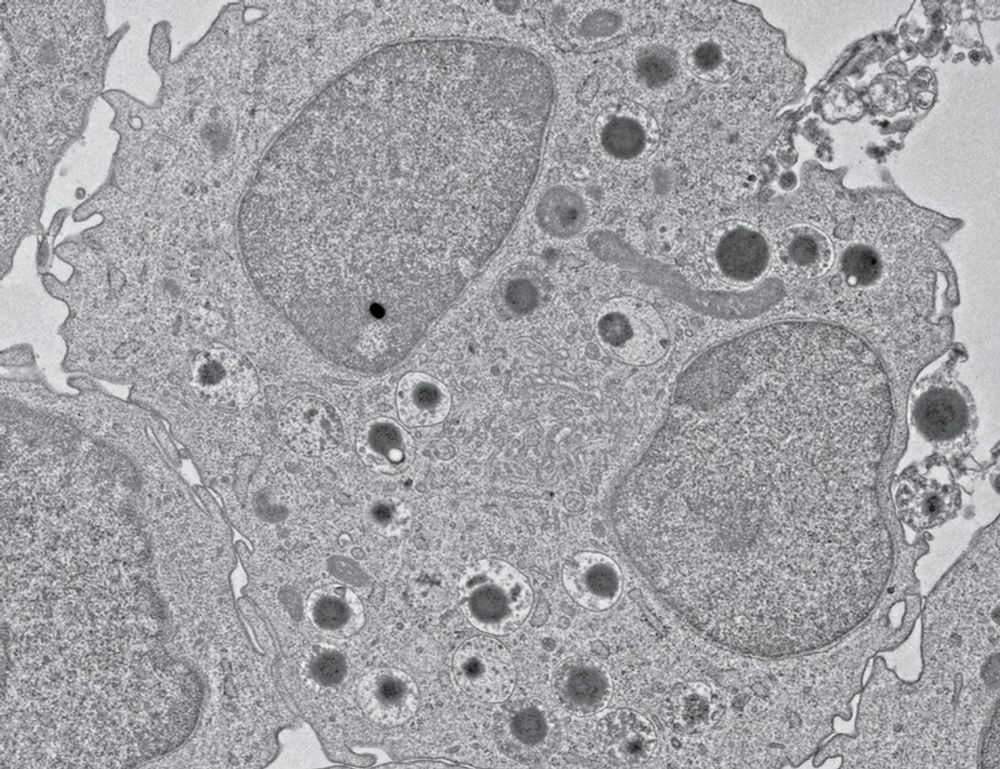
Eosinophil innate immune memory after bacterial skin infection promotes allergic lung inflammation
Staphylococcus aureus skin infection induces eosinophil innate immune memory to exacerbate allergen-induced airway inflammation.
www.science.org
April 4, 2025 at 6:18 PM
I'm excited to share my first-author PhD paper, now out in Science Immunology! @science.org
We show that S.aureus skin infection leaves a lasting imprint on bone marrow eosinophils, fueling allergic responses in the lungs.
📄 Read the full study: www.science.org/doi/10.1126/...
Let’s dive in 🧵 1/9
We show that S.aureus skin infection leaves a lasting imprint on bone marrow eosinophils, fueling allergic responses in the lungs.
📄 Read the full study: www.science.org/doi/10.1126/...
Let’s dive in 🧵 1/9
Reposted by Bhavya Singh
#MustRead. For #TumorImminologyLovers & more, check this fantastic review @ostunilab.bsky.social &co @cp-trendsimmuno.bsky.social all about #IL1 from #macrophages & pathogenic #inflammation in #cancer. #ScienceMatters dlvr.it/TJslPb
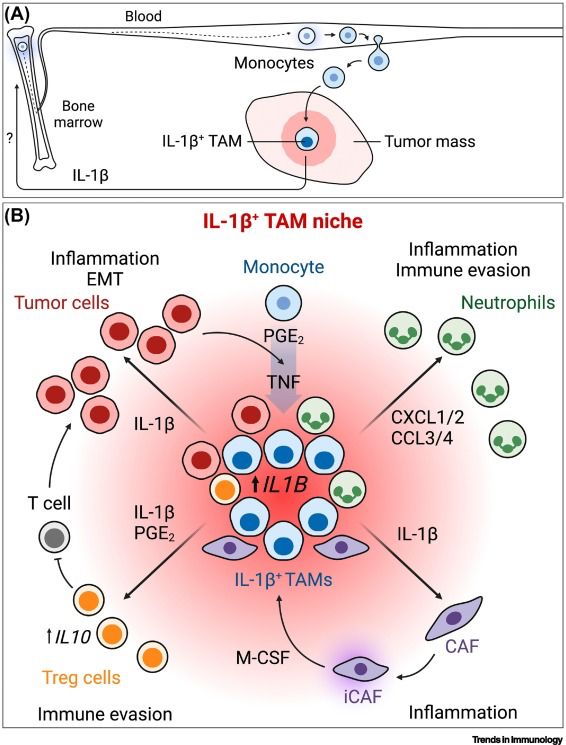
IL-1β+ macrophages and the control of pathogenic inflammation in cancer
While highlighting the complexity and heterogeneity of tumor immune microenvironments,
the application of single-cell analyses in human cancers has identified recurrent
subsets of tumor-associated mac...
dlvr.it
April 1, 2025 at 1:22 AM
#MustRead. For #TumorImminologyLovers & more, check this fantastic review @ostunilab.bsky.social &co @cp-trendsimmuno.bsky.social all about #IL1 from #macrophages & pathogenic #inflammation in #cancer. #ScienceMatters dlvr.it/TJslPb
Reposted by Bhavya Singh

Regulatory T (Treg) cells, discovered 30 years ago, show promise in therapy with ongoing trials despite some hurdles. PMID:39681737, Nat Rev Drug Discov 2025, @NatRevDrugDisc https://doi.org/10.1038/s41573-024-01089-x #Medsky #Pharmsky #RNA #ASHG #ESHG 🧪

Harnessing the biology of regulatory T cells to treat disease | Nature Reviews Drug Discovery
Regulatory T (Treg) cells are a suppressive subset of CD4+ T cells that maintain immune homeostasis and restrain inflammation. Three decades after their discovery, the promise of strategies to harness Treg cells for therapy has never been stronger. Multiple clinical trials seeking to enhance endogenous Treg cells or deliver them as a cell-based therapy have been performed and hint at signs of success, as well as to important limitations and unanswered questions. Strategies to deplete Treg cells in cancer are also in active clinical testing. Furthermore, multi-dimensional methods to interrogate the biology of Treg cells are leading to a refined understanding of Treg cell biology and new approaches to harness tissue-specific functions for therapy. A new generation of Treg cell clinical trials is now being fuelled by advances in nanomedicine and synthetic biology, seeking more precise ways to tailor Treg cell function. This Review will discuss recent advances in our understanding of human
doi.org
March 26, 2025 at 1:10 AM
Reposted by Bhavya Singh
📣 New preprint drop! In #ScienceImmunology, we found that regulatory #CD39 γδ IELs are reduced in #IBD, now @saraalonsomera.bsky.social shows that gut #microbiota promote enhanced CD39 expression in γδ IELs through #TCR and IL-15 activation. #gdTcells #GIresearch #Gastrosky @sinaiimmuno.bsky.social

Microbiota promote enhanced CD39 expression in γδ intraepithelial lymphocytes through the activation of TCR and IL-15 signaling https://www.biorxiv.org/content/10.1101/2025.03.22.644616v1
March 26, 2025 at 2:26 PM
📣 New preprint drop! In #ScienceImmunology, we found that regulatory #CD39 γδ IELs are reduced in #IBD, now @saraalonsomera.bsky.social shows that gut #microbiota promote enhanced CD39 expression in γδ IELs through #TCR and IL-15 activation. #gdTcells #GIresearch #Gastrosky @sinaiimmuno.bsky.social
Reposted by Bhavya Singh

By integrating single-cell RNA and physically interacting cell sequencing analysis, @meravcohen.bsky.social and colleagues report that neutrophils are enriched in physical crosstalk with breast tumor cells, promoting cancer aggressiveness.
⬇️
www.nature.com/articles/s43...
⬇️
www.nature.com/articles/s43...
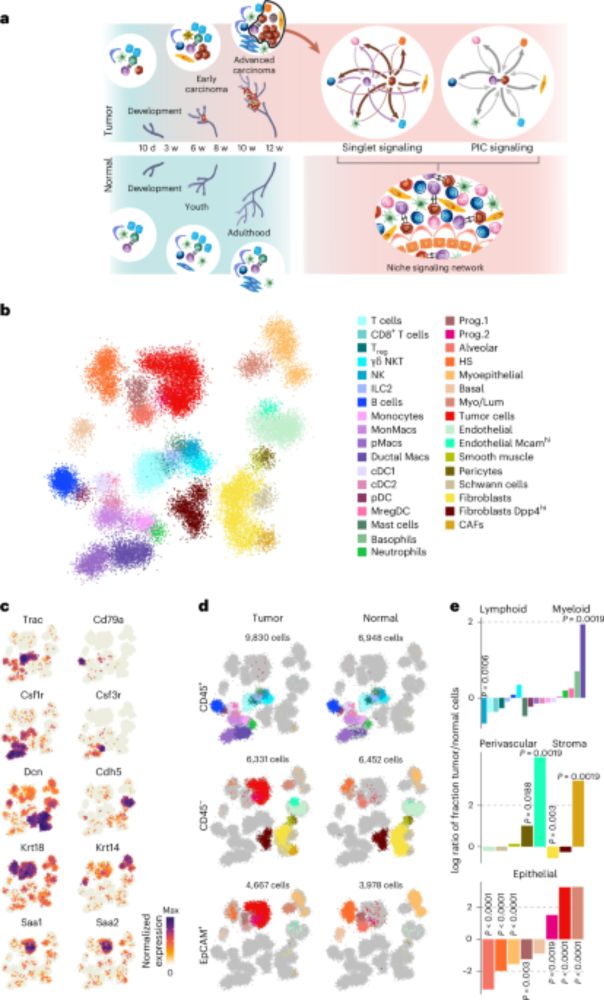
Neutrophils physically interact with tumor cells to form a signaling niche promoting breast cancer aggressiveness - Nature Cancer
By integrating single-cell RNA and physically interacting cell sequencing analysis, here Cohen and colleagues report that neutrophils are enriched in physical crosstalk with breast tumor cells, promot...
www.nature.com
March 23, 2025 at 10:24 PM
By integrating single-cell RNA and physically interacting cell sequencing analysis, @meravcohen.bsky.social and colleagues report that neutrophils are enriched in physical crosstalk with breast tumor cells, promoting cancer aggressiveness.
⬇️
www.nature.com/articles/s43...
⬇️
www.nature.com/articles/s43...
Reposted by Bhavya Singh
#Bluetorial: In our latest paper on #gdTcells and #IBD in #ScienceImmunology we found that γδ IEL number and regulatory function are severely compromised BEFORE ileal inflammation occurs, suggesting that γδ IELs may maintain IEL homeostasis in response to a pro-inflammatory microenvironment. 1/n

two men are riding a bicycle with a basket on it .
ALT: two men are riding a bicycle with a basket on it .
media.tenor.com
March 22, 2025 at 8:05 PM
#Bluetorial: In our latest paper on #gdTcells and #IBD in #ScienceImmunology we found that γδ IEL number and regulatory function are severely compromised BEFORE ileal inflammation occurs, suggesting that γδ IELs may maintain IEL homeostasis in response to a pro-inflammatory microenvironment. 1/n
Reposted by Bhavya Singh
@sinaiimmuno.bsky.social just gained a rockstar #PhD student with the acceptance of @ananya-p.bsky.social! Come see why we’re so lucky that Ananya will be joining us for a few more years at the APS Summit. She’ll be presenting two flashtalks (#GIL Trainee Symposium & Forte) on #gdTcell #migration 😍
March 21, 2025 at 10:56 PM
@sinaiimmuno.bsky.social just gained a rockstar #PhD student with the acceptance of @ananya-p.bsky.social! Come see why we’re so lucky that Ananya will be joining us for a few more years at the APS Summit. She’ll be presenting two flashtalks (#GIL Trainee Symposium & Forte) on #gdTcell #migration 😍