




Ben Vezina
@bananabenana.bsky.social
Computational Biology | Microbiology | Molecular Biology postdoc.
Right now I do lots of stats, vis, metabolic modelling and quantitative genomics
can we pls fix greenhouse emissions, gov, pls
Right now I do lots of stats, vis, metabolic modelling and quantitative genomics
can we pls fix greenhouse emissions, gov, pls
Wanted to highlight a cool recent paper I read. If you work on #Pseudomonas 🦠🧫🧬 you should check this out.
39(!) P. aeruginosa strains tested via C. elegans slow-kill assays, followed by GWAS to identify novel accessory genome virulence factors
#MicroSky #Microbiology
doi.org/10.3389/fmic...
39(!) P. aeruginosa strains tested via C. elegans slow-kill assays, followed by GWAS to identify novel accessory genome virulence factors
#MicroSky #Microbiology
doi.org/10.3389/fmic...

November 29, 2025 at 3:49 AM
Wanted to highlight a cool recent paper I read. If you work on #Pseudomonas 🦠🧫🧬 you should check this out.
39(!) P. aeruginosa strains tested via C. elegans slow-kill assays, followed by GWAS to identify novel accessory genome virulence factors
#MicroSky #Microbiology
doi.org/10.3389/fmic...
39(!) P. aeruginosa strains tested via C. elegans slow-kill assays, followed by GWAS to identify novel accessory genome virulence factors
#MicroSky #Microbiology
doi.org/10.3389/fmic...
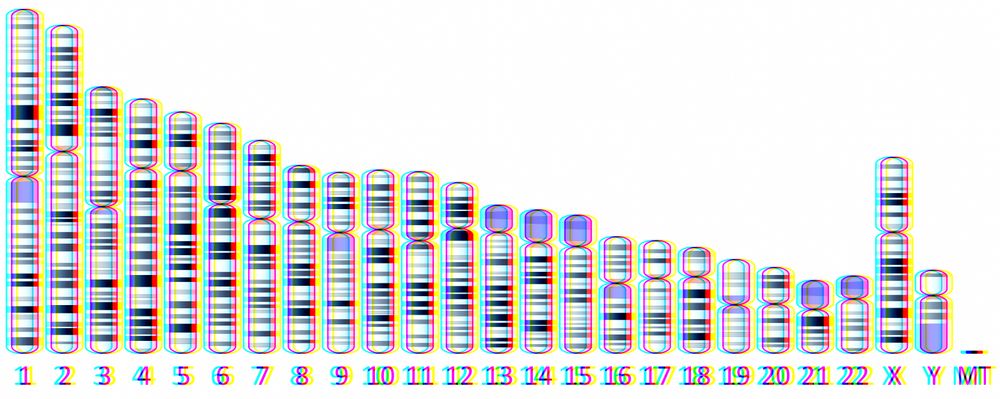
reject chromatic aberration, embrace chromosomal aberration
October 3, 2025 at 11:52 AM
reject chromatic aberration, embrace chromosomal aberration
Staggering analysis here linking ciprofloxacin resistance to specific mutations in #Klebsiella.
In short, using ONLY genotype, one can reasonably predict phenotypic CIP MICs! See Fig 3 (below).
Loving the splitting of MIC and disk diffusion data as well.
#AMR #MicroSky #IDSky
In short, using ONLY genotype, one can reasonably predict phenotypic CIP MICs! See Fig 3 (below).
Loving the splitting of MIC and disk diffusion data as well.
#AMR #MicroSky #IDSky

September 27, 2025 at 6:07 AM
Staggering analysis here linking ciprofloxacin resistance to specific mutations in #Klebsiella.
In short, using ONLY genotype, one can reasonably predict phenotypic CIP MICs! See Fig 3 (below).
Loving the splitting of MIC and disk diffusion data as well.
#AMR #MicroSky #IDSky
In short, using ONLY genotype, one can reasonably predict phenotypic CIP MICs! See Fig 3 (below).
Loving the splitting of MIC and disk diffusion data as well.
#AMR #MicroSky #IDSky
Automated, almost-error-free consensus #assemblies with Autocycler
Impressive benchmarks in Fig 2B (below): ≤10 median errors PER genome
Once again, incredible, landmark work from @rrwick.bsky.social
doi.org/10.1093/bioi...
Tool here: github.com/rrwick/Autoc...
#bioinformatics #genomics
Impressive benchmarks in Fig 2B (below): ≤10 median errors PER genome
Once again, incredible, landmark work from @rrwick.bsky.social
doi.org/10.1093/bioi...
Tool here: github.com/rrwick/Autoc...
#bioinformatics #genomics

September 22, 2025 at 3:02 PM
Automated, almost-error-free consensus #assemblies with Autocycler
Impressive benchmarks in Fig 2B (below): ≤10 median errors PER genome
Once again, incredible, landmark work from @rrwick.bsky.social
doi.org/10.1093/bioi...
Tool here: github.com/rrwick/Autoc...
#bioinformatics #genomics
Impressive benchmarks in Fig 2B (below): ≤10 median errors PER genome
Once again, incredible, landmark work from @rrwick.bsky.social
doi.org/10.1093/bioi...
Tool here: github.com/rrwick/Autoc...
#bioinformatics #genomics
Check out the paper for more findings on what chaos and shenanigans IS can cause for a genome: The IS-capades of Klebsiella pneumoniae

July 29, 2025 at 2:29 AM
Check out the paper for more findings on what chaos and shenanigans IS can cause for a genome: The IS-capades of Klebsiella pneumoniae
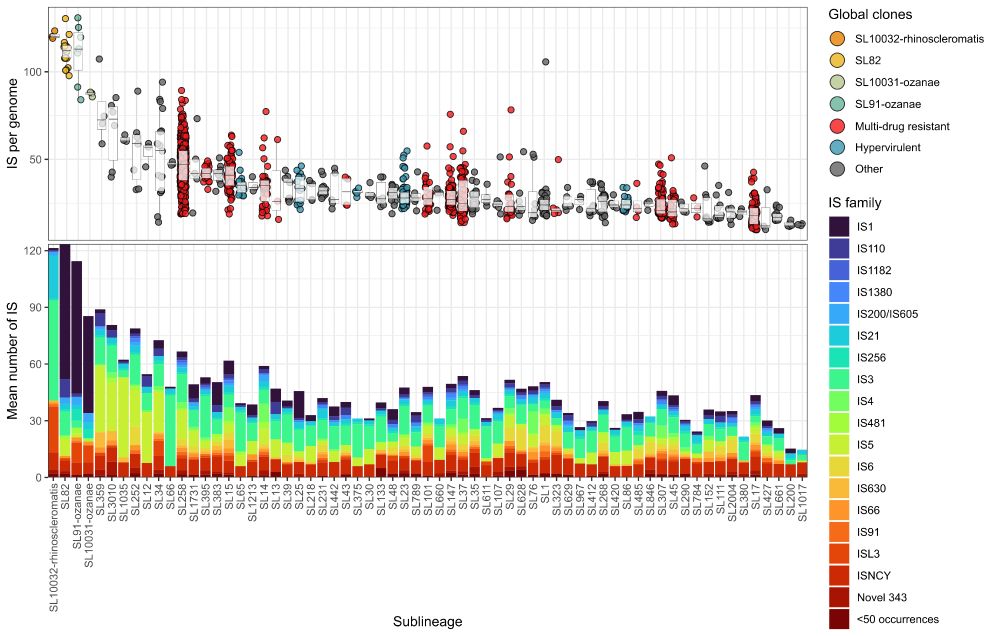
A few wacky lineages popped out right away, formally known as subspecies ozaenae and subspecies rhinoscleromatis and ST82. These had huge IS loads and also had parallel loss of key metabolic traits. We don't see these lineages that often anymore, but IS truly dominated their genomes

July 29, 2025 at 2:29 AM
A few wacky lineages popped out right away, formally known as subspecies ozaenae and subspecies rhinoscleromatis and ST82. These had huge IS loads and also had parallel loss of key metabolic traits. We don't see these lineages that often anymore, but IS truly dominated their genomes
New preprint where we analysed IS loads in 🦠 #Klebsiella pneumoniae lineages and found they're inversely associated with nutrient usage. We propose an insertional tolerance model, whereby IS can only insert into metabolically-tolerable sites.
#IDSky #MicroSky 🧪
www.biorxiv.org/content/10.1...
#IDSky #MicroSky 🧪
www.biorxiv.org/content/10.1...
July 29, 2025 at 2:29 AM
New preprint where we analysed IS loads in 🦠 #Klebsiella pneumoniae lineages and found they're inversely associated with nutrient usage. We propose an insertional tolerance model, whereby IS can only insert into metabolically-tolerable sites.
#IDSky #MicroSky 🧪
www.biorxiv.org/content/10.1...
#IDSky #MicroSky 🧪
www.biorxiv.org/content/10.1...
LibreOffice Writer imports SVGs while Microsoft Word compresses images.
LibreOffice Writer makes formatting easy while Microsoft Word anchors images 5 pages down.
I've made the switch and about to donate. Now LibreOffice Writer is my new best friend ❤️
LibreOffice Writer makes formatting easy while Microsoft Word anchors images 5 pages down.
I've made the switch and about to donate. Now LibreOffice Writer is my new best friend ❤️

July 20, 2025 at 5:04 AM
LibreOffice Writer imports SVGs while Microsoft Word compresses images.
LibreOffice Writer makes formatting easy while Microsoft Word anchors images 5 pages down.
I've made the switch and about to donate. Now LibreOffice Writer is my new best friend ❤️
LibreOffice Writer makes formatting easy while Microsoft Word anchors images 5 pages down.
I've made the switch and about to donate. Now LibreOffice Writer is my new best friend ❤️
I've been trying to articulate the 'modern' research biology 🧬🧪 process loop that I use/aspire to, where large-scale data is leveraged in it's own right while also driving experimental design.
The idea is to minimise risk, cost and time at experimental stages while maximising outputs and yield.
The idea is to minimise risk, cost and time at experimental stages while maximising outputs and yield.

July 5, 2025 at 7:51 AM
I've been trying to articulate the 'modern' research biology 🧬🧪 process loop that I use/aspire to, where large-scale data is leveraged in it's own right while also driving experimental design.
The idea is to minimise risk, cost and time at experimental stages while maximising outputs and yield.
The idea is to minimise risk, cost and time at experimental stages while maximising outputs and yield.
Karey Mullis invented PCR in 1983 🧪 which is the GOAT foundational technique of all #molbio to this day. Nothing beats it's elegance, sensitivity, simplicity or application. The initial experiments sans Taq polymerase were rough though:
www.nobelprize.org/prizes/chemi...
www.nobelprize.org/prizes/chemi...

June 16, 2025 at 3:11 PM
Karey Mullis invented PCR in 1983 🧪 which is the GOAT foundational technique of all #molbio to this day. Nothing beats it's elegance, sensitivity, simplicity or application. The initial experiments sans Taq polymerase were rough though:
www.nobelprize.org/prizes/chemi...
www.nobelprize.org/prizes/chemi...
In 2005, 'tidal cycling', was proposed, where moon-driven tides enabled salt-based amplification of 🧬. Inter-tidal zones experience varying ionic cycles, mimicking thermal cycling.
Long story short: Moon-based PCR. Interesting theory. Strong biochemistry. Weak earth science.
doi.org/10.1016/j.ic...
Long story short: Moon-based PCR. Interesting theory. Strong biochemistry. Weak earth science.
doi.org/10.1016/j.ic...

June 16, 2025 at 3:11 PM
In 2005, 'tidal cycling', was proposed, where moon-driven tides enabled salt-based amplification of 🧬. Inter-tidal zones experience varying ionic cycles, mimicking thermal cycling.
Long story short: Moon-based PCR. Interesting theory. Strong biochemistry. Weak earth science.
doi.org/10.1016/j.ic...
Long story short: Moon-based PCR. Interesting theory. Strong biochemistry. Weak earth science.
doi.org/10.1016/j.ic...
Conjugative plasmids be like:
June 15, 2025 at 1:54 PM
Conjugative plasmids be like:
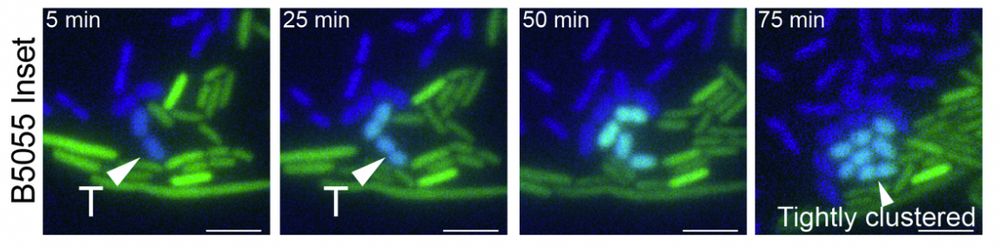
Cool paper showing 🦠 recipient response to #plasmid conjugation
Capsule blocks conjugation, preventing MPF between donor:recipient. However, conjugation exploits recipient strain heterogeneity of capsule thickness, conjugating to cells with less capsule
#MicroSky 🧪
www.biorxiv.org/content/10.1...
Capsule blocks conjugation, preventing MPF between donor:recipient. However, conjugation exploits recipient strain heterogeneity of capsule thickness, conjugating to cells with less capsule
#MicroSky 🧪
www.biorxiv.org/content/10.1...
June 15, 2025 at 1:47 PM
Cool paper showing 🦠 recipient response to #plasmid conjugation
Capsule blocks conjugation, preventing MPF between donor:recipient. However, conjugation exploits recipient strain heterogeneity of capsule thickness, conjugating to cells with less capsule
#MicroSky 🧪
www.biorxiv.org/content/10.1...
Capsule blocks conjugation, preventing MPF between donor:recipient. However, conjugation exploits recipient strain heterogeneity of capsule thickness, conjugating to cells with less capsule
#MicroSky 🧪
www.biorxiv.org/content/10.1...
Regarding #OneHealth, despite human clinical origin accounting for 88.9% of all genomes, we managed to find 65 IMP-clusters with putative evidence of spread between sources. These were mostly between hospital environments and humans, but also 3 IMP-clusters between animals and humans.

May 27, 2025 at 6:44 AM
Regarding #OneHealth, despite human clinical origin accounting for 88.9% of all genomes, we managed to find 65 IMP-clusters with putative evidence of spread between sources. These were mostly between hospital environments and humans, but also 3 IMP-clusters between animals and humans.
We examined mutations in key residues (30, 31, 51, 87, 150, 167, 196) previously shown to impact carbapenem hydrolytic specificity. We noted a consistent pattern of convergent evolutionary mutations throughout the protein phylogeny at these key residues, with many acquired independently such as 31F.

May 27, 2025 at 6:44 AM
We examined mutations in key residues (30, 31, 51, 87, 150, 167, 196) previously shown to impact carbapenem hydrolytic specificity. We noted a consistent pattern of convergent evolutionary mutations throughout the protein phylogeny at these key residues, with many acquired independently such as 31F.
We looked at the sequence/structures of 52 IMP variants. They were structurally conserved (lDDT 0.977), but showed reduced amino acid conservation scores at key positions, indicative of varying substrate specificity/activity.

May 27, 2025 at 6:44 AM
We looked at the sequence/structures of 52 IMP variants. They were structurally conserved (lDDT 0.977), but showed reduced amino acid conservation scores at key positions, indicative of varying substrate specificity/activity.
We were able to systematically examine the mobile elements #MGE associated with IMPs. In most cases, co-localisation of integrons WITH Insertion Sequences were the most frequent. Intersecting mobile elements promoted IMP mobility, enabling entry into a vast array of at least 52 plasmid clusters

May 27, 2025 at 6:44 AM
We were able to systematically examine the mobile elements #MGE associated with IMPs. In most cases, co-localisation of integrons WITH Insertion Sequences were the most frequent. Intersecting mobile elements promoted IMP mobility, enabling entry into a vast array of at least 52 plasmid clusters
Looking at #plasmids, we found that IMP was found on plasmids 2,909 (63.8%) of the time, though due to draft assemblies we had uncertainty about the remaining 1,553 genomes. IMP was found across 52 distinct plasmid clusters, but IncHI2A, IncN, IncL/M and IncC dominated, enabling interspecies spread.

May 27, 2025 at 6:44 AM
Looking at #plasmids, we found that IMP was found on plasmids 2,909 (63.8%) of the time, though due to draft assemblies we had uncertainty about the remaining 1,553 genomes. IMP was found across 52 distinct plasmid clusters, but IncHI2A, IncN, IncL/M and IncC dominated, enabling interspecies spread.
Clonal bias influenced the dataset, so we quantified its impact with ‘IMP-clusters’ – genomes which share the same IMP variant, species, lineage and were within a species-specific threshold of 5 SNVs/Mb. This resulted in 1,381 IMP-clusters, where 69.9% of genomes removed by dereplication.

May 27, 2025 at 6:44 AM
Clonal bias influenced the dataset, so we quantified its impact with ‘IMP-clusters’ – genomes which share the same IMP variant, species, lineage and were within a species-specific threshold of 5 SNVs/Mb. This resulted in 1,381 IMP-clusters, where 69.9% of genomes removed by dereplication.
IMPs were found across a total of 93 species, again with variant-specific distributions. IMP-1, IMP-4 and IMP-6 were predominantly associated with Enterobacterales (E. hormaechei, #Klebsiella pneumoniae, #Ecoli), while IMP-7, IMP-13 and IMP-26 were predominantly noted in #Pseudomonas aeruginosa

May 27, 2025 at 6:44 AM
IMPs were found across a total of 93 species, again with variant-specific distributions. IMP-1, IMP-4 and IMP-6 were predominantly associated with Enterobacterales (E. hormaechei, #Klebsiella pneumoniae, #Ecoli), while IMP-7, IMP-13 and IMP-26 were predominantly noted in #Pseudomonas aeruginosa
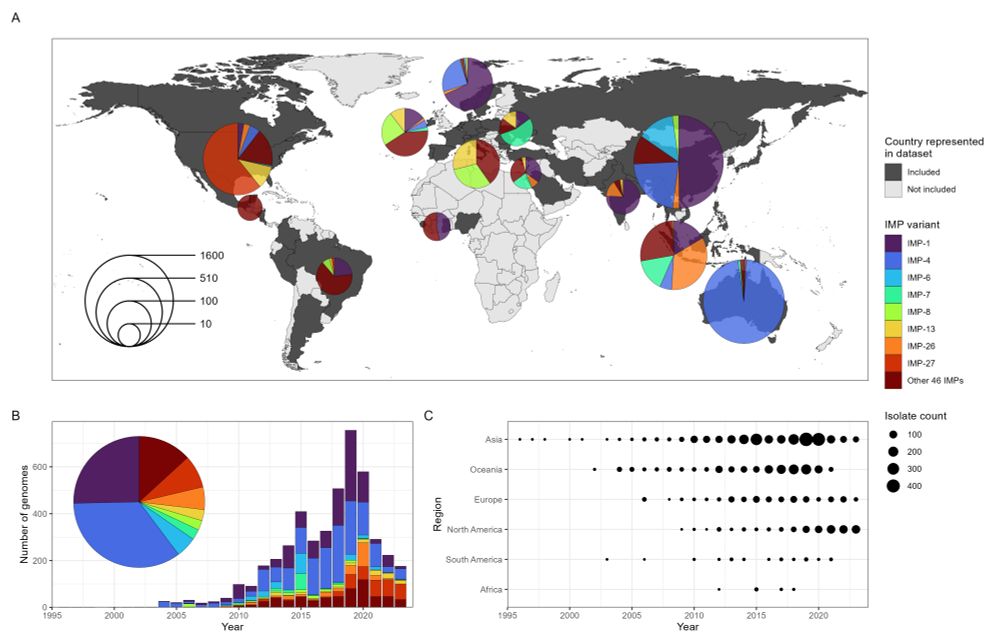
Let’s look closer at the regional IMP variants. IMP-26 was endemic to South Eastern Asia and highly associated with P. aeruginosa ST235. IMP-27 on the other hand, was the dominant variant in North America due to the clonal expansion of Providencia, Proteus mirabilis and Morganella lineages.

May 27, 2025 at 6:44 AM
Let’s look closer at the regional IMP variants. IMP-26 was endemic to South Eastern Asia and highly associated with P. aeruginosa ST235. IMP-27 on the other hand, was the dominant variant in North America due to the clonal expansion of Providencia, Proteus mirabilis and Morganella lineages.
Use of global public data showed that IMPs have truly spread across the globe, and different regions have different IMP variant prevalence, with IMP-1, IMP-4, IMP-7, IMP-8 and IMP-13 achieving global endemicity, while IMP-6, IMP-26, and IMP-27 were regionally endemic.
May 27, 2025 at 6:44 AM
Use of global public data showed that IMPs have truly spread across the globe, and different regions have different IMP variant prevalence, with IMP-1, IMP-4, IMP-7, IMP-8 and IMP-13 achieving global endemicity, while IMP-6, IMP-26, and IMP-27 were regionally endemic.
Our new paper on the global epi of IMP carbapenemases. We originally called this paper: ‘Planet of the IMPs’ as IMPs are now everywhere. We found IMP variant-specific distributions across species, plasmids, mobile elements and geography
www.medrxiv.org/content/10.1...
#amr #amrsky #IDsky
www.medrxiv.org/content/10.1...
#amr #amrsky #IDsky

May 27, 2025 at 6:44 AM
Our new paper on the global epi of IMP carbapenemases. We originally called this paper: ‘Planet of the IMPs’ as IMPs are now everywhere. We found IMP variant-specific distributions across species, plasmids, mobile elements and geography
www.medrxiv.org/content/10.1...
#amr #amrsky #IDsky
www.medrxiv.org/content/10.1...
#amr #amrsky #IDsky
Masterclass of applied quantitative #genomics - cool study design, findings and ties into real biology.
Unclear if statistical comparisons controlled for clonal population bias though?
Figure 4C is 👌👌 - using the upper tri for positive associations, and lower tri for negative associations.
Unclear if statistical comparisons controlled for clonal population bias though?
Figure 4C is 👌👌 - using the upper tri for positive associations, and lower tri for negative associations.

May 25, 2025 at 3:51 AM
Masterclass of applied quantitative #genomics - cool study design, findings and ties into real biology.
Unclear if statistical comparisons controlled for clonal population bias though?
Figure 4C is 👌👌 - using the upper tri for positive associations, and lower tri for negative associations.
Unclear if statistical comparisons controlled for clonal population bias though?
Figure 4C is 👌👌 - using the upper tri for positive associations, and lower tri for negative associations.