




Maria Balgova
@balgovamaria.bsky.social
Labour economist studying geography of jobs, matching, and pay. Researcher at Bank of England, Oxford PhD, IZA Fellow, made in 🇸🇰.
https://sites.google.com/view/mariabalgova
https://sites.google.com/view/mariabalgova
(iii) within cities, increase in migration inflows and increase in wages should be concentrated in the same occupations
I find that this is true for Craigslist cities but not for control cities, where the relationship is negative - driven by labour supply rather than by better matching.
I find that this is true for Craigslist cities but not for control cities, where the relationship is negative - driven by labour supply rather than by better matching.

November 16, 2023 at 9:53 AM
(iii) within cities, increase in migration inflows and increase in wages should be concentrated in the same occupations
I find that this is true for Craigslist cities but not for control cities, where the relationship is negative - driven by labour supply rather than by better matching.
I find that this is true for Craigslist cities but not for control cities, where the relationship is negative - driven by labour supply rather than by better matching.
Given these patterns in baseline recruitment, we'd expect
(i) Craigslist to have larger impact in occupations with high non-local recruitment in 1990
(ii) the impact to be larger for higher wages where the quality of match often matters most
This is exactly what I find!
(i) Craigslist to have larger impact in occupations with high non-local recruitment in 1990
(ii) the impact to be larger for higher wages where the quality of match often matters most
This is exactly what I find!


November 16, 2023 at 9:53 AM
Given these patterns in baseline recruitment, we'd expect
(i) Craigslist to have larger impact in occupations with high non-local recruitment in 1990
(ii) the impact to be larger for higher wages where the quality of match often matters most
This is exactly what I find!
(i) Craigslist to have larger impact in occupations with high non-local recruitment in 1990
(ii) the impact to be larger for higher wages where the quality of match often matters most
This is exactly what I find!
The data shows that firms recruit non-locally to find specific talent rather than to hire cheaply:
- non-local vacancies are posted in large markets with higher wages & lower-unemployment
- firms target markets which specialise in the occupation they’re searching for
- non-local vacancies are posted in large markets with higher wages & lower-unemployment
- firms target markets which specialise in the occupation they’re searching for


November 16, 2023 at 9:52 AM
The data shows that firms recruit non-locally to find specific talent rather than to hire cheaply:
- non-local vacancies are posted in large markets with higher wages & lower-unemployment
- firms target markets which specialise in the occupation they’re searching for
- non-local vacancies are posted in large markets with higher wages & lower-unemployment
- firms target markets which specialise in the occupation they’re searching for
At the same time, average wages in the treated cities went up by about 0.8% annually, putting an end to convergence in pay.

November 16, 2023 at 9:51 AM
At the same time, average wages in the treated cities went up by about 0.8% annually, putting an end to convergence in pay.
I find that Craigslist entry into a city significantly increased geographic mobility in and out of the city.
Looking at changes in bilateral city-to-city migration flows, almost all of the increase in migration churn is driven by greater mobility between Craigslist cities.
Looking at changes in bilateral city-to-city migration flows, almost all of the increase in migration churn is driven by greater mobility between Craigslist cities.
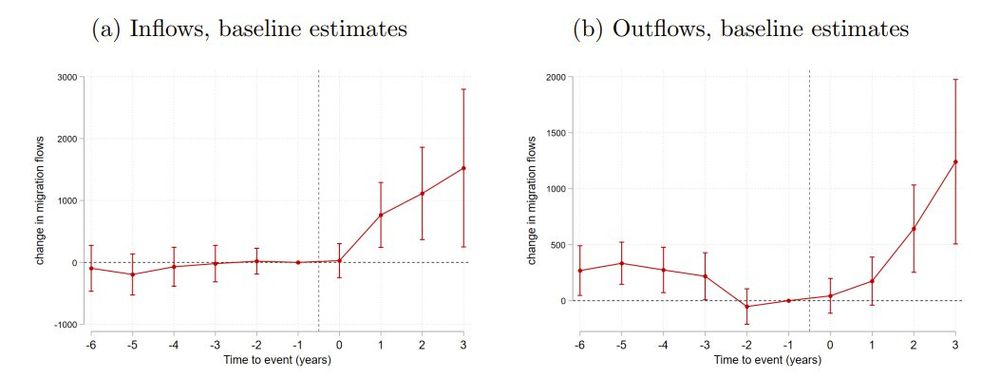

November 16, 2023 at 9:50 AM
I find that Craigslist entry into a city significantly increased geographic mobility in and out of the city.
Looking at changes in bilateral city-to-city migration flows, almost all of the increase in migration churn is driven by greater mobility between Craigslist cities.
Looking at changes in bilateral city-to-city migration flows, almost all of the increase in migration churn is driven by greater mobility between Craigslist cities.
Excited to share my new WP (which also happens to be my job market paper!)
How does online recruitment impact the geography of the labour market?
Full paper here sites.google.com/view/mariaba...
and a thread below:
How does online recruitment impact the geography of the labour market?
Full paper here sites.google.com/view/mariaba...
and a thread below:

November 16, 2023 at 9:48 AM
Excited to share my new WP (which also happens to be my job market paper!)
How does online recruitment impact the geography of the labour market?
Full paper here sites.google.com/view/mariaba...
and a thread below:
How does online recruitment impact the geography of the labour market?
Full paper here sites.google.com/view/mariaba...
and a thread below:
That's the next question!
However, I can share one graph (that didn't make it into the paper) that gets us a bit closer to answering this: the share of non-local recruitm. in 1990 is highly predictive of recruitm. online in 2015, with convexity at the top end - more polarisation across occupations
However, I can share one graph (that didn't make it into the paper) that gets us a bit closer to answering this: the share of non-local recruitm. in 1990 is highly predictive of recruitm. online in 2015, with convexity at the top end - more polarisation across occupations

November 16, 2023 at 9:39 AM
That's the next question!
However, I can share one graph (that didn't make it into the paper) that gets us a bit closer to answering this: the share of non-local recruitm. in 1990 is highly predictive of recruitm. online in 2015, with convexity at the top end - more polarisation across occupations
However, I can share one graph (that didn't make it into the paper) that gets us a bit closer to answering this: the share of non-local recruitm. in 1990 is highly predictive of recruitm. online in 2015, with convexity at the top end - more polarisation across occupations