



Meghan Schaberg (she/her)
@arctic-megs.bsky.social
Arctic Climate Scientist ❄️. NSF Postdoc Fellow at Colorado State University. Passionate about ECR community building, DEI, and mentorship
Last chance to register for our Roundtable discussion with some filmmakers tomorrow morning (9am MT)!
Thursday is day four of the 9th Annual International Polar Film Festival (PFF), hosted by USAPECS (March 17-21). Spotlight films focus on Arctic indigenous communities. Register for tomorrow’s Filmmaker’s Roundtable, access films, daily highlights, filmmaker blogs at: www.usapecs.org/polar-film-f...

March 20, 2025 at 4:49 PM
Last chance to register for our Roundtable discussion with some filmmakers tomorrow morning (9am MT)!
Live today! If you’d like to learn about the films from some of the filmmakers join us at the Roundtable on Friday ❄️
USAPECS’s 9th Annual International Polar Film Festival (PFF) is live from March 17-21, 2025 at www.usapecs.org/polar-film-f....
This online event showcases some of the best recent films about polar & alpine regions. Register here for roundtable filmmaker discussion (3/21): forms.gle/Do92aMcMohjG...
This online event showcases some of the best recent films about polar & alpine regions. Register here for roundtable filmmaker discussion (3/21): forms.gle/Do92aMcMohjG...

March 17, 2025 at 4:00 PM
Live today! If you’d like to learn about the films from some of the filmmakers join us at the Roundtable on Friday ❄️
Please considering signing!

So important & appreciated! Join the over 2000 individuals and organizations and sign & share the open Declaration To #DefendResearch Against US Gov Censorship! tinyurl.com/3bwuc38f Join a March 7th @standupforscience.bsky.social l demonstration! #standupforscience2025 #resist #NoTimeForSilence
February 24, 2025 at 10:29 PM
Please considering signing!
Reposted by Meghan Schaberg (she/her)

What is your vision of polar research in the next International Polar Year? Provide your input now to shape the next decade of polar research! PECWS 2025 encourages all polar early career professionals from around the world to provide their input through buff.ly/3Q3AOYV by February 23rd.

February 4, 2025 at 7:00 PM
What is your vision of polar research in the next International Polar Year? Provide your input now to shape the next decade of polar research! PECWS 2025 encourages all polar early career professionals from around the world to provide their input through buff.ly/3Q3AOYV by February 23rd.
Sea ice thickness and volume aren’t just declining in September.December is also experiencing large changes 😞
Variability and long-term decline of December #Arctic sea-ice thickness and sea-ice volume... 🥼❄️
+ Data information: climatedataguide.ucar.edu/climate-data...
+ Data information: climatedataguide.ucar.edu/climate-data...
January 28, 2025 at 4:39 PM
Sea ice thickness and volume aren’t just declining in September.December is also experiencing large changes 😞
Reposted by Meghan Schaberg (she/her)

Surge in ocean heat is a sign climate change is accelerating | New Scientist

Surge in ocean heat is a sign climate change is accelerating
The rate of warming in the oceans has more than quadrupled since 1985, suggesting global warming in general has undergone a marked acceleration
buff.ly
January 28, 2025 at 2:52 PM
Surge in ocean heat is a sign climate change is accelerating | New Scientist
Great opportunity to learn more about the Arctic Report Card

Tomorrow: Two decades of the NOAA Arctic Report Card: history, reflections, and next steps, featuring Twila Moon from CIRES and NSIDC.
🗓️: January 15
🕛: 2 pm EST
🔗: library.noaa.gov/seminars/upc...
🗓️: January 15
🕛: 2 pm EST
🔗: library.noaa.gov/seminars/upc...

January 14, 2025 at 7:04 PM
Great opportunity to learn more about the Arctic Report Card
Reposted by Meghan Schaberg (she/her)
Happy #DecemberSolstice! 🌞⚒️🧪
Understanding seasons - a look at the hourly incoming solar radiation during the two solstices (23.5°N/S). I've added a red marker for ease of viewing. Dashed line shows the equator
This graphic can now be found at zacklabe.com/arctic-clima...
Understanding seasons - a look at the hourly incoming solar radiation during the two solstices (23.5°N/S). I've added a red marker for ease of viewing. Dashed line shows the equator
This graphic can now be found at zacklabe.com/arctic-clima...
December 21, 2024 at 2:32 PM
Happy #DecemberSolstice! 🌞⚒️🧪
Understanding seasons - a look at the hourly incoming solar radiation during the two solstices (23.5°N/S). I've added a red marker for ease of viewing. Dashed line shows the equator
This graphic can now be found at zacklabe.com/arctic-clima...
Understanding seasons - a look at the hourly incoming solar radiation during the two solstices (23.5°N/S). I've added a red marker for ease of viewing. Dashed line shows the equator
This graphic can now be found at zacklabe.com/arctic-clima...

Reposted by Meghan Schaberg (she/her)
With #AGU24 in full swing, a stripy reminder that Arctic is warming rapidly, and there’s no mystery why. #ClimateChange #AGU2024

December 10, 2024 at 12:17 AM
With #AGU24 in full swing, a stripy reminder that Arctic is warming rapidly, and there’s no mystery why. #ClimateChange #AGU2024
Reposted by Meghan Schaberg (she/her)
Arctic Yearbook article- 10 years with USAPECS (US Association of Polar Early Career Scientists). @zacklabe.com @usapecs.bsky.social
Exploring the Past, Present, and Future of USAPECS: Lessons from a Decade of Supporting Early Career Research Across National and International Polar Networks
Susan B. Vanek, Zachary M. Labe, Olga Lauter, Kevin Shionalyn, Mohammad Afzal Shadab, Elena Adasheva, Annika Margevich, Meghan N. Schaberg, Lavanya Ashokkumar & Jonathan N. Naoukin
Navigating
arcticyearbook.com
November 18, 2024 at 6:09 PM
Arctic Yearbook article- 10 years with USAPECS (US Association of Polar Early Career Scientists). @zacklabe.com @usapecs.bsky.social
Reposted by Meghan Schaberg (she/her)
#Arctic sea ice volume was 54% below the average in this data set for October 2024. The animation shows changes in both sea ice volume (bar) and sea ice thickness (map) in October
+ Graphic available: zacklabe.com/arctic-sea-i...
+ Data from: psc.apl.uw.edu/research/pro...
+ Graphic available: zacklabe.com/arctic-sea-i...
+ Data from: psc.apl.uw.edu/research/pro...
November 16, 2024 at 3:00 PM
#Arctic sea ice volume was 54% below the average in this data set for October 2024. The animation shows changes in both sea ice volume (bar) and sea ice thickness (map) in October
+ Graphic available: zacklabe.com/arctic-sea-i...
+ Data from: psc.apl.uw.edu/research/pro...
+ Graphic available: zacklabe.com/arctic-sea-i...
+ Data from: psc.apl.uw.edu/research/pro...
Reposted by Meghan Schaberg (she/her)
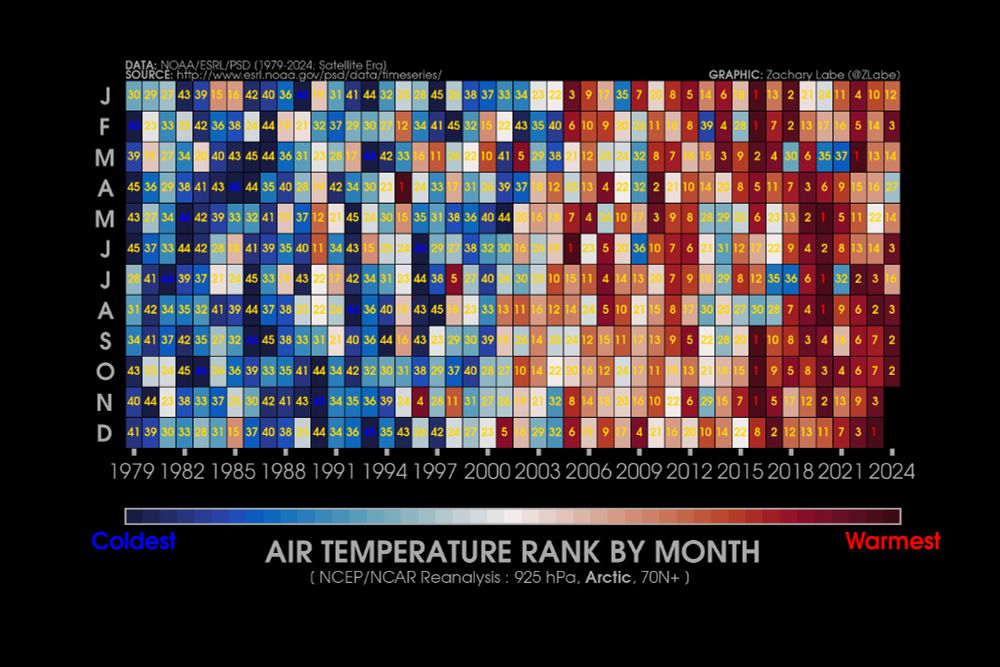
#Arctic air temperature rank by month over the satellite era - now updated through October 2024. Check out the last few months 😱
+ Ranks: 1=warmest (red), 45/46=coldest (blue)
+ Download visual: zacklabe.com/arctic-tempe...
+ Ranks: 1=warmest (red), 45/46=coldest (blue)
+ Download visual: zacklabe.com/arctic-tempe...
November 15, 2024 at 6:07 PM
#Arctic air temperature rank by month over the satellite era - now updated through October 2024. Check out the last few months 😱
+ Ranks: 1=warmest (red), 45/46=coldest (blue)
+ Download visual: zacklabe.com/arctic-tempe...
+ Ranks: 1=warmest (red), 45/46=coldest (blue)
+ Download visual: zacklabe.com/arctic-tempe...
Reposted by Meghan Schaberg (she/her)
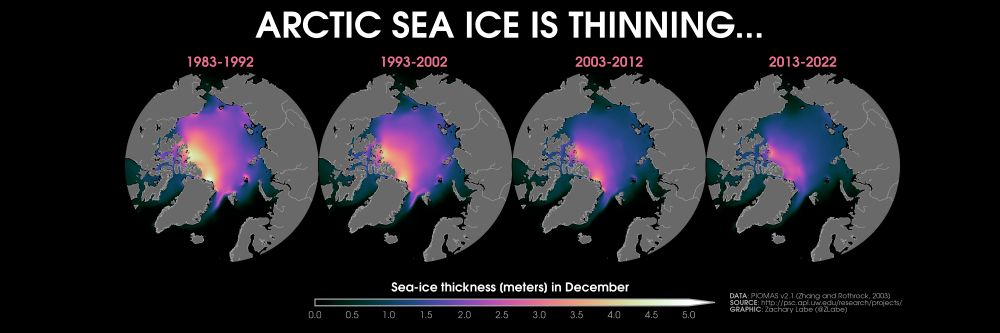
The disappearance of thicker Arctic sea ice by decade in December... 🧊📉
More info on data: climatedataguide.ucar.edu/climate-data...
More info on data: climatedataguide.ucar.edu/climate-data...
December 11, 2023 at 7:19 PM
The disappearance of thicker Arctic sea ice by decade in December... 🧊📉
More info on data: climatedataguide.ucar.edu/climate-data...
More info on data: climatedataguide.ucar.edu/climate-data...
Reposted by Meghan Schaberg (she/her)
The social will take place on Wed, December 13 from 6-8pm PT, starting in the Sierra AB room at the SF Marriott Marquis (room courtesy of ARCUS, located right by the Moscone Center) & then will likely move on to another food or drinks place outside of the hotel. See ya there! 2/2

November 27, 2023 at 4:04 PM
The social will take place on Wed, December 13 from 6-8pm PT, starting in the Sierra AB room at the SF Marriott Marquis (room courtesy of ARCUS, located right by the Moscone Center) & then will likely move on to another food or drinks place outside of the hotel. See ya there! 2/2
Check out this cool event by IARPC!
November 14, 2023 at 5:01 PM
Check out this cool event by IARPC!
Reposted by Meghan Schaberg (she/her)
Reviewing our record-breaking September...
🟥 - warmer than average
🟦 - colder than average
Overall, the average September global air temperature was +1.47°C above 1951-1980 climate baseline (+1.72°C above the 1880-1920 baseline).
Data code: data.giss.nasa.gov/gistemp/sour... ⚒️
🟥 - warmer than average
🟦 - colder than average
Overall, the average September global air temperature was +1.47°C above 1951-1980 climate baseline (+1.72°C above the 1880-1920 baseline).
Data code: data.giss.nasa.gov/gistemp/sour... ⚒️

October 26, 2023 at 11:51 AM
Reviewing our record-breaking September...
🟥 - warmer than average
🟦 - colder than average
Overall, the average September global air temperature was +1.47°C above 1951-1980 climate baseline (+1.72°C above the 1880-1920 baseline).
Data code: data.giss.nasa.gov/gistemp/sour... ⚒️
🟥 - warmer than average
🟦 - colder than average
Overall, the average September global air temperature was +1.47°C above 1951-1980 climate baseline (+1.72°C above the 1880-1920 baseline).
Data code: data.giss.nasa.gov/gistemp/sour... ⚒️
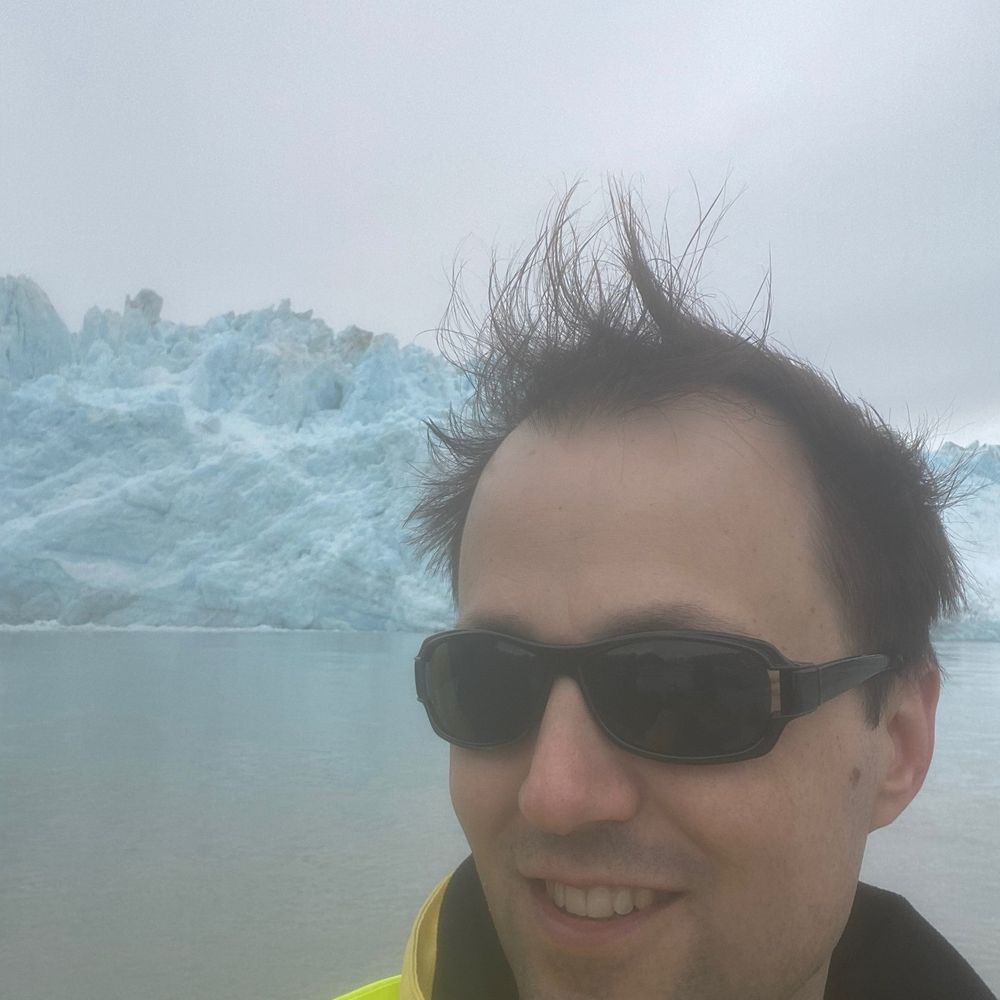
Missing the Arctic right now! It’s been too long ❄️


October 18, 2023 at 4:20 PM
Missing the Arctic right now! It’s been too long ❄️
Share your gorgeous polar experiences through @polarsecco.bsky.social photo contest!
Have some great polar photos? Win prizes in our photo contest by showcasing the beauty of the polar regions and the #polarECRs who work in them! Don’t miss our Oct 31 deadline! Learn more here: psecco.org/photo-contest

October 18, 2023 at 4:10 PM
Share your gorgeous polar experiences through @polarsecco.bsky.social photo contest!