



Alex_Lee
@alexlee-kaichun.bsky.social
Reposted by Alex_Lee

Latest paper from our lab to reinforce that "nitrogen-fixing" maize accessions keep producing nodal (aerial and brace) roots at the adult stage - Aerial root formation in Oaxacan maize (Zea mays) landraces persists into the adult phase and is minimally affected by soil nitrogen and ambient humidity

Aerial root formation in Oaxacan maize (Zea mays) landraces persists into the adult phase and is minimally affected by soil nitrogen and ambient humidity
Maize (Zea mays L.) is the most widely produced crop in the world, and conventional production requires significant amounts of synthetic nitrogen fertilizer, which has negative economic and environmental consequences. Maize landraces from Oaxaca, Mexico, can acquire nitrogen from nitrogen-fixing bacteria that live in a mucilage secreted by aerial nodal roots. The development of these nodal roots is a characteristic traditionally associated with the juvenile vegetative stage of maize plants. However, mature Oaxacan landraces develop many more nodes with aerial roots than commercial maize varieties. Our study shows that Oaxacan landraces develop aerial roots during the juvenile and adult vegetative phases and even during early flowering under greenhouse and field conditions. Surprisingly, the development of these roots was only minimally affected by soil nitrogen and ambient humidity. These findings are an essential first step in developing maize varieties to reduce fertilizer needs in maize production across different environmental conditions.
sco.lt
July 11, 2025 at 3:37 PM
Latest paper from our lab to reinforce that "nitrogen-fixing" maize accessions keep producing nodal (aerial and brace) roots at the adult stage - Aerial root formation in Oaxacan maize (Zea mays) landraces persists into the adult phase and is minimally affected by soil nitrogen and ambient humidity
Reposted by Alex_Lee

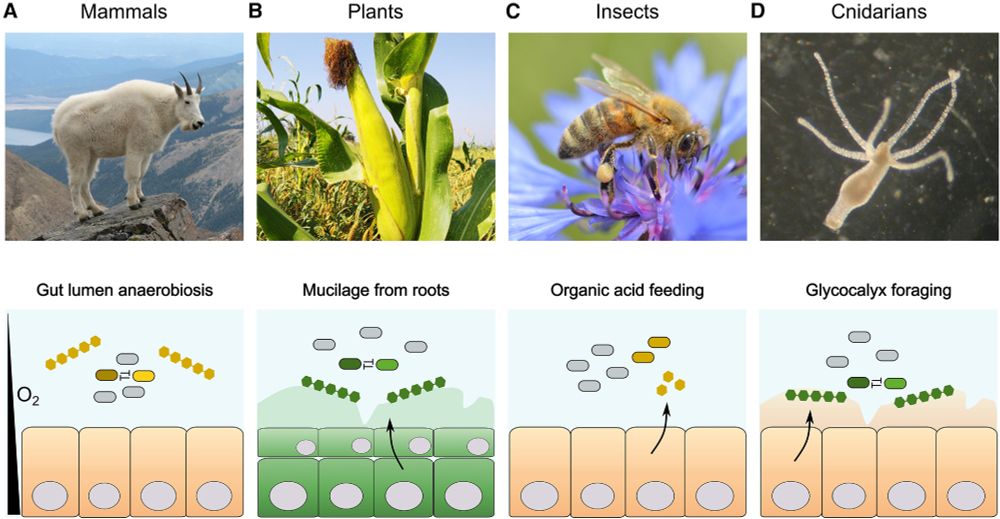
Metabolic ecology of microbiomes: Nutrient competition, host benefits, and community engineering
Review by Erik Bakkeren, Vit Piskovsky, and Kevin R. Foster
www.cell.com/cell-host-mi...
Review by Erik Bakkeren, Vit Piskovsky, and Kevin R. Foster
www.cell.com/cell-host-mi...
June 11, 2025 at 5:02 PM
Metabolic ecology of microbiomes: Nutrient competition, host benefits, and community engineering
Review by Erik Bakkeren, Vit Piskovsky, and Kevin R. Foster
www.cell.com/cell-host-mi...
Review by Erik Bakkeren, Vit Piskovsky, and Kevin R. Foster
www.cell.com/cell-host-mi...
Reposted by Alex_Lee
Interesting preprint - Unearthing the rhizosphere microbiome recruited by ancestral bread wheat landraces | bioRxiv
Unearthing the rhizosphere microbiome recruited by ancestral bread wheat landraces | bioRxiv
Crop root traits that modulate the soil microbiome can turn the tide of reduced fertility in intensively farmed land by optimising nutrient availability and resilience to environmental stresses. Advantageous genetic diversity that allows adaptation to nutrient availability is present in historic crop genotypes. The Watkins collection of bread wheat landraces is an unexploited resource, carrying untapped phenotypic traits. Here, we show that the rhizosphere microbiome assembly of these landraces is distinct compared to elite varieties, specifically those that come from ancestral groups (AGs) not used in modern breeding.
We used 16S rRNA sequencing to identify changes in microbial communities of rhizosphere soil collected from 81 landraces and two elite varieties. We found high similarity in microbiome recruitment between the elite cultivars and the two AGs genetically closest to the elite. The rhizosphere microbiome of five AGs genetically distant from the elite cultivars showed significant differences in the abundance of taxa involved in nitrogen and carbon turnover, keystone taxa and associations within the microbial network. Our findings suggest that genes to recruit or suppress microbial taxa in the rhizosphere are shared by landraces from these AGs. Selective breeding for traits to control microbial functions can enhance soil productivity and crop performance.
www.biorxiv.org
May 19, 2025 at 12:42 AM
Interesting preprint - Unearthing the rhizosphere microbiome recruited by ancestral bread wheat landraces | bioRxiv