



Aitor Irastorza-Fadrique
@aitor-if.bsky.social
Economist. Research Officer at the Institute for Fiscal Studies @theifs.bsky.social https://ifs.org.uk/people/aitor-irastorza-fadrique
Reposted by Aitor Irastorza-Fadrique

📗 Read our briefing here: ifs.org.uk/articles/wor...
📗 Read the journal article published in Labour Economics: ifs.org.uk/journals/imp...
📗 Read the journal article published in Labour Economics: ifs.org.uk/journals/imp...
Working in your 60s: a way to stay young for some | Institute for Fiscal Studies
On average, women who remained in work for longer following increases in the state pension age saw improved cognition and less physical disability.
ifs.org.uk
May 13, 2025 at 8:38 AM
📗 Read our briefing here: ifs.org.uk/articles/wor...
📗 Read the journal article published in Labour Economics: ifs.org.uk/journals/imp...
📗 Read the journal article published in Labour Economics: ifs.org.uk/journals/imp...
12/ Curious how we estimate elasticities from job flows?
Or how correlated shocks make inequality worse?
Full story – theory, data, and projections – in our WP ⬇️
ifs.org.uk/publications...
Or how correlated shocks make inequality worse?
Full story – theory, data, and projections – in our WP ⬇️
ifs.org.uk/publications...

The impact of labour demand shocks when occupational labour supplies are heterogeneous | Institute for Fiscal Studies
We develop a tractable equilibrium model of the labour market with heterogeneous labour supply elasticities by occupation and across occupation pairs.
ifs.org.uk
April 14, 2025 at 10:38 AM
12/ Curious how we estimate elasticities from job flows?
Or how correlated shocks make inequality worse?
Full story – theory, data, and projections – in our WP ⬇️
ifs.org.uk/publications...
Or how correlated shocks make inequality worse?
Full story – theory, data, and projections – in our WP ⬇️
ifs.org.uk/publications...
11/ But this works both ways.
Occupations in health/education may see larger wage increases, but can’t attract IT workers – low cross-elasticity.
Result: IT projected to grow >20% as share of employment over the next decade.
Occupations in health/education may see larger wage increases, but can’t attract IT workers – low cross-elasticity.
Result: IT projected to grow >20% as share of employment over the next decade.
April 14, 2025 at 10:38 AM
11/ But this works both ways.
Occupations in health/education may see larger wage increases, but can’t attract IT workers – low cross-elasticity.
Result: IT projected to grow >20% as share of employment over the next decade.
Occupations in health/education may see larger wage increases, but can’t attract IT workers – low cross-elasticity.
Result: IT projected to grow >20% as share of employment over the next decade.
10/ Take, for example, IT. Why does it grow fast?
Relative wage gains in IT attract inflows from jobs with smaller wage shifts.
It can pull in workers from many nearby jobs – both technical and managerial.
Relative wage gains in IT attract inflows from jobs with smaller wage shifts.
It can pull in workers from many nearby jobs – both technical and managerial.

April 14, 2025 at 10:38 AM
10/ Take, for example, IT. Why does it grow fast?
Relative wage gains in IT attract inflows from jobs with smaller wage shifts.
It can pull in workers from many nearby jobs – both technical and managerial.
Relative wage gains in IT attract inflows from jobs with smaller wage shifts.
It can pull in workers from many nearby jobs – both technical and managerial.
9/ The model projects
🏗️ IT & construction: employment gains
👩🏫 Health & education: wage rises
🏭 Manufacturing + some high-skill jobs (e.g accountants): wage declines
🏗️ IT & construction: employment gains
👩🏫 Health & education: wage rises
🏭 Manufacturing + some high-skill jobs (e.g accountants): wage declines

April 14, 2025 at 10:38 AM
9/ The model projects
🏗️ IT & construction: employment gains
👩🏫 Health & education: wage rises
🏭 Manufacturing + some high-skill jobs (e.g accountants): wage declines
🏗️ IT & construction: employment gains
👩🏫 Health & education: wage rises
🏭 Manufacturing + some high-skill jobs (e.g accountants): wage declines
8/ We then simulate how the labour market might respond to automation-driven tech shocks. We combine
🧍 Worker flows (2012-2021)
🤖 Expert views on task-automation risk
= equilibrium projections of employment, wage & job flows.
🧍 Worker flows (2012-2021)
🤖 Expert views on task-automation risk
= equilibrium projections of employment, wage & job flows.
April 14, 2025 at 10:38 AM
8/ We then simulate how the labour market might respond to automation-driven tech shocks. We combine
🧍 Worker flows (2012-2021)
🤖 Expert views on task-automation risk
= equilibrium projections of employment, wage & job flows.
🧍 Worker flows (2012-2021)
🤖 Expert views on task-automation risk
= equilibrium projections of employment, wage & job flows.
7/ Key insight 2️⃣
Elasticity heterogeneity explains 20% of the variation in occupational employment growth over 1985-2010.
Demand shocks explain 60%, supply shocks the rest.
Elasticity heterogeneity explains 20% of the variation in occupational employment growth over 1985-2010.
Demand shocks explain 60%, supply shocks the rest.
April 14, 2025 at 10:38 AM
7/ Key insight 2️⃣
Elasticity heterogeneity explains 20% of the variation in occupational employment growth over 1985-2010.
Demand shocks explain 60%, supply shocks the rest.
Elasticity heterogeneity explains 20% of the variation in occupational employment growth over 1985-2010.
Demand shocks explain 60%, supply shocks the rest.
6/ Key insight 1️⃣
Demand shocks often hit groups of similar jobs (e.g. motor vehicle drivers, railway engine drivers). This makes it harder for workers to switch, slows employment adjustment, and leads to more unequal wage changes.
Demand shocks often hit groups of similar jobs (e.g. motor vehicle drivers, railway engine drivers). This makes it harder for workers to switch, slows employment adjustment, and leads to more unequal wage changes.
April 14, 2025 at 10:38 AM
6/ Key insight 1️⃣
Demand shocks often hit groups of similar jobs (e.g. motor vehicle drivers, railway engine drivers). This makes it harder for workers to switch, slows employment adjustment, and leads to more unequal wage changes.
Demand shocks often hit groups of similar jobs (e.g. motor vehicle drivers, railway engine drivers). This makes it harder for workers to switch, slows employment adjustment, and leads to more unequal wage changes.
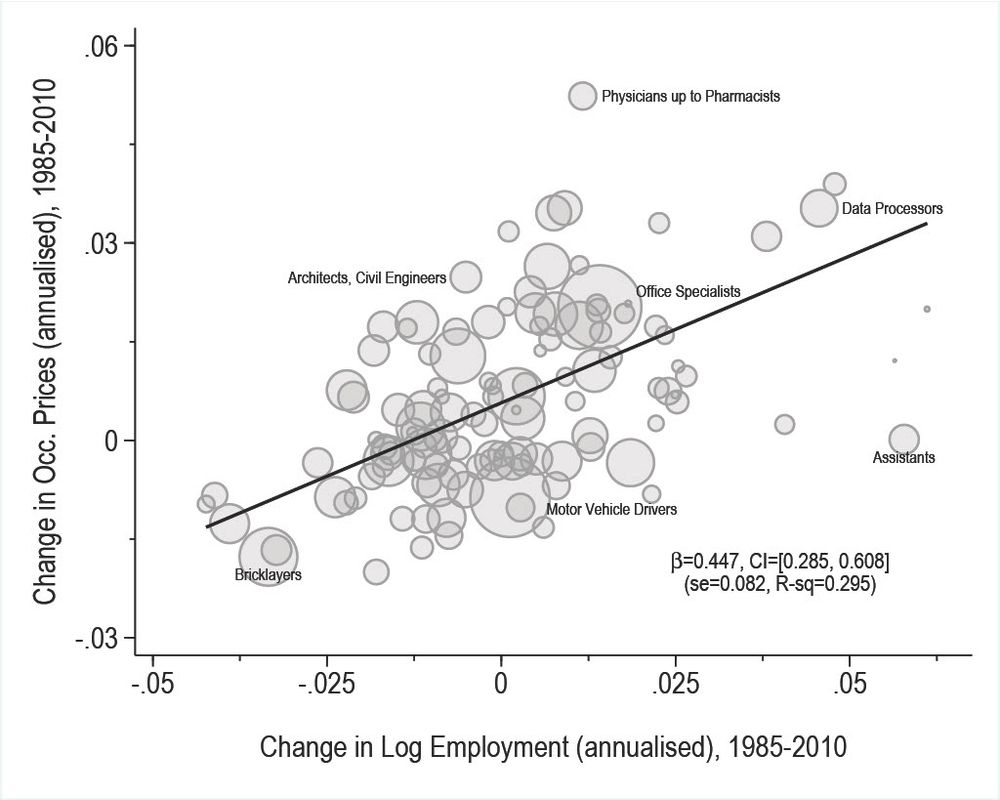
5/ We use German panel data tracking career moves.
[1985-2010] Some occupations adjusted to shocks via jobs (e.g. assistants), others via wages.
What explains this? Spoiler: elasticity matters.
[1985-2010] Some occupations adjusted to shocks via jobs (e.g. assistants), others via wages.
What explains this? Spoiler: elasticity matters.
April 14, 2025 at 10:38 AM
5/ We use German panel data tracking career moves.
[1985-2010] Some occupations adjusted to shocks via jobs (e.g. assistants), others via wages.
What explains this? Spoiler: elasticity matters.
[1985-2010] Some occupations adjusted to shocks via jobs (e.g. assistants), others via wages.
What explains this? Spoiler: elasticity matters.
4/ We develop a tractable equilibrium model of the labour market that accounts for this heterogeneity. It helps us:
1️⃣ explain historical employment & wage shifts
2️⃣ project responses to future automation shocks
1️⃣ explain historical employment & wage shifts
2️⃣ project responses to future automation shocks
April 14, 2025 at 10:38 AM
4/ We develop a tractable equilibrium model of the labour market that accounts for this heterogeneity. It helps us:
1️⃣ explain historical employment & wage shifts
2️⃣ project responses to future automation shocks
1️⃣ explain historical employment & wage shifts
2️⃣ project responses to future automation shocks
3/ Labour supply elasticities differ not just by job but by job pair.
For example, workers in laboratory medicine may shift quickly into human medicine if wages rise – but carpenters into IT? Much harder.
For example, workers in laboratory medicine may shift quickly into human medicine if wages rise – but carpenters into IT? Much harder.
April 14, 2025 at 10:38 AM
3/ Labour supply elasticities differ not just by job but by job pair.
For example, workers in laboratory medicine may shift quickly into human medicine if wages rise – but carpenters into IT? Much harder.
For example, workers in laboratory medicine may shift quickly into human medicine if wages rise – but carpenters into IT? Much harder.
2/ Not all jobs are equally “elastic”. Some (e.g. doctors) have rigid labour supply – higher wages don’t attract many new workers.
Others (e.g. assistants) are flexible – wage rises boost employment.
Others (e.g. assistants) are flexible – wage rises boost employment.
April 14, 2025 at 10:38 AM
2/ Not all jobs are equally “elastic”. Some (e.g. doctors) have rigid labour supply – higher wages don’t attract many new workers.
Others (e.g. assistants) are flexible – wage rises boost employment.
Others (e.g. assistants) are flexible – wage rises boost employment.