



Andrey Petrov
@petrovchem.bsky.social
PhD AK Müller (FU Berlin)’22
Postdoc AK Hering-Junghans (LIKAT)’25
Low valent Pn-compounds and coordination chemistry
Postdoc AK Hering-Junghans (LIKAT)’25
Low valent Pn-compounds and coordination chemistry
Reposted by Andrey Petrov
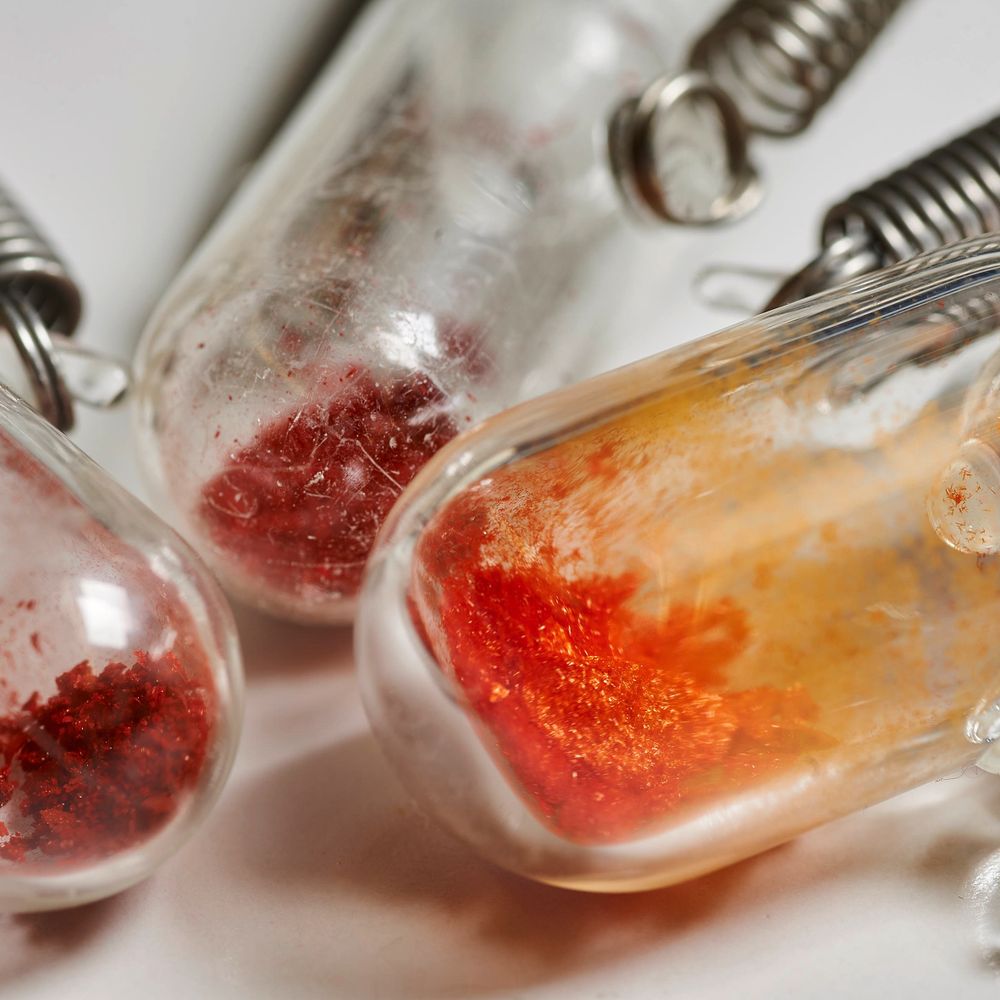
In his new paper in @daltontrans.rsc.org @kushikolla.bsky.social shows the synthesis of a new phosphaalkene and its coordination to Rh, including CH activition & different types of coordination. Congratulations to the team @likat.bsky.social @hering-lab.bsky.social pubs.rsc.org/en/content/a...
Coordination and C-H Activation of an Amidobis(phosphaalkene) Ligand at Rhodium(I)
Phosphaalkkenes are an underrepresented class of phosphorus-based ligands that hold great potential for the stabilisation of low-valent transition metal and main group fragments. We present the synthe...
pubs.rsc.org
July 24, 2025 at 9:08 AM
In his new paper in @daltontrans.rsc.org @kushikolla.bsky.social shows the synthesis of a new phosphaalkene and its coordination to Rh, including CH activition & different types of coordination. Congratulations to the team @likat.bsky.social @hering-lab.bsky.social pubs.rsc.org/en/content/a...
Reposted by Andrey Petrov
🎉 Just out in Nature Comm @natcomms.nature.com
"Unleashing phosphorus mononitride"
👉 www.nature.com/articles/s41...
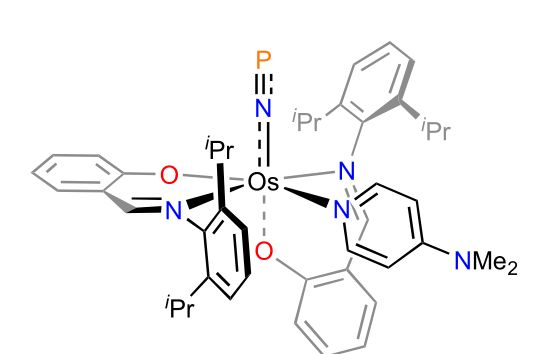
Spearheaded by the Reinholdt group (Lund), we find that the elusive P≡N molecule finds new life in an Os complex and unlocks unique [NPS₂]²⁻, [NPCl]⁻, and aromatic [PN₄]⁻ species.
"Unleashing phosphorus mononitride"
👉 www.nature.com/articles/s41...
Spearheaded by the Reinholdt group (Lund), we find that the elusive P≡N molecule finds new life in an Os complex and unlocks unique [NPS₂]²⁻, [NPCl]⁻, and aromatic [PN₄]⁻ species.
July 1, 2025 at 12:29 PM
🎉 Just out in Nature Comm @natcomms.nature.com
"Unleashing phosphorus mononitride"
👉 www.nature.com/articles/s41...
Spearheaded by the Reinholdt group (Lund), we find that the elusive P≡N molecule finds new life in an Os complex and unlocks unique [NPS₂]²⁻, [NPCl]⁻, and aromatic [PN₄]⁻ species.
"Unleashing phosphorus mononitride"
👉 www.nature.com/articles/s41...
Spearheaded by the Reinholdt group (Lund), we find that the elusive P≡N molecule finds new life in an Os complex and unlocks unique [NPS₂]²⁻, [NPCl]⁻, and aromatic [PN₄]⁻ species.
Reposted by Andrey Petrov
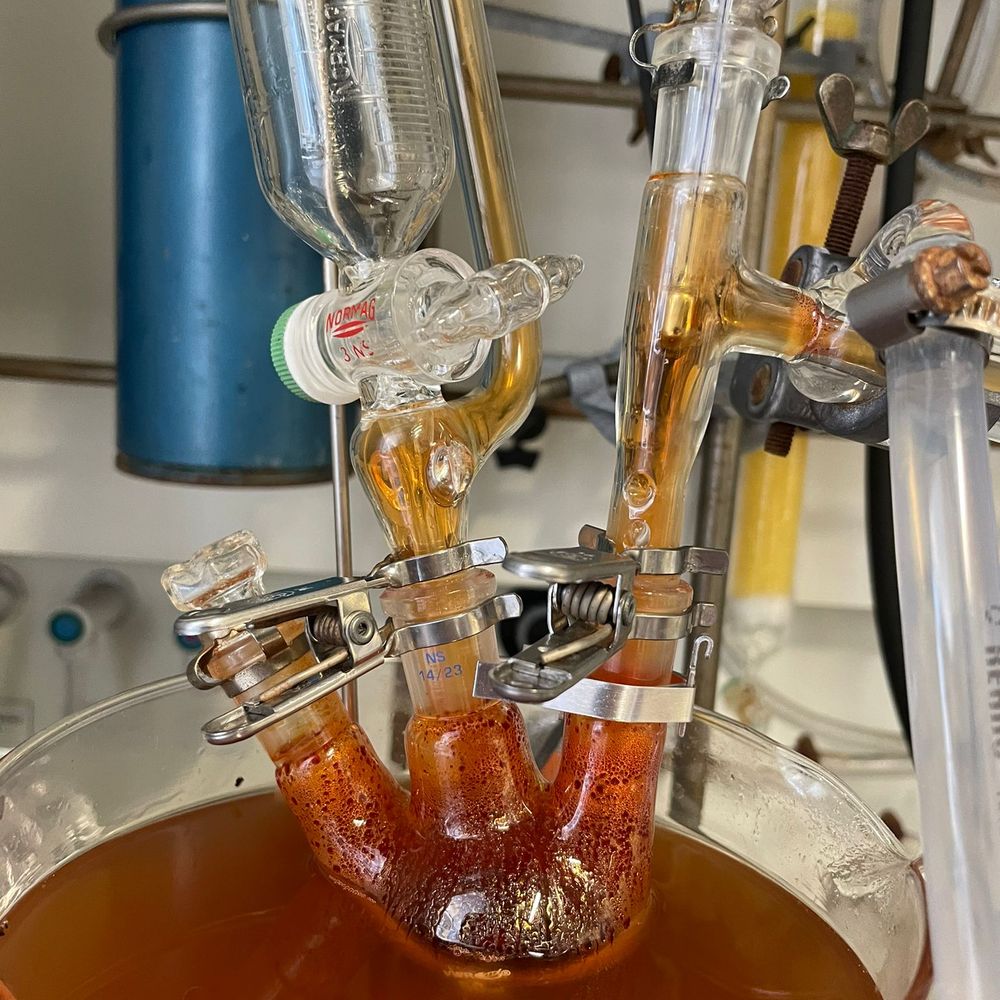
Excited to kick off this new account with great news: our latest work just appeared in Angewandte Chemie (onlinelibrary.wiley.com/doi/10.1002/...)! Huge thanks to our fantastic collaborators from the groups of Florian Weigend, Xulian Xie, and Xue-Bin Wang!
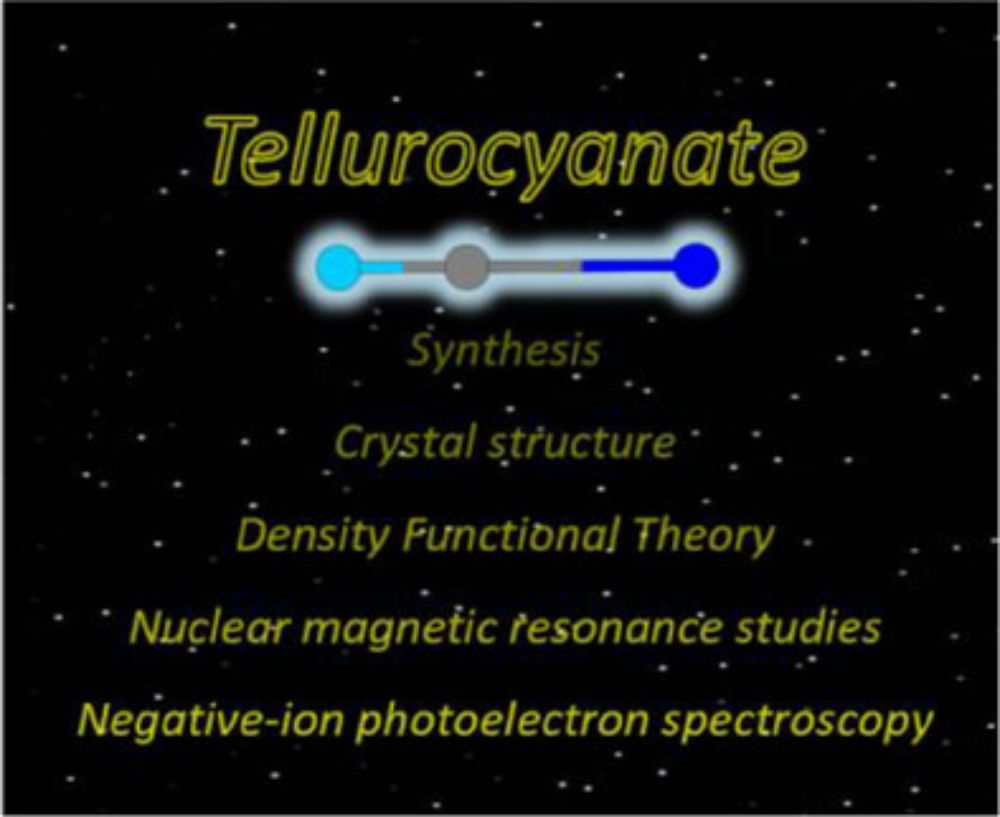
A Thorough Characterization of the Tellurocyanate Anion
[K@crypt-222][TeCN] was synthesized from KCN, Te, and crypt-222 in acetone. We discuss fundamental properties of [TeCN]−: Single crystal X-ray diffraction, nuclear magnetic resonance (13C, 15N, 125Te...
onlinelibrary.wiley.com
June 4, 2025 at 6:59 AM
Excited to kick off this new account with great news: our latest work just appeared in Angewandte Chemie (onlinelibrary.wiley.com/doi/10.1002/...)! Huge thanks to our fantastic collaborators from the groups of Florian Weigend, Xulian Xie, and Xue-Bin Wang!
Reposted by Andrey Petrov
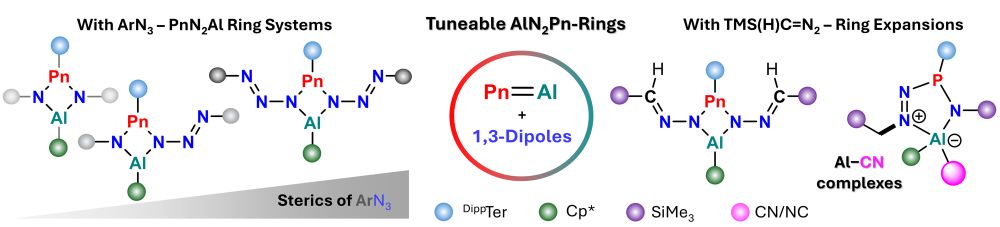
Rreactivity of Pnictaalumenes towards 1,3-Dipole Molecules fresh out in @angewandtechemie.bsky.social Tim, Edgar and Leonie uncover unique insertion chemsitry giving a plethora of Al,P,N-heterocycles! Again a fruitful collaboration with the Braunschweig Group!
doi.org/10.1002/anie...
doi.org/10.1002/anie...
April 10, 2025 at 3:21 PM
Rreactivity of Pnictaalumenes towards 1,3-Dipole Molecules fresh out in @angewandtechemie.bsky.social Tim, Edgar and Leonie uncover unique insertion chemsitry giving a plethora of Al,P,N-heterocycles! Again a fruitful collaboration with the Braunschweig Group!
doi.org/10.1002/anie...
doi.org/10.1002/anie...
Reposted by Andrey Petrov
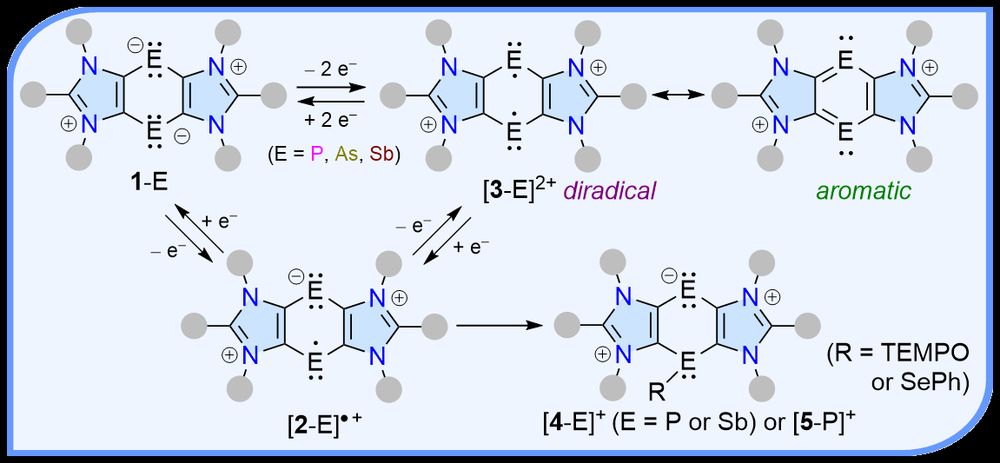
Reversible single-electron-transfer (SET) in #maingroup systems—cyclic pnictogen radicals—analogs of aryl radical anions in Birch reductions— @angewandtechemie.bsky.social Congratulations to Henric and all @ghadwalgroup.bsky.social
@basdebruin.bsky.social onlinelibrary.wiley.com/doi/10.1002/...
@basdebruin.bsky.social onlinelibrary.wiley.com/doi/10.1002/...
March 31, 2025 at 8:05 AM
Reversible single-electron-transfer (SET) in #maingroup systems—cyclic pnictogen radicals—analogs of aryl radical anions in Birch reductions— @angewandtechemie.bsky.social Congratulations to Henric and all @ghadwalgroup.bsky.social
@basdebruin.bsky.social onlinelibrary.wiley.com/doi/10.1002/...
@basdebruin.bsky.social onlinelibrary.wiley.com/doi/10.1002/...
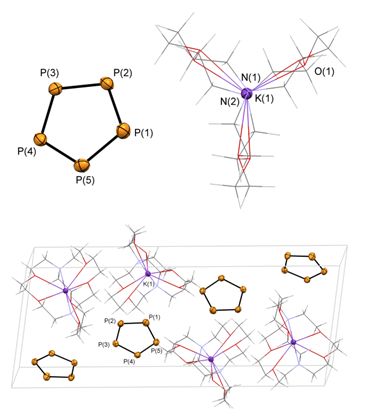
Together with @muellergroup.bsky.social we elucidated the molecular structure of "naked" cyclo-P5- in the crystal! Special thanks to Mirjam and Prof. Corzilius for their help with 31P ssNMR studies.
Read our @angewandtechemie.bsky.social commuinaction here: doi.org/10.1002/anie...
Read our @angewandtechemie.bsky.social commuinaction here: doi.org/10.1002/anie...
March 28, 2025 at 3:45 PM
Together with @muellergroup.bsky.social we elucidated the molecular structure of "naked" cyclo-P5- in the crystal! Special thanks to Mirjam and Prof. Corzilius for their help with 31P ssNMR studies.
Read our @angewandtechemie.bsky.social commuinaction here: doi.org/10.1002/anie...
Read our @angewandtechemie.bsky.social commuinaction here: doi.org/10.1002/anie...
Reposted by Andrey Petrov
Happy to share our recent #ChemEurJ paper on small molecule activation with dinuclear zirconocenes. Major contributions came from our former technician Hanan! Congratulations to the team @likat.bsky.social chemistry-europe.onlinelibrary.wiley.com/doi/10.1002/...
The Dinuclear Zirconocene Complex [(Cp2Zr)2(µ‐Me)(µ‐C2Ph)] as a Platform for Small Molecule Activation
The dinuclear title compound [(Cp2Zr)2(µ-Me)(µ-C2Ph)] 5 was prepared from a zirconocene alkynyl methyl complex and Rosenthal’s zirconocene source [Cp2Zr(py)(h2-Me3SiC2SiMe3)] in a formal comproportio....
chemistry-europe.onlinelibrary.wiley.com
March 25, 2025 at 6:31 AM
Happy to share our recent #ChemEurJ paper on small molecule activation with dinuclear zirconocenes. Major contributions came from our former technician Hanan! Congratulations to the team @likat.bsky.social chemistry-europe.onlinelibrary.wiley.com/doi/10.1002/...
Reposted by Andrey Petrov
Ayu is keeping it up! This piece is about ArPCN- transfer to give Germylenes and phosphapnictanes! Thanks @maltefischer.bsky.social and @fabiandankert.bsky.social for their help! Thanks Organomteallics for the smooth proceedings! #31p #phosphorus
pubs.acs.org/doi/10.1021/...
pubs.acs.org/doi/10.1021/...
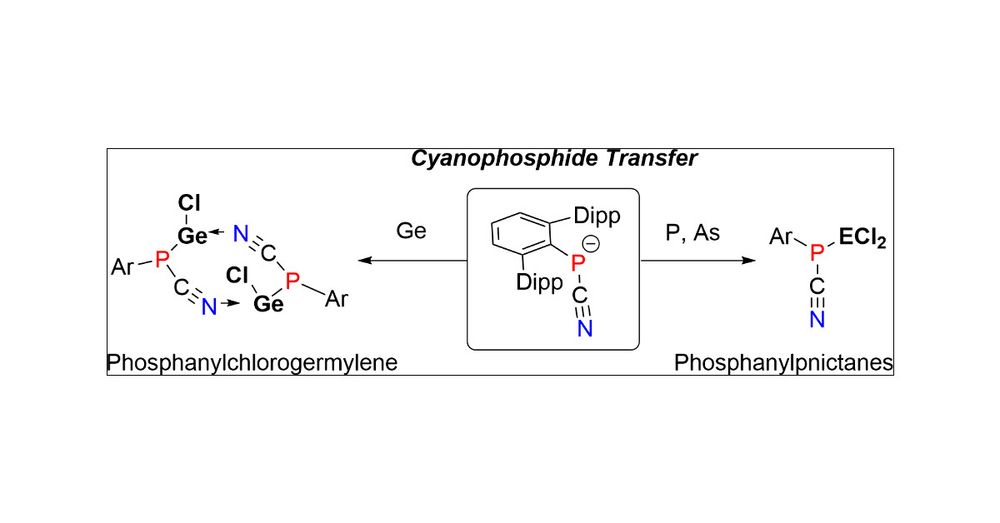
Flash Communication: Cyanophosphide Transfer Reactions
Cyanophosphides of the general form [RPCN]− can be viewed as cyanide adducts of phosphinidenes and are phosphorus species in the (+1)-oxidation state. We have recently reported on the stable cyanophosphide [DippTerPCN]K (DippTer = 2,6-Dipp2C6H3, Dipp = 2,6-iPrC6H3) and now investigate its reactions with ECln (E = Ge, n = 2; E = P, As, n = 3) in either salt metathesis or base-assisted dehydrohalogenation reactions. In the case of GeCl2, salt metathesis with [DippTerPCN]K afforded the dimer of a chlorogermylene [DippTerP(CN)GeCl]2. When only 0.5 equiv of GeCl2 was used, the diphosphanylgermylene [DippTerP(CN)]2Ge was generated in solution. With ECl3 (E = P, As), facile cyanophosphide transfer was achieved from DippTerP(H)CN in NEt3-assisted dehydrohalogenation, giving diphosphanes or arsaphosphanes of the type DippTerP(CN)ECl2 (E = P, As), respectively.
pubs.acs.org
March 17, 2025 at 3:23 PM
Ayu is keeping it up! This piece is about ArPCN- transfer to give Germylenes and phosphapnictanes! Thanks @maltefischer.bsky.social and @fabiandankert.bsky.social for their help! Thanks Organomteallics for the smooth proceedings! #31p #phosphorus
pubs.acs.org/doi/10.1021/...
pubs.acs.org/doi/10.1021/...
Reposted by Andrey Petrov
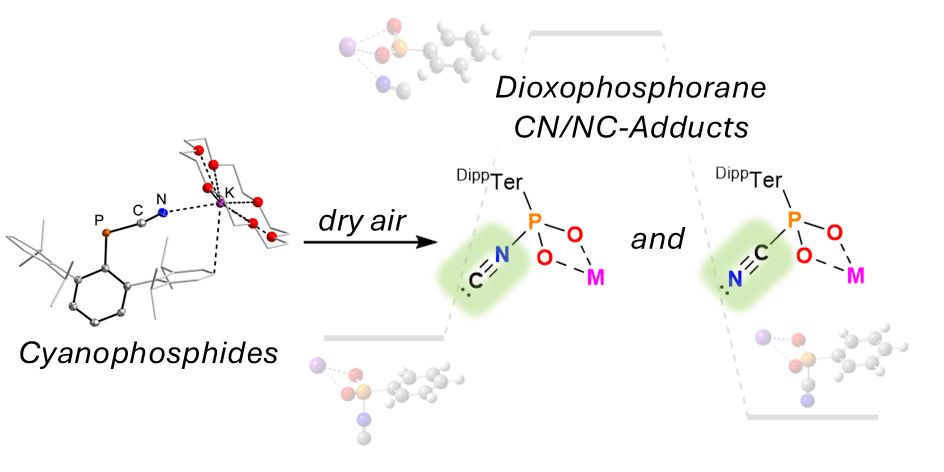
Ayu’s work on CN/NC-isomerism in Dioxophosphoranes is just out in Chem.Sci. Here we show that Cyanophosphides can be cleanly oxidized with O2, giving [ArPO2(CN)]-. Surprisingly both, cyanide and isocyanide form simultaneously! Super exited about this! @likat.bsky.social
pubs.rsc.org/en/content/a...
pubs.rsc.org/en/content/a...
March 13, 2025 at 7:45 AM
Ayu’s work on CN/NC-isomerism in Dioxophosphoranes is just out in Chem.Sci. Here we show that Cyanophosphides can be cleanly oxidized with O2, giving [ArPO2(CN)]-. Surprisingly both, cyanide and isocyanide form simultaneously! Super exited about this! @likat.bsky.social
pubs.rsc.org/en/content/a...
pubs.rsc.org/en/content/a...