




M. Ushio
@ong8181.bsky.social
An ecologist at HKUST in Hong Kong. Ecosystem ecology, environmental DNA, statistics, and many others | 香港科技大学、生態系動態、環境DNA、統計解析 | 野外の生態系動態を理解したい
さきがけ時代にやっていた京都のリアル田んぼでのモニタリング研究の論文が Agriculture, Ecosystems & Environment 誌から発表されました。
doi.org/10.1016/j.ag...
doi.org/10.1016/j.ag...
November 20, 2025 at 6:41 AM
さきがけ時代にやっていた京都のリアル田んぼでのモニタリング研究の論文が Agriculture, Ecosystems & Environment 誌から発表されました。
doi.org/10.1016/j.ag...
doi.org/10.1016/j.ag...
We have posted our second Hong Kong paper on bioRxiv! We developed species-specific qPCR primers and a TaqMan probe for detecting Chinese white dolphins. The specificity and sensitivity were meticulously tested.
Detection of environmental DNA of the Indo-Pacific humpback dolphins in Hong Kong waters using quantitative PCR https://www.biorxiv.org/content/10.1101/2025.10.30.685690v1
November 3, 2025 at 12:51 AM
We have posted our second Hong Kong paper on bioRxiv! We developed species-specific qPCR primers and a TaqMan probe for detecting Chinese white dolphins. The specificity and sensitivity were meticulously tested.
Our first Hong Kong paper was published in Environmental DNA! onlinelibrary.wiley.com/doi/10.1002/...
We developed cetacean-specific eDNA primers, named µCeta. Please try it if you are interested in cetacean eDNA metabarcoding!
We developed cetacean-specific eDNA primers, named µCeta. Please try it if you are interested in cetacean eDNA metabarcoding!

μCeta: A Set of Cetacean‐Specific Primers for Environmental DNA Metabarcoding With Minimal Amplification of Non‐Target Vertebrates
Cetacean eDNA metabarcoding results from the aquarium pool samples using new cetacean-specific primers. μCeta shows superior performance to detect and differentiate different cetacean species.
onlinelibrary.wiley.com
October 8, 2025 at 12:46 AM
Our first Hong Kong paper was published in Environmental DNA! onlinelibrary.wiley.com/doi/10.1002/...
We developed cetacean-specific eDNA primers, named µCeta. Please try it if you are interested in cetacean eDNA metabarcoding!
We developed cetacean-specific eDNA primers, named µCeta. Please try it if you are interested in cetacean eDNA metabarcoding!
Reposted by M. Ushio

Contrasting ecological communities in rice paddy fields under conventional and no-fertilizer farming practices https://www.biorxiv.org/content/10.1101/2025.08.12.669982v1
August 15, 2025 at 11:31 PM
Contrasting ecological communities in rice paddy fields under conventional and no-fertilizer farming practices https://www.biorxiv.org/content/10.1101/2025.08.12.669982v1
Foraging ants as liquid brains www.pnas.org/doi/10.1073/...

Foraging ants as liquid brains: Movement heterogeneity shapes collective efficiency | PNAS
Liquid brains conceptualize living systems that operate without central control, where
collective outcomes emerge from local and dynamic interactio...
www.pnas.org
August 6, 2025 at 12:40 AM
Foraging ants as liquid brains www.pnas.org/doi/10.1073/...
Ecosystem-based reservoir computing. Hypothesis paper
sciencedirect.com/science/arti...
sciencedirect.com/science/arti...

Ecosystem-based reservoir computing. Hypothesis paper
Reservoir computing (RC) has emerged as a powerful computational paradigm, leveraging the intrinsic dynamics of complex systems to process temporal da…
sciencedirect.com
July 27, 2025 at 9:15 AM
Ecosystem-based reservoir computing. Hypothesis paper
sciencedirect.com/science/arti...
sciencedirect.com/science/arti...
Reposted by M. Ushio
🙏 And just as an addition: don‘t use these primers for bulk sample metabarcoding. There others are ways better (we recommend fwhF2/fwhR2n as a good solution; further solutions like BF2/BR3 or mlCOI with dgHCO exist)

Take a deep dive into this article by @leeselab.bsky.social focusing on new primers for #eDNA metabarcoding, proving that they significantly boost detection of benthic invertebrates in freshwater.
Targeting the right sequences can overcome nontarget amplification
👉 bit.ly/4dC2rlT
#science #water
Targeting the right sequences can overcome nontarget amplification
👉 bit.ly/4dC2rlT
#science #water

Improved freshwater macroinvertebrate detection from environmental DNA through minimized nontarget amplification
Capturing benthic invertebrate biodiversity from environmental DNA (eDNA) isolated from water is difficult because of abundant nontarget taxa PCR amplification. A new primer combination maximizes tar...
bit.ly
June 27, 2025 at 12:03 PM
🙏 And just as an addition: don‘t use these primers for bulk sample metabarcoding. There others are ways better (we recommend fwhF2/fwhR2n as a good solution; further solutions like BF2/BR3 or mlCOI with dgHCO exist)
Plastic bag bans and fees reduce harmful bag litter on shorelines. www.science.org/doi/10.1126/...

Plastic bag bans and fees reduce harmful bag litter on shorelines
Plastic pollution threatens marine and freshwater ecosystems and the services they provide. Although plastic bag bans and taxes are increasingly implemented worldwide, their effectiveness in reducing ...
www.science.org
June 19, 2025 at 11:55 PM
Plastic bag bans and fees reduce harmful bag litter on shorelines. www.science.org/doi/10.1126/...
先週、日本にいましたが、ついに「研究のために潜る」を達成しました。海綿探してます

June 12, 2025 at 1:40 PM
先週、日本にいましたが、ついに「研究のために潜る」を達成しました。海綿探してます
Reposted by M. Ushio
Recovering historical fish eDNA from museum-preserved Antarctic filter feeders via non-destructive metabarcoding. https://www.biorxiv.org/content/10.1101/2025.06.07.656140v1
June 12, 2025 at 5:33 AM
Recovering historical fish eDNA from museum-preserved Antarctic filter feeders via non-destructive metabarcoding. https://www.biorxiv.org/content/10.1101/2025.06.07.656140v1
Reposted by M. Ushio
Contrasted effects of human pressure on biodiversity in the UK: a multi-taxonomic assessment using airborne environmental DNA https://www.biorxiv.org/content/10.1101/2025.05.01.651649v1
May 7, 2025 at 11:31 PM
Contrasted effects of human pressure on biodiversity in the UK: a multi-taxonomic assessment using airborne environmental DNA https://www.biorxiv.org/content/10.1101/2025.05.01.651649v1
随分前に受理されていたリザバー計算の和文総説(+生態リザバーの紹介)、ようやく公開されました!
jstage.jst.go.jp/article/seit...
jstage.jst.go.jp/article/seit...
jstage.jst.go.jp
April 21, 2025 at 2:08 AM
随分前に受理されていたリザバー計算の和文総説(+生態リザバーの紹介)、ようやく公開されました!
jstage.jst.go.jp/article/seit...
jstage.jst.go.jp/article/seit...
Reposted by M. Ushio
Flexible Methods for Species Distribution Modeling with Small Samples https://www.biorxiv.org/content/10.1101/2025.04.03.647025v1
April 9, 2025 at 4:31 AM
Flexible Methods for Species Distribution Modeling with Small Samples https://www.biorxiv.org/content/10.1101/2025.04.03.647025v1
Reposted by M. Ushio

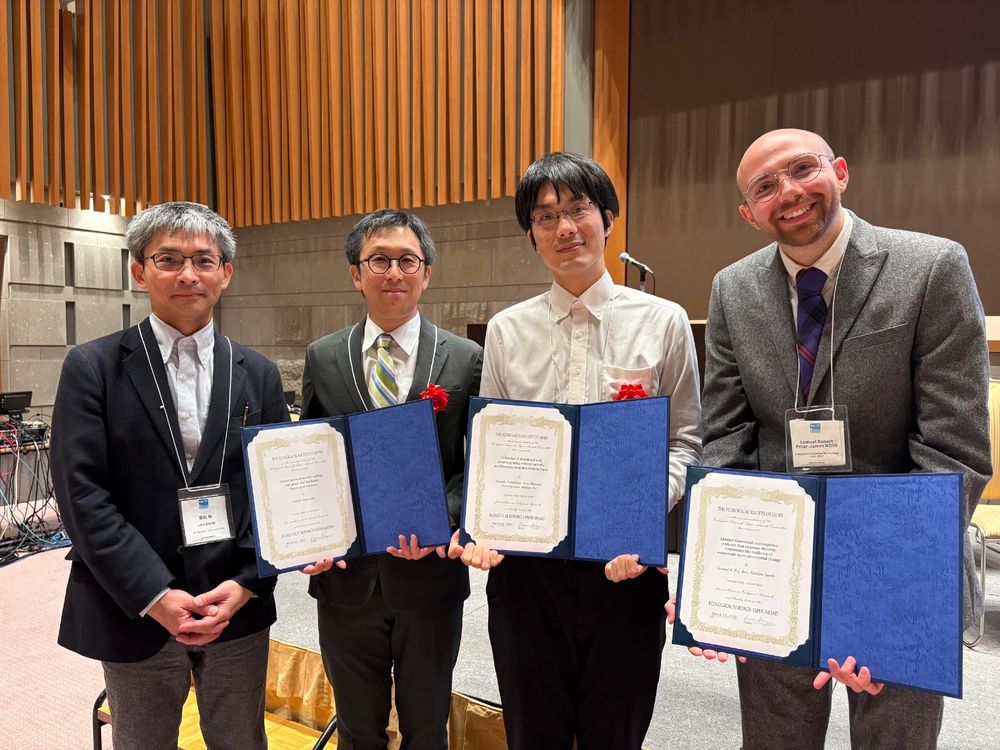
We were honored to celebrate with our Awardees at the ceremony. Congratulations to all!👏
From left to right: Hiroshi Tomimatsu (EiC of Ecological Research @hrstm.bsky.social ), Kohmei Kadowaki, Naoyuki Nakahama @naoyukinkhm.bsky.social, Samuel R. P.-J. Ross
#ESJ72 #ERPaperAward
From left to right: Hiroshi Tomimatsu (EiC of Ecological Research @hrstm.bsky.social ), Kohmei Kadowaki, Naoyuki Nakahama @naoyukinkhm.bsky.social, Samuel R. P.-J. Ross
#ESJ72 #ERPaperAward
March 15, 2025 at 12:08 PM
We were honored to celebrate with our Awardees at the ceremony. Congratulations to all!👏
From left to right: Hiroshi Tomimatsu (EiC of Ecological Research @hrstm.bsky.social ), Kohmei Kadowaki, Naoyuki Nakahama @naoyukinkhm.bsky.social, Samuel R. P.-J. Ross
#ESJ72 #ERPaperAward
From left to right: Hiroshi Tomimatsu (EiC of Ecological Research @hrstm.bsky.social ), Kohmei Kadowaki, Naoyuki Nakahama @naoyukinkhm.bsky.social, Samuel R. P.-J. Ross
#ESJ72 #ERPaperAward
Reposted by M. Ushio
μCeta: a set of cetacean-specific primers for environmental DNA metabarcoding with minimal amplification of non-target vertebrates https://www.biorxiv.org/content/10.1101/2025.03.19.644246v1
March 20, 2025 at 4:31 PM
μCeta: a set of cetacean-specific primers for environmental DNA metabarcoding with minimal amplification of non-target vertebrates https://www.biorxiv.org/content/10.1101/2025.03.19.644246v1
Our new preprint published! (My first Hong Kong paper!)
We developed a new eDNA primer set, named µCeta, to detect cetaceans. It can avoid amplification of non-target eDNA such as human and fishes, enabling more sensitive and efficient detection of cetacean eDNA. www.biorxiv.org/content/10.1...
We developed a new eDNA primer set, named µCeta, to detect cetaceans. It can avoid amplification of non-target eDNA such as human and fishes, enabling more sensitive and efficient detection of cetacean eDNA. www.biorxiv.org/content/10.1...

μCeta: a set of cetacean-specific primers for environmental DNA metabarcoding with minimal amplification of non-target vertebrates
Biodiversity monitoring is crucial for understanding ecosystem dynamics and species distributions, particularly in the context of anthropogenic impacts and climate change. Cetaceans, as key indicator ...
www.biorxiv.org
March 21, 2025 at 12:37 AM
Our new preprint published! (My first Hong Kong paper!)
We developed a new eDNA primer set, named µCeta, to detect cetaceans. It can avoid amplification of non-target eDNA such as human and fishes, enabling more sensitive and efficient detection of cetacean eDNA. www.biorxiv.org/content/10.1...
We developed a new eDNA primer set, named µCeta, to detect cetaceans. It can avoid amplification of non-target eDNA such as human and fishes, enabling more sensitive and efficient detection of cetacean eDNA. www.biorxiv.org/content/10.1...
The information of our symposium at The 11th EAFES (July 2025 in Tokyo) is now open: eafes2025.com/symposia.htm...
There are four available oral presentation slots in our symposium. Please submit your eDNA talk to our symposium!
There are four available oral presentation slots in our symposium. Please submit your eDNA talk to our symposium!
The 11th EAFES International Congress | Official Site
The 11th EAFES International Congress Official Site.
eafes2025.com
March 14, 2025 at 4:36 AM
The information of our symposium at The 11th EAFES (July 2025 in Tokyo) is now open: eafes2025.com/symposia.htm...
There are four available oral presentation slots in our symposium. Please submit your eDNA talk to our symposium!
There are four available oral presentation slots in our symposium. Please submit your eDNA talk to our symposium!
Reposted by M. Ushio

This is a ‘lickometer’.
Researchers have used it to understand how the rodent brain might be coding kinematic, reward, and difficulty parameters, particularly while moving around.
buff.ly/jDxn0DX
Researchers have used it to understand how the rodent brain might be coding kinematic, reward, and difficulty parameters, particularly while moving around.
buff.ly/jDxn0DX
March 8, 2025 at 9:21 AM
This is a ‘lickometer’.
Researchers have used it to understand how the rodent brain might be coding kinematic, reward, and difficulty parameters, particularly while moving around.
buff.ly/jDxn0DX
Researchers have used it to understand how the rodent brain might be coding kinematic, reward, and difficulty parameters, particularly while moving around.
buff.ly/jDxn0DX
Our paper in eLife was highlighted in this commentary article "Quantifying species interactions in the Anthropocene"
www.nature.com/articles/s44...
www.nature.com/articles/s44...
Quantifying species interactions in the Anthropocene - Nature Reviews Biodiversity
Nature Reviews Biodiversity - Quantifying species interactions in the Anthropocene
www.nature.com
February 18, 2025 at 2:41 AM
Our paper in eLife was highlighted in this commentary article "Quantifying species interactions in the Anthropocene"
www.nature.com/articles/s44...
www.nature.com/articles/s44...
Finished Hong Kong Marathon in 3:57!

February 9, 2025 at 3:06 AM
Finished Hong Kong Marathon in 3:57!
Young and adult Chinese White Dolphins
January 18, 2025 at 2:19 AM
Young and adult Chinese White Dolphins
We sighted Chinese White Dolphins in our winter Lantau survey! (it was close to the Hong Kong–Zhuhai–Macau Bridge)
January 18, 2025 at 2:18 AM
We sighted Chinese White Dolphins in our winter Lantau survey! (it was close to the Hong Kong–Zhuhai–Macau Bridge)

Just sign up and here's my first post
December 15, 2024 at 9:00 AM
Just sign up and here's my first post