




Ryan H Glaubke
@ocnogrphr.bsky.social
Postdoctoral researcher in the Paleo² Lab at The University of Arizona. Interested in past climates 🌎 and old oceans 🌊.
Outdoorsy. Reader. Audiophile. Soccer fan. Cat dad. Opinions subject to change. https://www.ryanglaubke.com
Outdoorsy. Reader. Audiophile. Soccer fan. Cat dad. Opinions subject to change. https://www.ryanglaubke.com
Pinned
Ryan H Glaubke
@ocnogrphr.bsky.social
· Aug 6

Elevated shallow water salinity in the deglacial Indian Ocean was sourced from the deep - Nature Geoscience
Increased salinity of Subantarctic Mode Water during the initial phase of the Last Deglaciation could have enhanced deep water formation in the North Atlantic, according to proxy records from a sedime...
www.nature.com
🚨 New Paper Alert! 🚨
We reconstructed past ocean salinity in one of the largest Subantarctic Mode Water production centers on the planet: the southeast Indian Ocean. We found a rapid increase in SAMW salinity during the Last Deglaciation.
Where did this salt come from? We argue the deep ocean. 🧪🌊
We reconstructed past ocean salinity in one of the largest Subantarctic Mode Water production centers on the planet: the southeast Indian Ocean. We found a rapid increase in SAMW salinity during the Last Deglaciation.
Where did this salt come from? We argue the deep ocean. 🧪🌊
Reposted by Ryan H Glaubke
Absolutely delighted to announce the publication of our benthic foraminifera trace element compilation + revised multivariate calibrations: Nauter-Alves et al. (2025):
agupubs.onlinelibrary.wiley.com/doi/10.1029/...
With @willerstorfi.bsky.social @mudwaterclimate.bsky.social and others
agupubs.onlinelibrary.wiley.com/doi/10.1029/...
With @willerstorfi.bsky.social @mudwaterclimate.bsky.social and others

Thermal and Non‐Thermal Controls on Benthic Foraminiferal Mg/Ca, Sr/Ca, B/Ca, and Mg/Li: Global Core‐Top Compilation, Revised Calibrations, and Application to the Geologic Record
We compile ∼1,500 core-top benthic foraminiferal Mg-Sr-B-Li/Ca measurements from five species and one genus to produce new calibrations Many benthic foraminiferal elemental systems require multiv...
agupubs.onlinelibrary.wiley.com
December 5, 2025 at 12:07 PM
Absolutely delighted to announce the publication of our benthic foraminifera trace element compilation + revised multivariate calibrations: Nauter-Alves et al. (2025):
agupubs.onlinelibrary.wiley.com/doi/10.1029/...
With @willerstorfi.bsky.social @mudwaterclimate.bsky.social and others
agupubs.onlinelibrary.wiley.com/doi/10.1029/...
With @willerstorfi.bsky.social @mudwaterclimate.bsky.social and others
Looking forward to seeing everyone at #AGU25 in New Orleans! If you're interested in past variability in the Indian Ocean, come find me Wednesday (PP33D) and let's chat 😁.
You can also find me at ~literally anywhere that sells a fried shrimp po'boy~. If you want to join, let's make lunch plans!
You can also find me at ~literally anywhere that sells a fried shrimp po'boy~. If you want to join, let's make lunch plans!
November 21, 2025 at 4:54 PM
Looking forward to seeing everyone at #AGU25 in New Orleans! If you're interested in past variability in the Indian Ocean, come find me Wednesday (PP33D) and let's chat 😁.
You can also find me at ~literally anywhere that sells a fried shrimp po'boy~. If you want to join, let's make lunch plans!
You can also find me at ~literally anywhere that sells a fried shrimp po'boy~. If you want to join, let's make lunch plans!
“The dash is a [normal] tool for constructing sentences! ...Part of what makes them popular, in fact, is that they can feel more casually human… we think and speak in thoughts, which interrupt and introduce and complicate one another in a neat little dance that creates larger, more complex ideas.”

With the Em Dash, A.I. Embraces a Fading Tradition
www.nytimes.com
September 18, 2025 at 8:51 PM
“The dash is a [normal] tool for constructing sentences! ...Part of what makes them popular, in fact, is that they can feel more casually human… we think and speak in thoughts, which interrupt and introduce and complicate one another in a neat little dance that creates larger, more complex ideas.”
What an incredibly fun time in India for #ICP15! All of the chats I last week have given such a burst of inspiration and energy. Between that and the safari, caving, and the invited talk at IISc… I’m so lucky to do what I do, and to do it with all of you!
Now, back to work.
Now, back to work.


September 8, 2025 at 5:48 PM
What an incredibly fun time in India for #ICP15! All of the chats I last week have given such a burst of inspiration and energy. Between that and the safari, caving, and the invited talk at IISc… I’m so lucky to do what I do, and to do it with all of you!
Now, back to work.
Now, back to work.
Reposted by Ryan H Glaubke

Since at least the time of Greek philosophers, many writers have discovered a deep, intuitive connection between walking, thinking, and writing.
Why Walking Helps Us Think
Since at least the time of Greek philosophers, many writers have discovered a deep, intuitive connection between walking, thinking, and writing.
www.newyorker.com
September 3, 2025 at 5:34 PM
Since at least the time of Greek philosophers, many writers have discovered a deep, intuitive connection between walking, thinking, and writing.
Reposted by Ryan H Glaubke
The Department of Energy hired five academics to raise doubts about climate change. 85+ climate experts (organized by @andrewdessler.com) reviewed their report. Our conclusion, detailed in 450 pages of analysis: it is biased, full of errors, and not fit to inform policy making.
DOEresponseSite
On July 29, 2025, the Department of Energy (DOE) published a report from its Climate Working Group (CWG). This report features prominently in the EPA's reconsideration of its 2009 Endangerment Finding...
sites.google.com
September 2, 2025 at 1:07 PM
The Department of Energy hired five academics to raise doubts about climate change. 85+ climate experts (organized by @andrewdessler.com) reviewed their report. Our conclusion, detailed in 450 pages of analysis: it is biased, full of errors, and not fit to inform policy making.

Reposted by Ryan H Glaubke

Doctors and advocates are warning of rising burn injuries and vector-borne diseases as climate change intensifies in Arizona. “We are pushing the climate into uncharted territory,” said Dr. Ryan Glaubke, a paleoclimatologist and UCS member, at a recent People’s Hearing event in Phoenix.
azmirror.com
July 11, 2025 at 4:08 PM
Doctors and advocates are warning of rising burn injuries and vector-borne diseases as climate change intensifies in Arizona. “We are pushing the climate into uncharted territory,” said Dr. Ryan Glaubke, a paleoclimatologist and UCS member, at a recent People’s Hearing event in Phoenix.
Reposted by Ryan H Glaubke

#ICP15 welcomes you if you are attending pre-conference workshops on #foraminifera #proxies @oscarbranson.bsky.social and #paleotemperature Antje Voelker 🙏🏼
Detailed programme 👇🏼
Detailed programme 👇🏼


August 30, 2025 at 2:47 AM
#ICP15 welcomes you if you are attending pre-conference workshops on #foraminifera #proxies @oscarbranson.bsky.social and #paleotemperature Antje Voelker 🙏🏼
Detailed programme 👇🏼
Detailed programme 👇🏼
Reposted by Ryan H Glaubke
V nice talk by @ocnogrphr.bsky.social this morning at the Indian Institute of Science #IISc on his recently published work on the deglacial “salty blob” in the southeastern Indian Ocean (www.nature.com/articles/s41...)

August 26, 2025 at 11:54 AM
V nice talk by @ocnogrphr.bsky.social this morning at the Indian Institute of Science #IISc on his recently published work on the deglacial “salty blob” in the southeastern Indian Ocean (www.nature.com/articles/s41...)
Reposted by Ryan H Glaubke
Earth scientists know a lot more about getting out of an ice age than going into one. We report an episode of AMOC slowdown at 115 thousand years ago that's likely astronomically forced (via sea-ice) and coincides with a delayed drawdown of atmospheric CO2 @natcomms.nature.com rdcu.be/eALD1

Abrupt weakening of deep Atlantic circulation at the last glacial inception - Nature Communications
Zhou et al. report an abrupt weakening of the Atlantic Meridional Overturning Circulation at the last glacial inception. The observed circulation slowdown could explain the delayed timing of the atmos...
www.nature.com
August 14, 2025 at 3:15 PM
Earth scientists know a lot more about getting out of an ice age than going into one. We report an episode of AMOC slowdown at 115 thousand years ago that's likely astronomically forced (via sea-ice) and coincides with a delayed drawdown of atmospheric CO2 @natcomms.nature.com rdcu.be/eALD1
For any @rfkuang.bsky.social fans, she has a new book coming out and, wouldn’t you believe it, it’s about postgraduates becoming disillusioned with the literal hellscape of the academy 👀
August 14, 2025 at 1:07 PM
For any @rfkuang.bsky.social fans, she has a new book coming out and, wouldn’t you believe it, it’s about postgraduates becoming disillusioned with the literal hellscape of the academy 👀
🚨 Another new paper! 🚨
My coauthors and I gathered data on four planktic foraminiferal species from 115 core tops in the Indian Ocean to test the question: does adding non thermal parameters to Mg/Ca calibrations make them "better" than temperature-only models?
Check out our work below! 🌊🧪
My coauthors and I gathered data on four planktic foraminiferal species from 115 core tops in the Indian Ocean to test the question: does adding non thermal parameters to Mg/Ca calibrations make them "better" than temperature-only models?
Check out our work below! 🌊🧪

Core-top constraints on the ecology and paleothermometry of planktic foraminifera in the Indian Ocean
The magnesium-to‑calcium ratio (Mg/Ca) of fossil foraminifera is a widely used geochemical proxy for reconstructing past ocean temperatures. Culturing…
www.sciencedirect.com
August 13, 2025 at 9:16 PM
🚨 Another new paper! 🚨
My coauthors and I gathered data on four planktic foraminiferal species from 115 core tops in the Indian Ocean to test the question: does adding non thermal parameters to Mg/Ca calibrations make them "better" than temperature-only models?
Check out our work below! 🌊🧪
My coauthors and I gathered data on four planktic foraminiferal species from 115 core tops in the Indian Ocean to test the question: does adding non thermal parameters to Mg/Ca calibrations make them "better" than temperature-only models?
Check out our work below! 🌊🧪
Reposted by Ryan H Glaubke
Small update: NSF source confirms that new funding opportunities at the agency are currently frozen, which is what the EO dictates (until a new review policy is implemented). Source is hopeful the freeze will be lifted in the coming days though.
There are a lot of details in yesterday's sweeping executive order, but the bottom line is that it gives political appointees immense power over scientific grants, which have until now been stewarded by career civil servants and experts.
My reporting:
www.nature.com/articles/d41...
My reporting:
www.nature.com/articles/d41...

Trump order gives political appointees vast powers over research grants
Researchers are alarmed that the move might upend a long-standing tradition of peer-review for grants.
www.nature.com
August 12, 2025 at 3:33 PM
Small update: NSF source confirms that new funding opportunities at the agency are currently frozen, which is what the EO dictates (until a new review policy is implemented). Source is hopeful the freeze will be lifted in the coming days though.
“…states need standardized and legible information to write good rules and to make good decisions. The original meaning of the word ‘statistics’ is ‘information about the state.’ Without statistics, a state cannot operate effectively. It cannot establish good rules. It cannot make good decisions.”

Opinion | America Will Suffer From Trump’s Assault on Facts
www.nytimes.com
August 7, 2025 at 3:07 PM
“…states need standardized and legible information to write good rules and to make good decisions. The original meaning of the word ‘statistics’ is ‘information about the state.’ Without statistics, a state cannot operate effectively. It cannot establish good rules. It cannot make good decisions.”
PREACH

As a physicist I can easily calculate time dilation from relativistic motion (time slows when you're moving fast) or proximity to a massive object (time slows in gravity) but I have yet to find a solution for emotional time dilation (the task takes five minutes to complete but six weeks to start) 🫠
August 6, 2025 at 7:17 PM
PREACH
🚨 New Paper Alert! 🚨
We reconstructed past ocean salinity in one of the largest Subantarctic Mode Water production centers on the planet: the southeast Indian Ocean. We found a rapid increase in SAMW salinity during the Last Deglaciation.
Where did this salt come from? We argue the deep ocean. 🧪🌊
We reconstructed past ocean salinity in one of the largest Subantarctic Mode Water production centers on the planet: the southeast Indian Ocean. We found a rapid increase in SAMW salinity during the Last Deglaciation.
Where did this salt come from? We argue the deep ocean. 🧪🌊
Elevated shallow water salinity in the deglacial Indian Ocean was sourced from the deep - Nature Geoscience
Increased salinity of Subantarctic Mode Water during the initial phase of the Last Deglaciation could have enhanced deep water formation in the North Atlantic, according to proxy records from a sedime...
www.nature.com
August 6, 2025 at 4:31 PM
🚨 New Paper Alert! 🚨
We reconstructed past ocean salinity in one of the largest Subantarctic Mode Water production centers on the planet: the southeast Indian Ocean. We found a rapid increase in SAMW salinity during the Last Deglaciation.
Where did this salt come from? We argue the deep ocean. 🧪🌊
We reconstructed past ocean salinity in one of the largest Subantarctic Mode Water production centers on the planet: the southeast Indian Ocean. We found a rapid increase in SAMW salinity during the Last Deglaciation.
Where did this salt come from? We argue the deep ocean. 🧪🌊
Reposted by Ryan H Glaubke

Sounds about right!

August 4, 2025 at 2:42 PM
Sounds about right!
Reposted by Ryan H Glaubke

Climate models have underestimated the departure of high temperature extremes from monthly means.
If we assume these model biases persist in future projections, then the climate models are also likely underestimating the magnitude of future high temperature extremes.
www.nature.com/articles/s43...
If we assume these model biases persist in future projections, then the climate models are also likely underestimating the magnitude of future high temperature extremes.
www.nature.com/articles/s43...
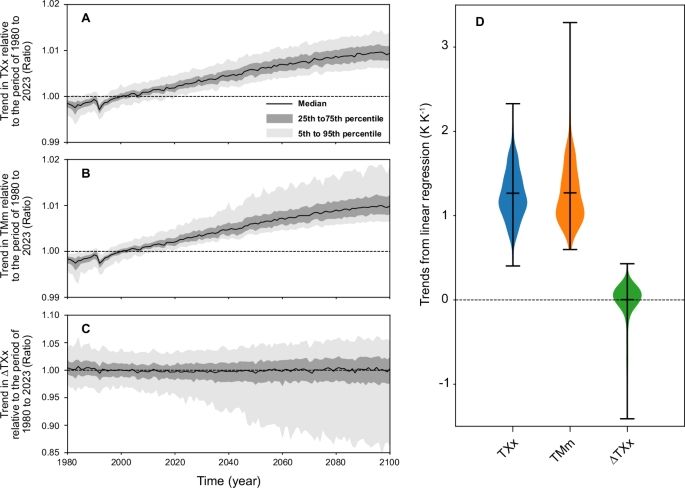
Historical model biases in monthly high temperature anomalies indicate under-estimation of future temperature extremes - Communications Earth & Environment
Models tend to underestimate mean monthly maximum temperature anomalies by 2-3% and extreme anomalies by 11-12% over the period 1980 and 2023, which could lead to temperatures 3 °C to 5 °C higher than...
www.nature.com
July 31, 2025 at 10:54 PM
Climate models have underestimated the departure of high temperature extremes from monthly means.
If we assume these model biases persist in future projections, then the climate models are also likely underestimating the magnitude of future high temperature extremes.
www.nature.com/articles/s43...
If we assume these model biases persist in future projections, then the climate models are also likely underestimating the magnitude of future high temperature extremes.
www.nature.com/articles/s43...
Reposted by Ryan H Glaubke
This @wired.com article is extremely timely for those of us in Tucson, Arizona, as we face the possibility of Amazon Web Services building a huge data center at our outskirts. Energy and water use for AI data centers are non-trivial. Read my thread below if you want to hear about our local story ⬇️

AI this, AI that, what about how much energy AI actually uses?
“It blows my mind that you can buy a car and know how many miles per gallon it consumes, yet we use all these AI tools every day and we have absolutely no efficiency metrics, emissions factors, nothing." From the experts:
“It blows my mind that you can buy a car and know how many miles per gallon it consumes, yet we use all these AI tools every day and we have absolutely no efficiency metrics, emissions factors, nothing." From the experts:

How Much Energy Does AI Use? The People Who Know Aren’t Saying
A growing body of research attempts to put a number on energy use and AI—even as the companies behind the most popular models keep their carbon emissions a secret.
www.wired.com
July 24, 2025 at 6:20 PM
This @wired.com article is extremely timely for those of us in Tucson, Arizona, as we face the possibility of Amazon Web Services building a huge data center at our outskirts. Energy and water use for AI data centers are non-trivial. Read my thread below if you want to hear about our local story ⬇️
Reposted by Ryan H Glaubke
We are pleased to have @cavemangriff.bsky.social and Sam Bova as invited speakers for our 4th #PaleoSEA session at #AGU25.
Last week to submit abstract: tinyurl.com/paleoSEA2025
AGU Student Travel Grant: www.agu.org/honors/fmstg
Last week to submit abstract: tinyurl.com/paleoSEA2025
AGU Student Travel Grant: www.agu.org/honors/fmstg

July 23, 2025 at 8:48 PM
We are pleased to have @cavemangriff.bsky.social and Sam Bova as invited speakers for our 4th #PaleoSEA session at #AGU25.
Last week to submit abstract: tinyurl.com/paleoSEA2025
AGU Student Travel Grant: www.agu.org/honors/fmstg
Last week to submit abstract: tinyurl.com/paleoSEA2025
AGU Student Travel Grant: www.agu.org/honors/fmstg
Reposted by Ryan H Glaubke

In the subtropics, supply of nutrients by deep winter mixing is thought to cause spring phytoplankton blooms after warming restratifies the water column. Sukigara et al., use autonomous profilers to study bloom onset in the western North Pacific 🌊
agupubs.onlinelibrary.wiley.com/doi/10.1029/...
agupubs.onlinelibrary.wiley.com/doi/10.1029/...

July 23, 2025 at 1:04 AM
In the subtropics, supply of nutrients by deep winter mixing is thought to cause spring phytoplankton blooms after warming restratifies the water column. Sukigara et al., use autonomous profilers to study bloom onset in the western North Pacific 🌊
agupubs.onlinelibrary.wiley.com/doi/10.1029/...
agupubs.onlinelibrary.wiley.com/doi/10.1029/...
Nothing like a nervous breakdown about your science to spice up a weekend!
(Everything should be fine, I just lack self-confidence.)
(Everything should be fine, I just lack self-confidence.)

a smiley face with its eyes closed and hands folded in front of it .
ALT: a smiley face with its eyes closed and hands folded in front of it .
media.tenor.com
July 21, 2025 at 9:05 PM
Nothing like a nervous breakdown about your science to spice up a weekend!
(Everything should be fine, I just lack self-confidence.)
(Everything should be fine, I just lack self-confidence.)