




Lianet Noda
@lianetn.bsky.social
PI - Noda Lab - Hebrew University. Interested in enzymes and pathways, their evolution, and utilization for a sustainable future.
Pinned

A synthetic bacterium that degrades and assimilates poly(ethylene terephthalate)
Polyethylene terephthalate (PET) is the fourth most commonly used plastic worldwide. Like all plastics, post-consumer PET is poorly managed and accumulates in the environment, posing significant ecolo...
www.biorxiv.org
Paper alert!
We have created a bacterium that eats plastic! We named it PETBuster! Great work by PhD student Dekel Freund @dekel-freund.bsky.social.
www.biorxiv.org/content/10.1...
We have created a bacterium that eats plastic! We named it PETBuster! Great work by PhD student Dekel Freund @dekel-freund.bsky.social.
www.biorxiv.org/content/10.1...
Paper alert!
We have created a bacterium that eats plastic! We named it PETBuster! Great work by PhD student Dekel Freund @dekel-freund.bsky.social.
www.biorxiv.org/content/10.1...
We have created a bacterium that eats plastic! We named it PETBuster! Great work by PhD student Dekel Freund @dekel-freund.bsky.social.
www.biorxiv.org/content/10.1...
A synthetic bacterium that degrades and assimilates poly(ethylene terephthalate)
Polyethylene terephthalate (PET) is the fourth most commonly used plastic worldwide. Like all plastics, post-consumer PET is poorly managed and accumulates in the environment, posing significant ecolo...
www.biorxiv.org
December 1, 2025 at 10:11 AM
Paper alert!
We have created a bacterium that eats plastic! We named it PETBuster! Great work by PhD student Dekel Freund @dekel-freund.bsky.social.
www.biorxiv.org/content/10.1...
We have created a bacterium that eats plastic! We named it PETBuster! Great work by PhD student Dekel Freund @dekel-freund.bsky.social.
www.biorxiv.org/content/10.1...
Reposted by Lianet Noda

🚨 News on bioremediation! A study published in Nature reveals how by genetically modifying the bacterium Vibrio natriegens, it simultaneously degrades five toxic contaminants in industrial wastewater and saline soils. Read the full article: www.nature.com/articles/d41...

Engineered bacteria can degrade five wastewater pollutants at the same time
Five gene clusters have been introduced into a single rapidly growing bacterial strain.
www.nature.com
November 14, 2025 at 11:02 AM
🚨 News on bioremediation! A study published in Nature reveals how by genetically modifying the bacterium Vibrio natriegens, it simultaneously degrades five toxic contaminants in industrial wastewater and saline soils. Read the full article: www.nature.com/articles/d41...
Reposted by Lianet Noda

🔊New perspective piece out @genomebiolevol.bsky.social.
"The Genomic Kaleidoscope: On the Hidden Dimensions of Within-Species Genomic Diversity" 💡🌀🌈
doi.org/10.1093/gbe/...
Co-led with @mbrasovives.bsky.social and @diegoharta.bsky.social
Check out our thread! 🧵👇 (1/n)
"The Genomic Kaleidoscope: On the Hidden Dimensions of Within-Species Genomic Diversity" 💡🌀🌈
doi.org/10.1093/gbe/...
Co-led with @mbrasovives.bsky.social and @diegoharta.bsky.social
Check out our thread! 🧵👇 (1/n)
Validate User
doi.org
November 14, 2025 at 9:11 AM
🔊New perspective piece out @genomebiolevol.bsky.social.
"The Genomic Kaleidoscope: On the Hidden Dimensions of Within-Species Genomic Diversity" 💡🌀🌈
doi.org/10.1093/gbe/...
Co-led with @mbrasovives.bsky.social and @diegoharta.bsky.social
Check out our thread! 🧵👇 (1/n)
"The Genomic Kaleidoscope: On the Hidden Dimensions of Within-Species Genomic Diversity" 💡🌀🌈
doi.org/10.1093/gbe/...
Co-led with @mbrasovives.bsky.social and @diegoharta.bsky.social
Check out our thread! 🧵👇 (1/n)
Reposted by Lianet Noda

Design stable, folded proteins using only the 10 "ancient" amino acids.
www.biorxiv.org/content/10.1...
www.biorxiv.org/content/10.1...


October 31, 2025 at 7:40 PM
Design stable, folded proteins using only the 10 "ancient" amino acids.
www.biorxiv.org/content/10.1...
www.biorxiv.org/content/10.1...
Reposted by Lianet Noda
🫵 Our daily bread: Experimental evolution of gene essentiality in bacteria!
| mBio journals.asm.org/doi/10.1128/...
@mbio.bsky.social
| mBio journals.asm.org/doi/10.1128/...
@mbio.bsky.social

Experimental evolution of gene essentiality in bacteria | mBio
Essential genes are traditionally considered indispensable for bacterial survival,
but how they interact with other cellular processes is not well understood. Here,
we deleted essential genes from div...
journals.asm.org
November 10, 2025 at 8:13 PM
🫵 Our daily bread: Experimental evolution of gene essentiality in bacteria!
| mBio journals.asm.org/doi/10.1128/...
@mbio.bsky.social
| mBio journals.asm.org/doi/10.1128/...
@mbio.bsky.social
Reposted by Lianet Noda
A wonderful collaboration between my lab and Andy Ellington and Edward Marcotte here at UT.
We obtained lots of thermal stable plastic degrading enzymes from the deep sea (Guaymas Basin, Gulf of California)
We obtained lots of thermal stable plastic degrading enzymes from the deep sea (Guaymas Basin, Gulf of California)

Plastic degradation by enzymes from uncultured deep sea microorganisms
Abstract. Polyethylene terephthalate (PET)-hydrolyzing enzymes (PETases) are a recently discovered enzyme class capable of plastic degradation. PETases are
academic.oup.com
November 10, 2025 at 6:04 PM
A wonderful collaboration between my lab and Andy Ellington and Edward Marcotte here at UT.
We obtained lots of thermal stable plastic degrading enzymes from the deep sea (Guaymas Basin, Gulf of California)
We obtained lots of thermal stable plastic degrading enzymes from the deep sea (Guaymas Basin, Gulf of California)
Reposted by Lianet Noda

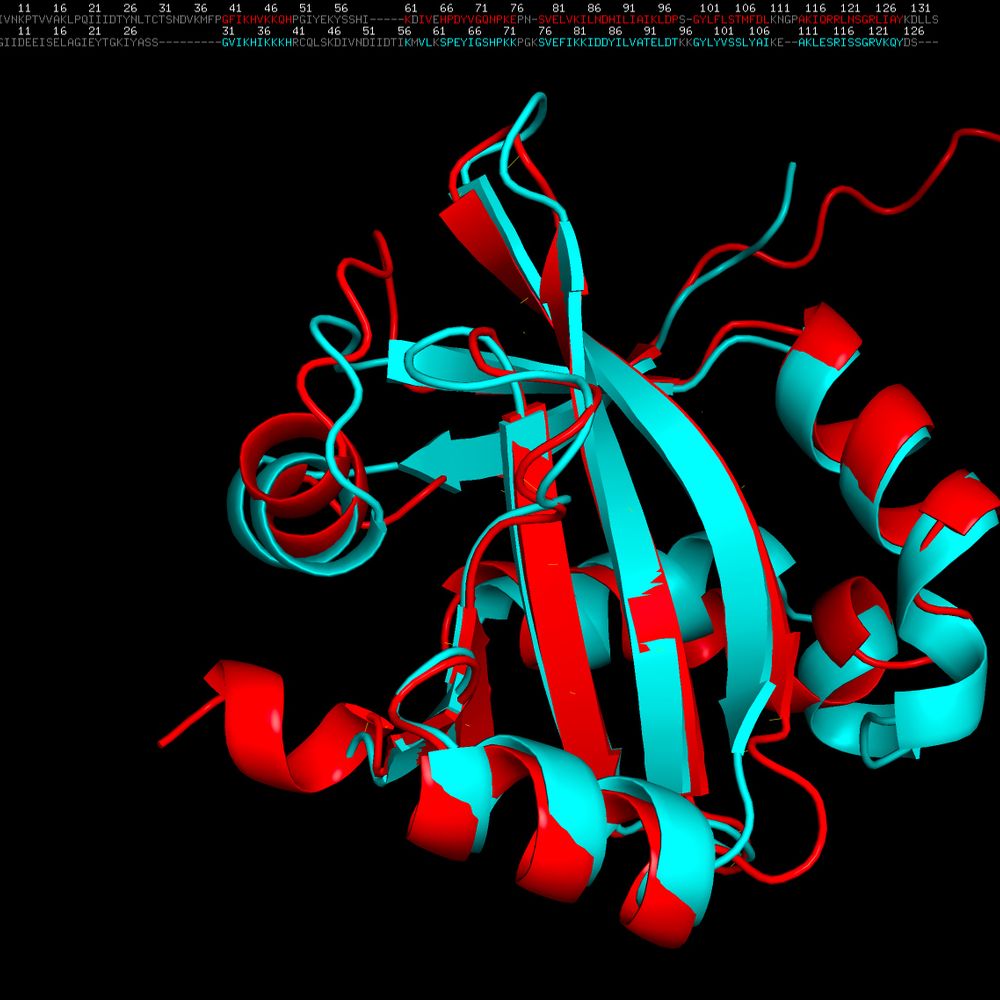
Looking forward to seeing David Moi's talk about Foldtree and the upcoming Foldtree II at #APSPM2026 in sunny Brisbane.
biosig.lab.uq.edu.au/strphy26/spe...
@official-smbe.bsky.social
biosig.lab.uq.edu.au/strphy26/spe...
@official-smbe.bsky.social

Viral protein sequences are highly variable, but structures are much more conserved.
In this paper, David Moi et al. present a highly accurate method to infer phylogenetic trees from 3D protein structures — opening new ways to explore viral evolution and protein function.
In this paper, David Moi et al. present a highly accurate method to infer phylogenetic trees from 3D protein structures — opening new ways to explore viral evolution and protein function.

Structural phylogenetics unravels the evolutionary diversification of communication systems in gram-positive bacteria and their viruses - Nature Structural & Molecular Biology
Using a new method called FoldTree, the authors compare proteins on the basis of their shape to construct more accurate family trees over long evolutionary timescales and capture distant relationships...
www.nature.com
November 7, 2025 at 3:24 AM
Looking forward to seeing David Moi's talk about Foldtree and the upcoming Foldtree II at #APSPM2026 in sunny Brisbane.
biosig.lab.uq.edu.au/strphy26/spe...
@official-smbe.bsky.social
biosig.lab.uq.edu.au/strphy26/spe...
@official-smbe.bsky.social
Reposted by Lianet Noda
Beautiful work from my friend @kiranrpatil.bsky.social . Gut bacteria can accumulate Forever chemicals and help us get rid of them! Happy we could contribute! www.nature.com/articles/s41...
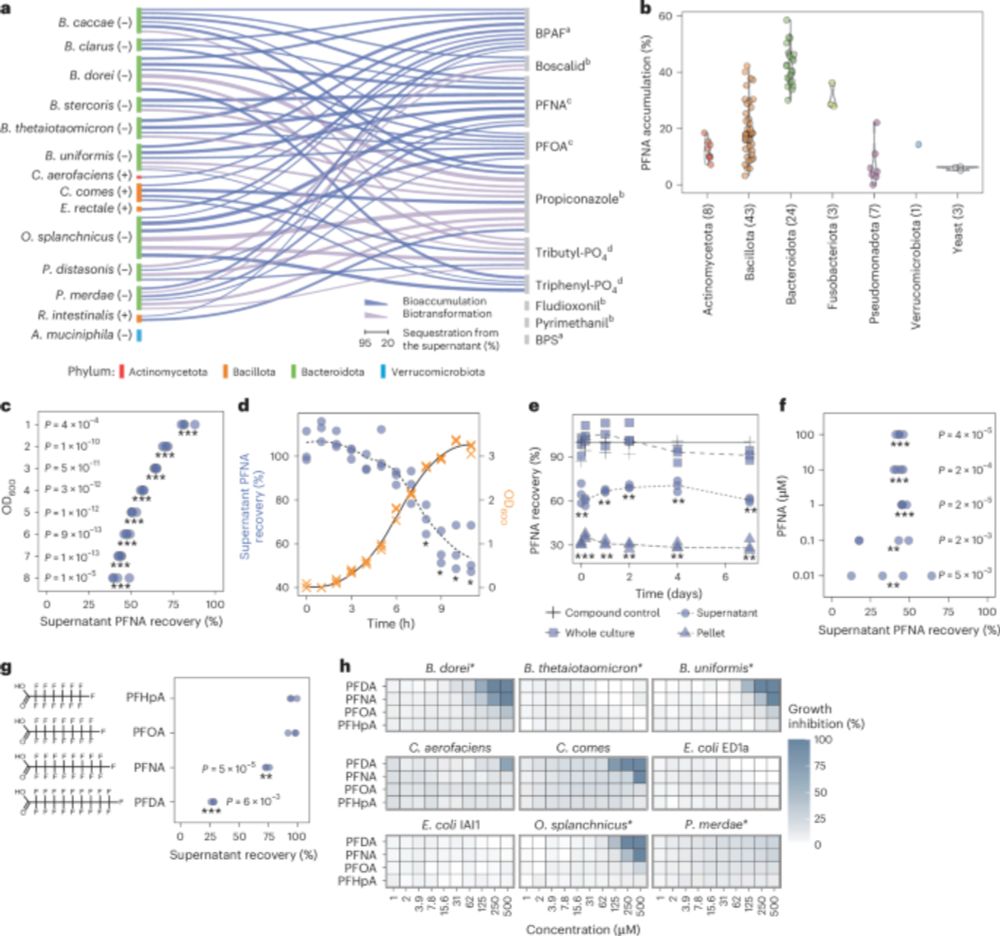
Human gut bacteria bioaccumulate per- and polyfluoroalkyl substances - Nature Microbiology
Human gut bacteria bioaccumulate per- and polyfluoroalkyl substances (PFAS), commonly known as forever chemicals, in intracellular aggregates. Colonization of gnotobiotic mice with bioaccumulating bac...
www.nature.com
July 1, 2025 at 11:25 AM
Beautiful work from my friend @kiranrpatil.bsky.social . Gut bacteria can accumulate Forever chemicals and help us get rid of them! Happy we could contribute! www.nature.com/articles/s41...
Reposted by Lianet Noda

Molecular fossils may not always be what they seem.
“Just as archaeologists know to be careful in how they interpret physical fossils, historians of protein evolution could take similar care in their interpretation of molecular fossils.”
- @lynnkamerlin.bsky.social in this co-authored article⤵️
“Just as archaeologists know to be careful in how they interpret physical fossils, historians of protein evolution could take similar care in their interpretation of molecular fossils.”
- @lynnkamerlin.bsky.social in this co-authored article⤵️

Molecular ‘Fossils’ Offer Microscopic Clues to the Origins of Life – But They Take Care to Interpret
cos.gatech.edu
September 25, 2025 at 4:39 PM
Molecular fossils may not always be what they seem.
“Just as archaeologists know to be careful in how they interpret physical fossils, historians of protein evolution could take similar care in their interpretation of molecular fossils.”
- @lynnkamerlin.bsky.social in this co-authored article⤵️
“Just as archaeologists know to be careful in how they interpret physical fossils, historians of protein evolution could take similar care in their interpretation of molecular fossils.”
- @lynnkamerlin.bsky.social in this co-authored article⤵️
New Paper Alert! “The diversity of PET-degrading enzymes: A review”. We present a database of PET-plastic hydrolases, including sequence, structure, and function. From this, we discuss the distribution, efficiency, stability, and potential for biodegradation of PETases.
September 14, 2025 at 6:59 AM
New Paper Alert! “The diversity of PET-degrading enzymes: A review”. We present a database of PET-plastic hydrolases, including sequence, structure, and function. From this, we discuss the distribution, efficiency, stability, and potential for biodegradation of PETases.
Reposted by Lianet Noda

The future of bioremediation? Not seeding sites with super-degrader bacteria, but super-fortifying microbiomes of target locations with catabolic genes via HGT. Nature has been doing it forever 💪🏻! Eng community-level function is the way! enviromicro-journals.onlinelibrary.wiley.com/doi/10.1111/...
enviromicro-journals.onlinelibrary.wiley.com
August 1, 2025 at 1:14 PM
The future of bioremediation? Not seeding sites with super-degrader bacteria, but super-fortifying microbiomes of target locations with catabolic genes via HGT. Nature has been doing it forever 💪🏻! Eng community-level function is the way! enviromicro-journals.onlinelibrary.wiley.com/doi/10.1111/...
Reposted by Lianet Noda

Do people in the same household share strains when they have the same species?
How many cells transmit when a strain is shared?
Can strain composition be dynamic when species composition is stable?
We answer these and related questions for the facial skin microbiome in our latest paper.
🧵[1/10]
How many cells transmit when a strain is shared?
Can strain composition be dynamic when species composition is stable?
We answer these and related questions for the facial skin microbiome in our latest paper.
🧵[1/10]

May 1, 2025 at 6:41 PM
Do people in the same household share strains when they have the same species?
How many cells transmit when a strain is shared?
Can strain composition be dynamic when species composition is stable?
We answer these and related questions for the facial skin microbiome in our latest paper.
🧵[1/10]
How many cells transmit when a strain is shared?
Can strain composition be dynamic when species composition is stable?
We answer these and related questions for the facial skin microbiome in our latest paper.
🧵[1/10]
Reposted by Lianet Noda

Bite-sized solutions
A recent study found high amounts of microplastics in the human brain. This could spur funding and technological advances for plastic degradation go.nature.com/3QL4L0b
A recent study found high amounts of microplastics in the human brain. This could spur funding and technological advances for plastic degradation go.nature.com/3QL4L0b

April 3, 2025 at 4:21 PM
Bite-sized solutions
A recent study found high amounts of microplastics in the human brain. This could spur funding and technological advances for plastic degradation go.nature.com/3QL4L0b
A recent study found high amounts of microplastics in the human brain. This could spur funding and technological advances for plastic degradation go.nature.com/3QL4L0b
Reposted by Lianet Noda

Fun to see it out in print! I was really lucky to have an amazing team to work with on this. If this sort of work seems interesting to you or someone you know, please feel free to reach out (planning to staff a lab later this year).
www.nature.com/articles/s41...
www.nature.com/articles/s41...
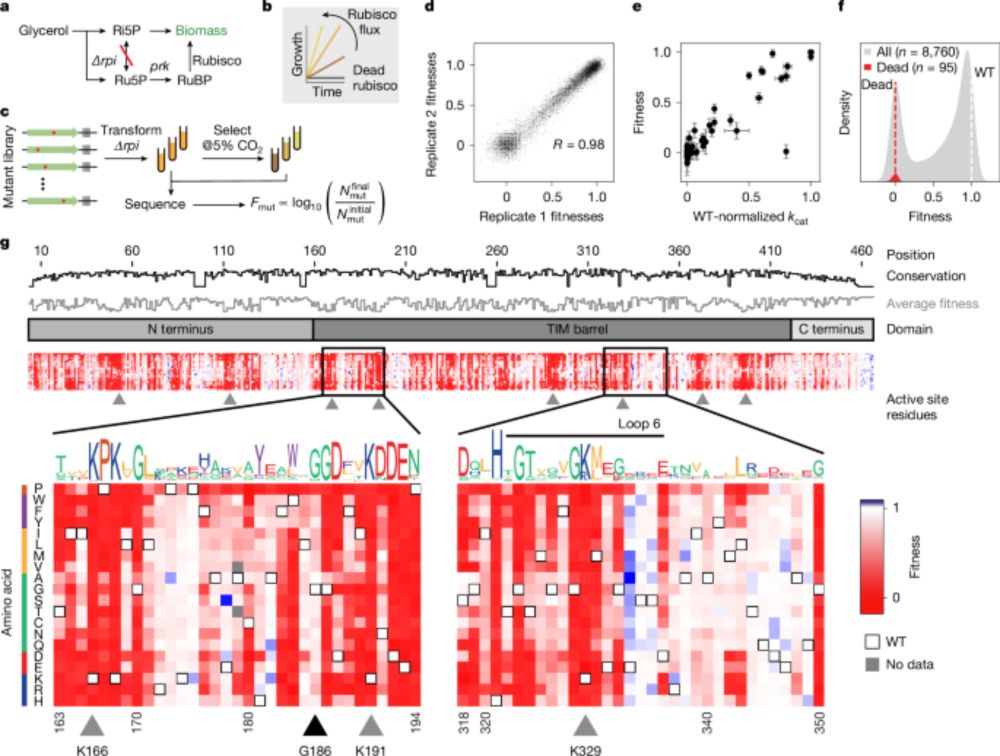
A map of the rubisco biochemical landscape - Nature
A massively parallel assay developed to map the essential photosynthetic enzyme rubisco showed that non-trivial biochemical changes and improvements in CO2 affinity are possible, signposting further e...
www.nature.com
January 22, 2025 at 10:34 PM
Fun to see it out in print! I was really lucky to have an amazing team to work with on this. If this sort of work seems interesting to you or someone you know, please feel free to reach out (planning to staff a lab later this year).
www.nature.com/articles/s41...
www.nature.com/articles/s41...
Reposted by Lianet Noda

Guess what? You got it, another @plosbiology.org focus issue of thought-provoking Perspectives and Essays on an issue relevant to this Keystone Symposium
What can I say? We clearly care a lot about many of the topics at these joint meetings
Take a look and let us know what you think! 👀⬇️
🧪
What can I say? We clearly care a lot about many of the topics at these joint meetings
Take a look and let us know what you think! 👀⬇️
🧪
At #KSSustainFuture25 session on waste upcycling, bioremediation, biomanufacturing, biodegradation
@plosbiology.org recently published a relevant focus issue exploring biological solutions to reduce CO2 emissions, get rid of plastics, produce food sustainably & generate energy plos.io/3MiXJyW
🧪⬇️
@plosbiology.org recently published a relevant focus issue exploring biological solutions to reduce CO2 emissions, get rid of plastics, produce food sustainably & generate energy plos.io/3MiXJyW
🧪⬇️

Going for green: Biology for planetary sustainability - PLOS Collections
Our green planet is beginning to show a lot of signs of decay triggered by the demands of our modern lifestyle and constantly growing population numbers. It is our responsibility to try to balance the...
plos.io
January 23, 2025 at 12:49 AM
Guess what? You got it, another @plosbiology.org focus issue of thought-provoking Perspectives and Essays on an issue relevant to this Keystone Symposium
What can I say? We clearly care a lot about many of the topics at these joint meetings
Take a look and let us know what you think! 👀⬇️
🧪
What can I say? We clearly care a lot about many of the topics at these joint meetings
Take a look and let us know what you think! 👀⬇️
🧪
Dear #Streptomyces community, Jana (@janitensen.bsky.social) and I want to test the evolvability/plasticity of Streptomyces metabolic networks. We plan to use #auxotrophic strains for this. If you have some and are willing to share, please get in touch with us! Thank you!
January 20, 2025 at 9:44 AM
Dear #Streptomyces community, Jana (@janitensen.bsky.social) and I want to test the evolvability/plasticity of Streptomyces metabolic networks. We plan to use #auxotrophic strains for this. If you have some and are willing to share, please get in touch with us! Thank you!
Reposted by Lianet Noda

The ability of pentose pathways to form all essential metabolites provides clues to the origins of metabolism journals.plos.org/plosbiology/... #jcampubs

The ability of pentose pathways to form all essential metabolites provides clues to the origins of metabolism
The structure of the early metabolic network is unknown. Here, we report that when considered together, pentose utilization pathways form all life-essential precursors. We speculate that the chemistry...
journals.plos.org
January 13, 2025 at 5:57 PM
The ability of pentose pathways to form all essential metabolites provides clues to the origins of metabolism journals.plos.org/plosbiology/... #jcampubs
Loving this platform.
November 20, 2024 at 6:05 PM
Loving this platform.