



Georgia Turner
@georgiaturner.bsky.social
She/her | email: gt342@cam.ac.uk | PhD student http://orben.group | computational & cognitive approaches to study technology use | Views my own | Happy to chat about Masters or PhD applications/experiences, send me an email!
Pinned
Georgia Turner
@georgiaturner.bsky.social
· Nov 13
🚨New preprint 🚨
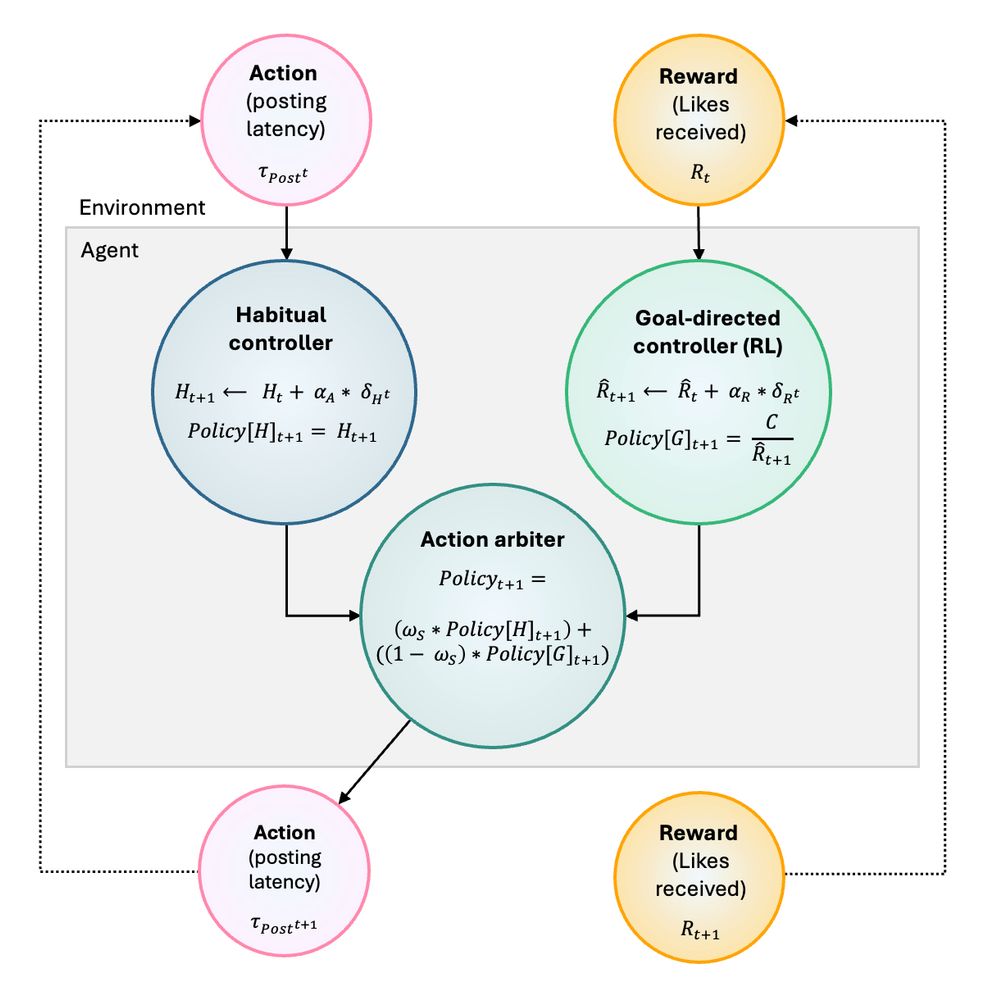
**A computational model of reward learning and habits on social media**
🧵
We develop a computational reward learning model of real-world social media data, which infers the separate goal-directed and habitual cognitive processes driving posting...
**A computational model of reward learning and habits on social media**
🧵
We develop a computational reward learning model of real-world social media data, which infers the separate goal-directed and habitual cognitive processes driving posting...
Important work on perceived social media addiction 👇

Excited to see these studies (finally) published in Scientific Reports! 🚨
S1: More social media users perceived themselves as addicted than met clinical addiction criteria.
S2: Increasing perceived addiction hurt perceived control over use and increased self-blame for overuse.
Thread below... 🧵
S1: More social media users perceived themselves as addicted than met clinical addiction criteria.
S2: Increasing perceived addiction hurt perceived control over use and increased self-blame for overuse.
Thread below... 🧵

November 30, 2025 at 12:42 PM
Important work on perceived social media addiction 👇
Selling three tickets to the Play Totoro in London tonight! Email me if interested georgianjt@gmail.com
November 26, 2025 at 4:40 PM
Selling three tickets to the Play Totoro in London tonight! Email me if interested georgianjt@gmail.com
Reposted by Georgia Turner
🚨Friends, we’re happy to share that our book is available for pre-order! 🎉
We aimed to cover all the foundations of the topic in an accessible manner for a large audience.
It could help set up a bachelor-level curriculum on the topic.
Pre-orders are very key for the fate of books: shorturl.at/Dxbif
We aimed to cover all the foundations of the topic in an accessible manner for a large audience.
It could help set up a bachelor-level curriculum on the topic.
Pre-orders are very key for the fate of books: shorturl.at/Dxbif


November 26, 2025 at 11:38 AM
🚨Friends, we’re happy to share that our book is available for pre-order! 🎉
We aimed to cover all the foundations of the topic in an accessible manner for a large audience.
It could help set up a bachelor-level curriculum on the topic.
Pre-orders are very key for the fate of books: shorturl.at/Dxbif
We aimed to cover all the foundations of the topic in an accessible manner for a large audience.
It could help set up a bachelor-level curriculum on the topic.
Pre-orders are very key for the fate of books: shorturl.at/Dxbif
Looking forward to speaking tomorrow at the Cambridge University Behavioural Insights Student Society about the psychology of social media - come along if you're in Cambridge!
cubiss.wixsite.com/cubiss/event...
cubiss.wixsite.com/cubiss/event...

Talk by Dr. Georgia Turner - Understanding Digital Wellbeing: How Psychology and Neuroscience Can Help Us Rethink Social | Cambridge CUBISS
Attend an engaging talk by the Dr Georgia Turner, University of Cambridge, MRC Cognition and Brain Sciences Unit on her research into digital wellbeing. Followed by an interactive Q&A.
cubiss.wixsite.com
November 17, 2025 at 1:37 PM
Looking forward to speaking tomorrow at the Cambridge University Behavioural Insights Student Society about the psychology of social media - come along if you're in Cambridge!
cubiss.wixsite.com/cubiss/event...
cubiss.wixsite.com/cubiss/event...
This is one of the rare papers that completely changed my thinking about the field I work in. Have a read!
My first paper, out in PsychReview!!
Along with @orbenamy.bsky.social, Nik & @jaeggiadrian.bsky.social, @realadamhunt.bsky.social & I revisit an old theoretical question using concepts from evo psychiatry and anthro:
Why do mixed associations exist b/w social media & mental health?
A 🧵
Along with @orbenamy.bsky.social, Nik & @jaeggiadrian.bsky.social, @realadamhunt.bsky.social & I revisit an old theoretical question using concepts from evo psychiatry and anthro:
Why do mixed associations exist b/w social media & mental health?
A 🧵

November 4, 2025 at 9:42 AM
This is one of the rare papers that completely changed my thinking about the field I work in. Have a read!
I spoke to The Economist @economist.com about dopamine detoxes - thank you @ainsliejstone.bsky.social for the write-up!
www.economist.com/science-and-...
www.economist.com/science-and-...

Can a dopamine detox reset your brain?
Taken literally, the idea makes no sense. But it might still be good for you
www.economist.com
November 3, 2025 at 12:20 PM
I spoke to The Economist @economist.com about dopamine detoxes - thank you @ainsliejstone.bsky.social for the write-up!
www.economist.com/science-and-...
www.economist.com/science-and-...
Reposted by Georgia Turner

as a condition of funding, we were asked to affirm that we wouldn’t undertake any diversity, equity, and inclusion work, whether or not we used the government funds to do so. The PSF simply couldn’t agree to that statement,
October 27, 2025 at 2:47 PM
as a condition of funding, we were asked to affirm that we wouldn’t undertake any diversity, equity, and inclusion work, whether or not we used the government funds to do so. The PSF simply couldn’t agree to that statement,
Reposted by Georgia Turner
🚨 New Preprint 🚨
Some people are at greater risk of experiencing negative mental health outcomes of social media use than others, but why?
🧵
We examined whether individual differences in cognitive processes shape risk and resilience to mental health effects on social media: osf.io/preprints/ps...
Some people are at greater risk of experiencing negative mental health outcomes of social media use than others, but why?
🧵
We examined whether individual differences in cognitive processes shape risk and resilience to mental health effects on social media: osf.io/preprints/ps...
October 17, 2025 at 11:20 AM
🚨 New Preprint 🚨
Some people are at greater risk of experiencing negative mental health outcomes of social media use than others, but why?
🧵
We examined whether individual differences in cognitive processes shape risk and resilience to mental health effects on social media: osf.io/preprints/ps...
Some people are at greater risk of experiencing negative mental health outcomes of social media use than others, but why?
🧵
We examined whether individual differences in cognitive processes shape risk and resilience to mental health effects on social media: osf.io/preprints/ps...
Reposted by Georgia Turner

🚨Out now in @cp-trendscognsci.bsky.social 🚨
We explore the use of cognitive theories/models with real-world data for understanding mental health.
We review emerging studies and discuss challenges and opportunities of this approach.
With @yaelniv.bsky.social and @eriknook.bsky.social
Thread ⬇️
We explore the use of cognitive theories/models with real-world data for understanding mental health.
We review emerging studies and discuss challenges and opportunities of this approach.
With @yaelniv.bsky.social and @eriknook.bsky.social
Thread ⬇️

September 29, 2025 at 3:05 PM
🚨Out now in @cp-trendscognsci.bsky.social 🚨
We explore the use of cognitive theories/models with real-world data for understanding mental health.
We review emerging studies and discuss challenges and opportunities of this approach.
With @yaelniv.bsky.social and @eriknook.bsky.social
Thread ⬇️
We explore the use of cognitive theories/models with real-world data for understanding mental health.
We review emerging studies and discuss challenges and opportunities of this approach.
With @yaelniv.bsky.social and @eriknook.bsky.social
Thread ⬇️
Really excited to see this out, led by the brilliant @bcdavidson.bsky.social
🚨 New Preprint 🚨
Prolonged Isolation is associated with an increased behavioural sensitivity to ‘Likes’ on social media.
🧵
Social media rewards are inherently social—but does posting change during social isolation, when in-person social rewards are limited?
It turns out, yes!
Prolonged Isolation is associated with an increased behavioural sensitivity to ‘Likes’ on social media.
🧵
Social media rewards are inherently social—but does posting change during social isolation, when in-person social rewards are limited?
It turns out, yes!
September 16, 2025 at 1:09 PM
Really excited to see this out, led by the brilliant @bcdavidson.bsky.social
@anne-urai.bsky.social , @weijima.bsky.social , Ili Ma and @tsonj.bsky.social organised an amazing workshop on 'Science for Social Good' at #CCN2025 @cogcompneuro.bsky.social
We wrote a blog reflecting on it:
anneurai.net/2025/08/14/r...
We wrote a blog reflecting on it:
anneurai.net/2025/08/14/r...

Reflections on the ‘Science for Social Good’ Satellite Event at CCN 2025
by Georgia Turner The day before the CCN 2025 conference kicked off in Amsterdam, attendees from career stages ranging from pre-PhD students to keynote speakers gathered together for an event focus…
anneurai.net
August 15, 2025 at 7:52 AM
@anne-urai.bsky.social , @weijima.bsky.social , Ili Ma and @tsonj.bsky.social organised an amazing workshop on 'Science for Social Good' at #CCN2025 @cogcompneuro.bsky.social
We wrote a blog reflecting on it:
anneurai.net/2025/08/14/r...
We wrote a blog reflecting on it:
anneurai.net/2025/08/14/r...
Looking forward to giving a Contributed Talk at #CCN2025 @cogcompneuro.bsky.social tomorrow on this study!
Come and say hi if you're at the conference, or watch the livestream here (10am BST / 11am CET) 👉 hva-uva.cloud.panopto.eu/Panopto/Page...
Come and say hi if you're at the conference, or watch the livestream here (10am BST / 11am CET) 👉 hva-uva.cloud.panopto.eu/Panopto/Page...
August 13, 2025 at 7:16 PM
Looking forward to giving a Contributed Talk at #CCN2025 @cogcompneuro.bsky.social tomorrow on this study!
Come and say hi if you're at the conference, or watch the livestream here (10am BST / 11am CET) 👉 hva-uva.cloud.panopto.eu/Panopto/Page...
Come and say hi if you're at the conference, or watch the livestream here (10am BST / 11am CET) 👉 hva-uva.cloud.panopto.eu/Panopto/Page...
Very cool work linking reward learning and social learning 👇

Thrilled that our paper on the mechanisms underlying social learning strategies is out! First big paper from my @erc.europa.eu & @kawresearch.bsky.social funded group. More to come! I'm currently looking to recruit two post docs, get in touch if you find this line of research interesting.
Through experiments and simulations, this study shows how individuals learn to learn from others, dynamically shaping the processes involved in cultural evolution. @davidschultner.bsky.social @bjornlindstrom.bsky.social
@lucasmolleman.bsky.social
www.nature.com/articles/s41...
@lucasmolleman.bsky.social
www.nature.com/articles/s41...
July 23, 2025 at 2:01 PM
Very cool work linking reward learning and social learning 👇
Reposted by Georgia Turner

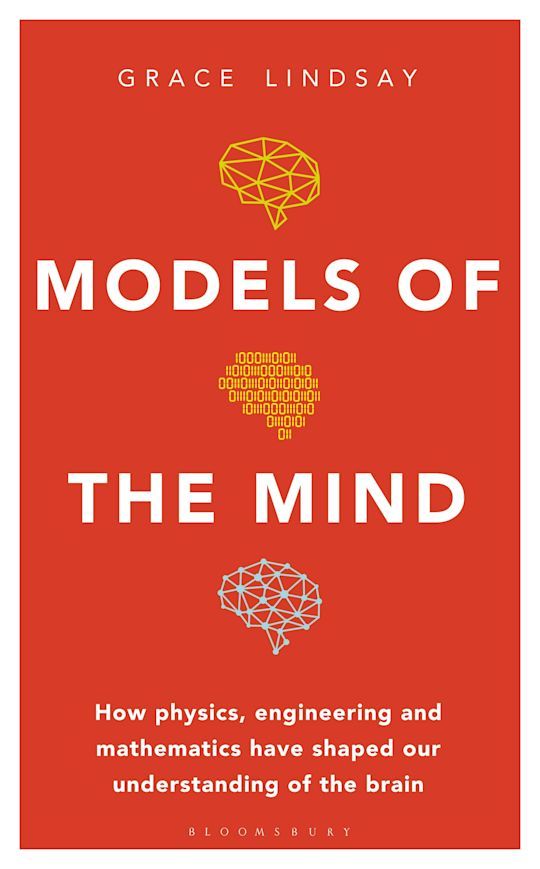
EP #15 | @lukasgunschera.bsky.social & @georgiaturner.bsky.social recommend

June 26, 2025 at 8:55 AM
EP #15 | @lukasgunschera.bsky.social & @georgiaturner.bsky.social recommend
Reposted by Georgia Turner
🚨New preprint 🚨
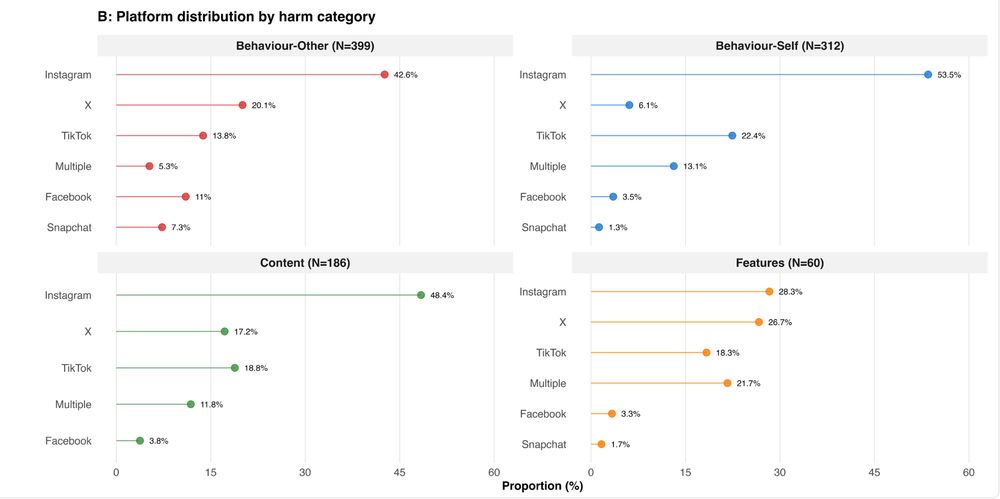
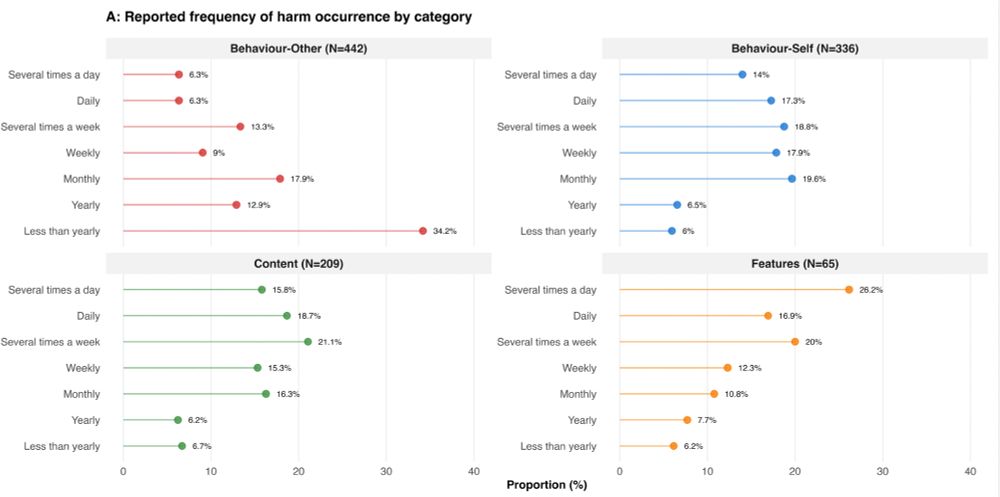
𝐘𝐨𝐮𝐭𝐡 𝐏𝐞𝐫𝐬𝐩𝐞𝐜𝐭𝐢𝐯𝐞𝐬 𝐨𝐧 𝐒𝐨𝐜𝐢𝐚𝐥 𝐌𝐞𝐝𝐢𝐚 𝐇𝐚𝐫𝐦𝐬: 𝐀 𝐋𝐚𝐫𝐠𝐞-𝐒𝐜𝐚𝐥𝐞 𝐌𝐢𝐜𝐫𝐨-𝐍𝐚𝐫𝐫𝐚𝐭𝐢𝐯𝐞 𝐒𝐭𝐮𝐝𝐲
osf.io/preprints/ps...
🧵
Using a novel micro-narrative method, we collected ~ 900 first-person accounts of social media harms from young people across the UK and US.
𝐘𝐨𝐮𝐭𝐡 𝐏𝐞𝐫𝐬𝐩𝐞𝐜𝐭𝐢𝐯𝐞𝐬 𝐨𝐧 𝐒𝐨𝐜𝐢𝐚𝐥 𝐌𝐞𝐝𝐢𝐚 𝐇𝐚𝐫𝐦𝐬: 𝐀 𝐋𝐚𝐫𝐠𝐞-𝐒𝐜𝐚𝐥𝐞 𝐌𝐢𝐜𝐫𝐨-𝐍𝐚𝐫𝐫𝐚𝐭𝐢𝐯𝐞 𝐒𝐭𝐮𝐝𝐲
osf.io/preprints/ps...
🧵
Using a novel micro-narrative method, we collected ~ 900 first-person accounts of social media harms from young people across the UK and US.
June 24, 2025 at 10:58 AM
🚨New preprint 🚨
𝐘𝐨𝐮𝐭𝐡 𝐏𝐞𝐫𝐬𝐩𝐞𝐜𝐭𝐢𝐯𝐞𝐬 𝐨𝐧 𝐒𝐨𝐜𝐢𝐚𝐥 𝐌𝐞𝐝𝐢𝐚 𝐇𝐚𝐫𝐦𝐬: 𝐀 𝐋𝐚𝐫𝐠𝐞-𝐒𝐜𝐚𝐥𝐞 𝐌𝐢𝐜𝐫𝐨-𝐍𝐚𝐫𝐫𝐚𝐭𝐢𝐯𝐞 𝐒𝐭𝐮𝐝𝐲
osf.io/preprints/ps...
🧵
Using a novel micro-narrative method, we collected ~ 900 first-person accounts of social media harms from young people across the UK and US.
𝐘𝐨𝐮𝐭𝐡 𝐏𝐞𝐫𝐬𝐩𝐞𝐜𝐭𝐢𝐯𝐞𝐬 𝐨𝐧 𝐒𝐨𝐜𝐢𝐚𝐥 𝐌𝐞𝐝𝐢𝐚 𝐇𝐚𝐫𝐦𝐬: 𝐀 𝐋𝐚𝐫𝐠𝐞-𝐒𝐜𝐚𝐥𝐞 𝐌𝐢𝐜𝐫𝐨-𝐍𝐚𝐫𝐫𝐚𝐭𝐢𝐯𝐞 𝐒𝐭𝐮𝐝𝐲
osf.io/preprints/ps...
🧵
Using a novel micro-narrative method, we collected ~ 900 first-person accounts of social media harms from young people across the UK and US.
Reposted by Georgia Turner
At #RLDM2025? Come to our workshop on real-world RL tomorrow! Including:
- amazing line-up: @bjornlindstrom.bsky.social, Aaron Heller, Sugandha Sharma, @arossotto.bsky.social + flash talks
- panel debate (chair: @yaelniv.bsky.social)
- group brainstorming session!
Mailing list: tinyurl.com/rlinwild
- amazing line-up: @bjornlindstrom.bsky.social, Aaron Heller, Sugandha Sharma, @arossotto.bsky.social + flash talks
- panel debate (chair: @yaelniv.bsky.social)
- group brainstorming session!
Mailing list: tinyurl.com/rlinwild

June 11, 2025 at 1:09 PM
At #RLDM2025? Come to our workshop on real-world RL tomorrow! Including:
- amazing line-up: @bjornlindstrom.bsky.social, Aaron Heller, Sugandha Sharma, @arossotto.bsky.social + flash talks
- panel debate (chair: @yaelniv.bsky.social)
- group brainstorming session!
Mailing list: tinyurl.com/rlinwild
- amazing line-up: @bjornlindstrom.bsky.social, Aaron Heller, Sugandha Sharma, @arossotto.bsky.social + flash talks
- panel debate (chair: @yaelniv.bsky.social)
- group brainstorming session!
Mailing list: tinyurl.com/rlinwild
So well deserved 🎉
Very excited and grateful to receive the 2025 Psychology of Technology Dissertation Award for my PhD thesis!
A special thanks to the Institute, the organisers and my wonderful PhD supervisors @orbenamy.bsky.social & @tamsinford.bsky.social.
More info: psychoftech.substack.com/p/congratula...
A special thanks to the Institute, the organisers and my wonderful PhD supervisors @orbenamy.bsky.social & @tamsinford.bsky.social.
More info: psychoftech.substack.com/p/congratula...

We're excited to announce the 2025 Psychology of Technology Dissertation Award winners! Please join us in congratulating them!
June 5, 2025 at 1:48 PM
So well deserved 🎉
Excited to co-host a workshop at @rldmdublin2025.bsky.social with @danmirea.bsky.social & @anadasilvapinho.bsky.social next week!
We will be exploring applications of reinforcement learning to real-world data 🌳 Sign up to our mailing list to receive updates: sites.google.com/view/rlinthe...
We will be exploring applications of reinforcement learning to real-world data 🌳 Sign up to our mailing list to receive updates: sites.google.com/view/rlinthe...
June 5, 2025 at 12:15 PM
Excited to co-host a workshop at @rldmdublin2025.bsky.social with @danmirea.bsky.social & @anadasilvapinho.bsky.social next week!
We will be exploring applications of reinforcement learning to real-world data 🌳 Sign up to our mailing list to receive updates: sites.google.com/view/rlinthe...
We will be exploring applications of reinforcement learning to real-world data 🌳 Sign up to our mailing list to receive updates: sites.google.com/view/rlinthe...
🔷New in Biological Psychiatry🔷
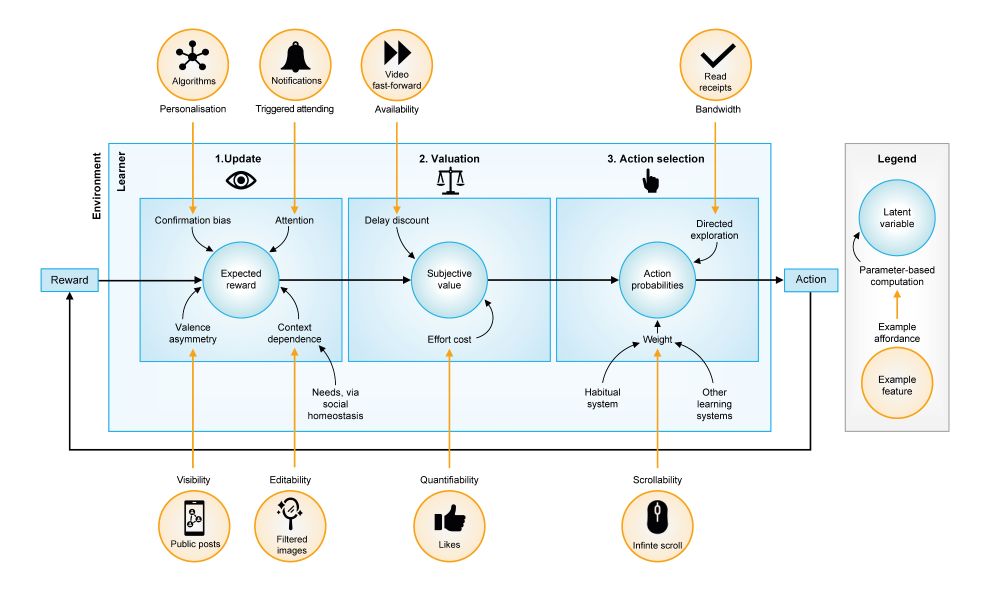
**Old Strategies, New Environments: Reinforcement Learning on Social Media**
In this Review, we argue that the computational framework of Reinforcement Learning can help us understand social media behaviour:
www.sciencedirect.com/science/arti...
**Old Strategies, New Environments: Reinforcement Learning on Social Media**
In this Review, we argue that the computational framework of Reinforcement Learning can help us understand social media behaviour:
www.sciencedirect.com/science/arti...
May 22, 2025 at 9:53 AM
🔷New in Biological Psychiatry🔷
**Old Strategies, New Environments: Reinforcement Learning on Social Media**
In this Review, we argue that the computational framework of Reinforcement Learning can help us understand social media behaviour:
www.sciencedirect.com/science/arti...
**Old Strategies, New Environments: Reinforcement Learning on Social Media**
In this Review, we argue that the computational framework of Reinforcement Learning can help us understand social media behaviour:
www.sciencedirect.com/science/arti...
Nuanced, theoretically-grounded framework for designing social media interventions 👀
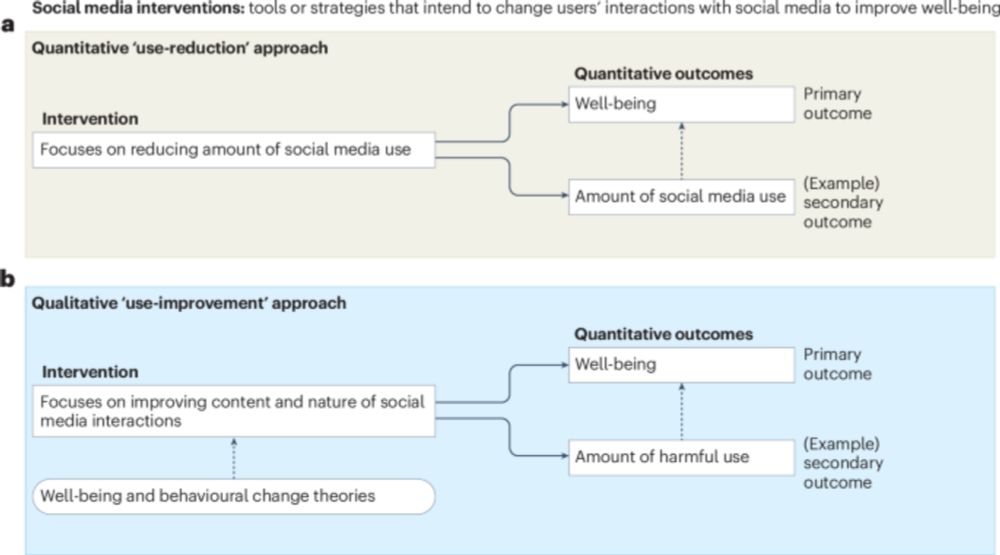
New Perspective out in @nathumbehav.nature.com today with co-author @orbenamy.bsky.social!
We propose a new framework for designing 𝘀𝗼𝗰𝗶𝗮𝗹 𝗺𝗲𝗱𝗶𝗮 𝗶𝗻𝘁𝗲𝗿𝘃𝗲𝗻𝘁𝗶𝗼𝗻𝘀 that support well-being, grounded in self-determination theory 🧵
www.nature.com/articles/s41...
We propose a new framework for designing 𝘀𝗼𝗰𝗶𝗮𝗹 𝗺𝗲𝗱𝗶𝗮 𝗶𝗻𝘁𝗲𝗿𝘃𝗲𝗻𝘁𝗶𝗼𝗻𝘀 that support well-being, grounded in self-determination theory 🧵
www.nature.com/articles/s41...
Social media interventions to improve well-being - Nature Human Behaviour
In this Perspective, the authors review current interventions on social media use among adolescents and propose a new theoretical model based on self-determination theory to guide the effective design...
www.nature.com
May 15, 2025 at 9:42 AM
Nuanced, theoretically-grounded framework for designing social media interventions 👀
Important new study about social media use in vulnerable young people:
After 3 years in the making, our Registered Report is out in @nathumbehav.nature.com!
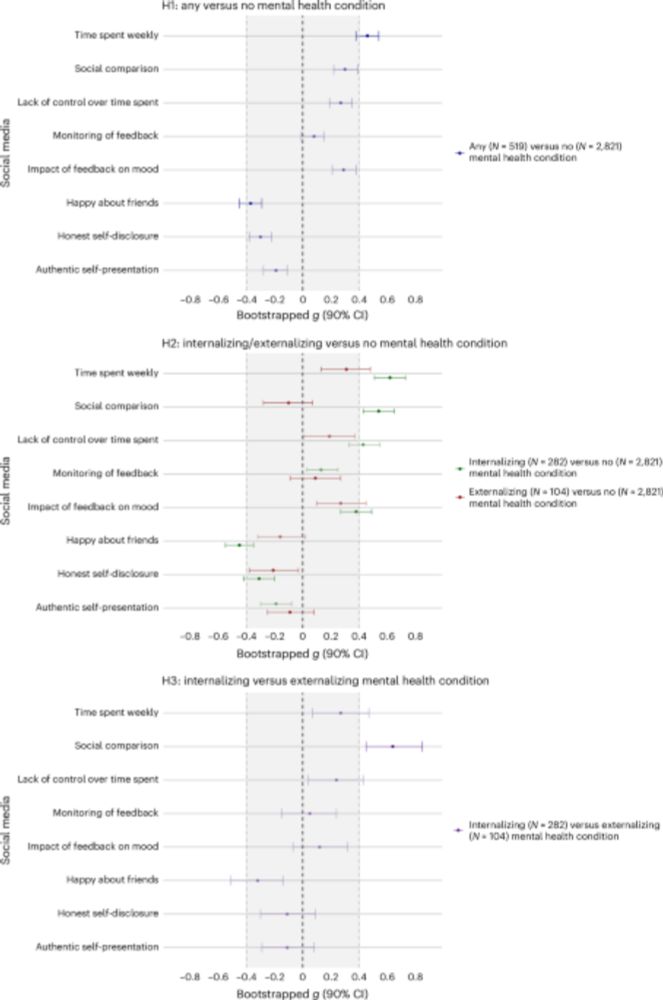
We analyse nationally representative UK data from 3,340 adolescents (aged 11–19) to examine how social media use differs between those with and without mental health conditions. 🧵
www.nature.com/articles/s41...
We analyse nationally representative UK data from 3,340 adolescents (aged 11–19) to examine how social media use differs between those with and without mental health conditions. 🧵
www.nature.com/articles/s41...
Social media use in adolescents with and without mental health conditions - Nature Human Behaviour
Using a nationally representative UK sample of adolescents with clinical-level mental health symptoms, this Registered Report examined differences in social media use. The results suggest that adolesc...
www.nature.com
May 6, 2025 at 9:53 AM
Important new study about social media use in vulnerable young people:
@lukasgunschera.bsky.social and I spoke to @adigitaltanay.bsky.social about our work on social media and cognition - have a listen to hear how we ended up here, what we have enjoyed reading & more 📕🎙️
🎙️ EP #15
How can methods from cognitive science provide new ways of investigating social media’s mental health effects? Does it offer new policy insights? @adigitaltanay.bsky.social discusses this and much more with @lukasgunschera.bsky.social & @georgiaturner.bsky.social
tinyurl.com/4ayf4x5s
🧵
How can methods from cognitive science provide new ways of investigating social media’s mental health effects? Does it offer new policy insights? @adigitaltanay.bsky.social discusses this and much more with @lukasgunschera.bsky.social & @georgiaturner.bsky.social
tinyurl.com/4ayf4x5s
🧵
EP #15 | Social Media and Mental Health: The Cognitive Turn | Georgia Turner & Lukas Gunschera
Cognitations · Episode
tinyurl.com
May 3, 2025 at 9:50 AM
@lukasgunschera.bsky.social and I spoke to @adigitaltanay.bsky.social about our work on social media and cognition - have a listen to hear how we ended up here, what we have enjoyed reading & more 📕🎙️
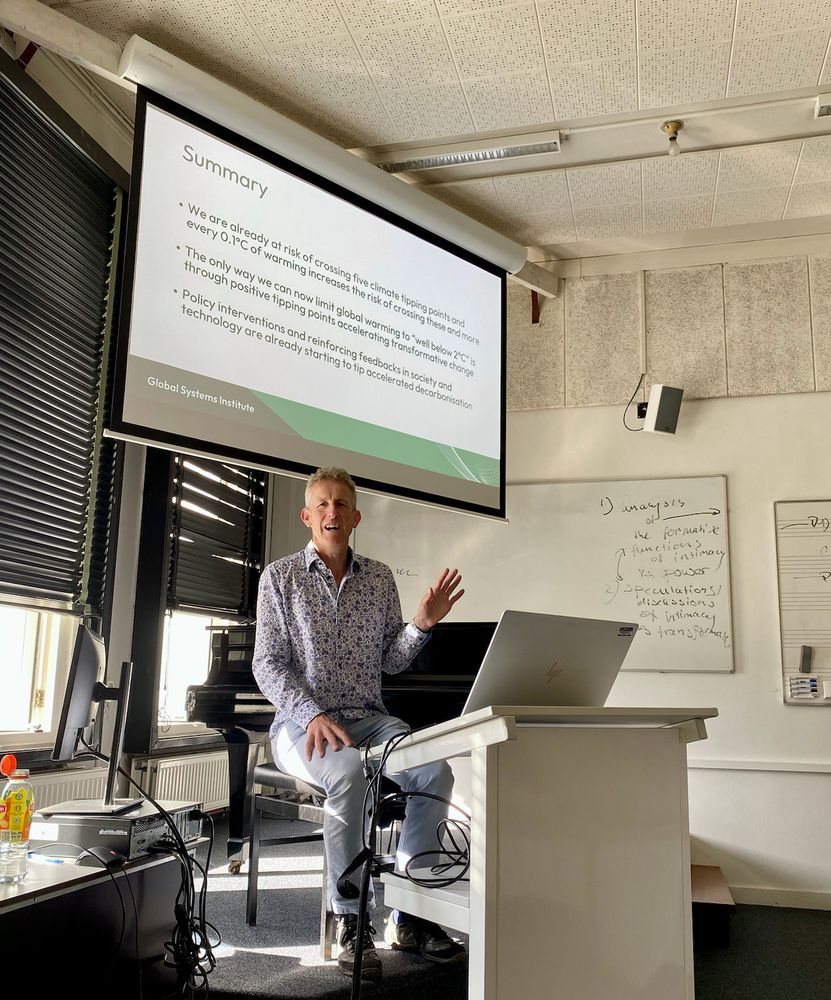
Learning so much at the Amsterdam Complexity School for Climate Change, beyond grateful for the opportunity to hear from such incredible speakers and meet so many kind & motivated people 🤝

The second day of ACSCC was again full of inspiring lectures and discussions!
Day two was kicked-off by the keynote of Tim Lenton, who gave an introduction to tipping points and an update on the latest research, followed by a discussion about effective leverage points using positive tipping points.
Day two was kicked-off by the keynote of Tim Lenton, who gave an introduction to tipping points and an update on the latest research, followed by a discussion about effective leverage points using positive tipping points.
April 30, 2025 at 10:38 AM
Learning so much at the Amsterdam Complexity School for Climate Change, beyond grateful for the opportunity to hear from such incredible speakers and meet so many kind & motivated people 🤝
Important, timely and innovative thinking on the science-policy interface for tech research 👇
New Paper! I'm truly excited to share @natematias.bsky.social and my new Policy Forum in Science published yesterday.
We evaluate science's ability to address technological harms, and offer recommendations for what could be done to improve on the status quo: www.science.org/doi/10.1126/...
We evaluate science's ability to address technological harms, and offer recommendations for what could be done to improve on the status quo: www.science.org/doi/10.1126/...

Fixing the science of digital technology harms
Technology development outpaces scientific assessment of impacts
www.science.org
April 11, 2025 at 2:10 PM
Important, timely and innovative thinking on the science-policy interface for tech research 👇
Does anyone know of an available dataset including (1) passively collected data on what Apps are being used in the foreground of one's phone and when, & (2) mental health questionnaire measures (from 1 or many time points)?
Thank you 🙏
Thank you 🙏
April 4, 2025 at 9:28 AM
Does anyone know of an available dataset including (1) passively collected data on what Apps are being used in the foreground of one's phone and when, & (2) mental health questionnaire measures (from 1 or many time points)?
Thank you 🙏
Thank you 🙏