



Elizabeth Mitchell Elder
@elizabethelder.bsky.social
Political scientist studying behavior, knowledge, & attitudes towards government. Currently @ Hoover Institution, formerly @ UC Berkeley.
Out today! I argue companies that dominate local economies can durably shape the capacity of local governments. Read on if you’re interested in business power, local political economy, or (for some reason) how coal companies were (not) taxed by early 20th century local governments.

NEW -
Company Towns: Single-Industry Dominance and Local Government Capacity - https://cup.org/48yJZcG
- @elizabethelder.bsky.social
#OpenAccess
Company Towns: Single-Industry Dominance and Local Government Capacity - https://cup.org/48yJZcG
- @elizabethelder.bsky.social
#OpenAccess

December 5, 2025 at 1:57 PM
Out today! I argue companies that dominate local economies can durably shape the capacity of local governments. Read on if you’re interested in business power, local political economy, or (for some reason) how coal companies were (not) taxed by early 20th century local governments.
Reposted by Elizabeth Mitchell Elder
🚨We analyzed 138 million geocoded property tax records to quantify how municipal boundaries spatially overlap onto economic segregation in every US metro area—creating disparities in localities’ ability to fund public goods. And we made an interactive map of our results! [1/16]

November 24, 2025 at 4:31 PM
🚨We analyzed 138 million geocoded property tax records to quantify how municipal boundaries spatially overlap onto economic segregation in every US metro area—creating disparities in localities’ ability to fund public goods. And we made an interactive map of our results! [1/16]
What a comparison! By the way, with coal in the news this morning...if you're interested in learning more about how the 20th century coal industry's dominance of local governance hollowed out mining areas' faith in institutions, I have a book you can pre-order!



September 29, 2025 at 4:32 PM
What a comparison! By the way, with coal in the news this morning...if you're interested in learning more about how the 20th century coal industry's dominance of local governance hollowed out mining areas' faith in institutions, I have a book you can pre-order!
Excited to see this out! @hanslueders.bsky.social & I develop a concept & measure of place attachment, distinct from place identity. We show local attachments are similarly strong in urban & rural places, and they predict engagement in local (vs. national) politics. link.springer.com/10.1007/s111...

Place Attachments: Theory and Measurement for Political Science - Political Behavior
Scholars increasingly ask how place shapes citizens’ attitudes and behavior. Despite growing interest in place-based politics, recent work engages with only a subset of the potential roles for place i...
link.springer.com
September 12, 2025 at 2:42 PM
Excited to see this out! @hanslueders.bsky.social & I develop a concept & measure of place attachment, distinct from place identity. We show local attachments are similarly strong in urban & rural places, and they predict engagement in local (vs. national) politics. link.springer.com/10.1007/s111...
Reposted by Elizabeth Mitchell Elder

📢 The APSR is opening a new Research Notes track!
Authors may now submit directly as Notes—or, with editor agreement, have papers reclassified during review. Notes should be ≤7,000 words (excl. refs/appendices).
Authors may now submit directly as Notes—or, with editor agreement, have papers reclassified during review. Notes should be ≤7,000 words (excl. refs/appendices).
May 27, 2025 at 9:44 PM
📢 The APSR is opening a new Research Notes track!
Authors may now submit directly as Notes—or, with editor agreement, have papers reclassified during review. Notes should be ≤7,000 words (excl. refs/appendices).
Authors may now submit directly as Notes—or, with editor agreement, have papers reclassified during review. Notes should be ≤7,000 words (excl. refs/appendices).
Reposted by Elizabeth Mitchell Elder

🚨 “Good Description” with @annagbusse.bsky.social 🚨
What sets 'good' description apart from 'mere' description?
We develop a framework for evaluating descriptive research, whether we are doing it as scholars or assessing it as readers.
Two main contributions...
🔗📄 tinyurl.com/gooddesc
What sets 'good' description apart from 'mere' description?
We develop a framework for evaluating descriptive research, whether we are doing it as scholars or assessing it as readers.
Two main contributions...
🔗📄 tinyurl.com/gooddesc
good_description/good_description_ddk_agb.pdf at main · ddekadt/good_description
Homepage of "Good Description" by Daniel de Kadt & Anna Grzymala-Busse - ddekadt/good_description
tinyurl.com
May 14, 2025 at 9:52 PM
🚨 “Good Description” with @annagbusse.bsky.social 🚨
What sets 'good' description apart from 'mere' description?
We develop a framework for evaluating descriptive research, whether we are doing it as scholars or assessing it as readers.
Two main contributions...
🔗📄 tinyurl.com/gooddesc
What sets 'good' description apart from 'mere' description?
We develop a framework for evaluating descriptive research, whether we are doing it as scholars or assessing it as readers.
Two main contributions...
🔗📄 tinyurl.com/gooddesc
Reposted by Elizabeth Mitchell Elder

We are extremely pleased to announce the preliminary release of the combined pre-election and post-election dataset for the ANES 2024 Time Series Study!
The data and documentation can be downloaded from the ANES website at: electionstudies.org/data-center/...
Best,
The ANES Team
The data and documentation can be downloaded from the ANES website at: electionstudies.org/data-center/...
Best,
The ANES Team
2024 Time Series Study - ANES | American National Election Studies
electionstudies.org
May 1, 2025 at 9:59 PM
We are extremely pleased to announce the preliminary release of the combined pre-election and post-election dataset for the ANES 2024 Time Series Study!
The data and documentation can be downloaded from the ANES website at: electionstudies.org/data-center/...
Best,
The ANES Team
The data and documentation can be downloaded from the ANES website at: electionstudies.org/data-center/...
Best,
The ANES Team
Reposted by Elizabeth Mitchell Elder

I'm excited to present this today at UAA. If you're in Vancouver, it's at 9:50am at Pavillion B.
Demand Shocks & Special Districts: Evidence from Chinese Import Shocks – Christopher B. Goodman
One of the primary theoretical benefits of specialized governance is rapid response to changes in demand for public services. If demand increases quickly, special districts can be quickly formed to re...
slides.cgoodman.com
April 18, 2025 at 2:57 PM
I'm excited to present this today at UAA. If you're in Vancouver, it's at 9:50am at Pavillion B.
Reposted by Elizabeth Mitchell Elder
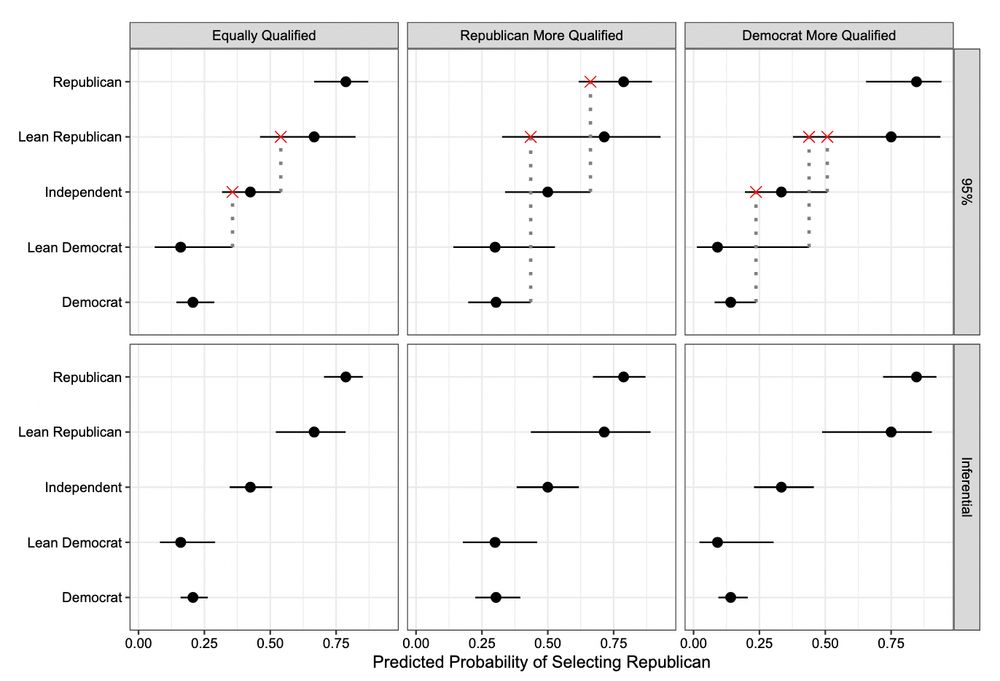
Overlapping CI's do not tell you if 2 estimates are significantly different from one another. These packages in R and Stata can help with this common visualization problem. Fan-freaking-tastic.
Currently in FirstView: “Decoupling Visualization and Testing when Presenting Confidence Intervals” by David Armstrong and @olsisblue.bsky.social. They develop a way to present estimates and confidence intervals to accurately visualize the underlying pairwise tests.
March 28, 2025 at 7:26 PM
Overlapping CI's do not tell you if 2 estimates are significantly different from one another. These packages in R and Stata can help with this common visualization problem. Fan-freaking-tastic.
Reposted by Elizabeth Mitchell Elder

My book is now officially out! How Politicians Polarize introduces and documents the concept of "negative representation" – when representatives focus on the other side rather than their own.
Some key findings: 🧵
www.amazon.com/How-Politici...
Some key findings: 🧵
www.amazon.com/How-Politici...

March 27, 2025 at 1:05 PM
My book is now officially out! How Politicians Polarize introduces and documents the concept of "negative representation" – when representatives focus on the other side rather than their own.
Some key findings: 🧵
www.amazon.com/How-Politici...
Some key findings: 🧵
www.amazon.com/How-Politici...
Reposted by Elizabeth Mitchell Elder

Despite trust in personal doctors becoming a partisan issue, experimental evidence suggests that sharing a political background with one's medical provider increases willingness to seek care, finds @obrian.bsky.social & Bradley Kent in @bjpols.bsky.social doi.org/10.1017/S000...


March 25, 2025 at 1:28 PM
Despite trust in personal doctors becoming a partisan issue, experimental evidence suggests that sharing a political background with one's medical provider increases willingness to seek care, finds @obrian.bsky.social & Bradley Kent in @bjpols.bsky.social doi.org/10.1017/S000...
Reposted by Elizabeth Mitchell Elder

🚨 New paper (with Kasey Rhee & Nico Studen). We use a new within-precinct design to isolate how ideology affects vote choice holding turnout fixed, analyzing 3.4M precinct observations across state & fed elections (2016-2022).
tldr: Ideological moderation affects vote shares, but not by much. 🧵⬇️
tldr: Ideological moderation affects vote shares, but not by much. 🧵⬇️
The Electoral Consequences of Ideological Persuasion: Evidence from a Within-Precinct Analysis of U.S. Elections
Most research on the electoral penalty of candidate ideology relies on betweendistrict or longitudinal comparisons, which are confounded by turnout and ballot c
papers.ssrn.com
March 11, 2025 at 8:58 PM
🚨 New paper (with Kasey Rhee & Nico Studen). We use a new within-precinct design to isolate how ideology affects vote choice holding turnout fixed, analyzing 3.4M precinct observations across state & fed elections (2016-2022).
tldr: Ideological moderation affects vote shares, but not by much. 🧵⬇️
tldr: Ideological moderation affects vote shares, but not by much. 🧵⬇️
Reposted by Elizabeth Mitchell Elder

In case anyone needs a break from reality (me, by 9 a.m. every day), my coauthor Anna Berg and I have a new, open access essay out in Perspectives! buff.ly/4gN6cFR. We describe the marginalization of qual methods in the study of American political behavior and make a case for their revival.
February 25, 2025 at 2:47 PM
In case anyone needs a break from reality (me, by 9 a.m. every day), my coauthor Anna Berg and I have a new, open access essay out in Perspectives! buff.ly/4gN6cFR. We describe the marginalization of qual methods in the study of American political behavior and make a case for their revival.
Reposted by Elizabeth Mitchell Elder

When Queen Victoria’s mourning disrupted the "London Season" (elite marriage market), peer-commoner intermarriage rose by 40%, marital wealth sorting fell by 30%, and peers' political power declined as a result. www.aeaweb.org/articles?id=...

Assortative Matching at the Top of the Distribution: Evidence from the World's Most Exclusive Marriage Market
(July 2022) - Using novel data on peerage marriages in Britain, I find that low search costs and marriage-market segregation can generate sorting. Peers courted in the London Season, a matching techno...
www.aeaweb.org
February 19, 2025 at 12:37 PM
When Queen Victoria’s mourning disrupted the "London Season" (elite marriage market), peer-commoner intermarriage rose by 40%, marital wealth sorting fell by 30%, and peers' political power declined as a result. www.aeaweb.org/articles?id=...
Reposted by Elizabeth Mitchell Elder

New in POQ from Stephen Jessee, Neil Malhotra and @mayasen.bsky.social, new empirical research on why you should write shorter survey questions
academic.oup.com/poq/advance-...
academic.oup.com/poq/advance-...

February 11, 2025 at 8:29 PM
New in POQ from Stephen Jessee, Neil Malhotra and @mayasen.bsky.social, new empirical research on why you should write shorter survey questions
academic.oup.com/poq/advance-...
academic.oup.com/poq/advance-...
Just looked through this checklist for a survey experiment I'm working on this morning!

🚨It's finally got an issue and page numbers 😊
If you ever do survey experiments and maybe, just maybe, sometimes get null results, this article might help you (plus it's Open Access!).
www.cambridge.org/core/journal...
If you ever do survey experiments and maybe, just maybe, sometimes get null results, this article might help you (plus it's Open Access!).
www.cambridge.org/core/journal...

February 7, 2025 at 4:49 PM
Just looked through this checklist for a survey experiment I'm working on this morning!
Reposted by Elizabeth Mitchell Elder

being bused to an inner-city school significantly increases White support for the Democratic Party and its candidates more than forty years later
www.nber.org/papers/w33365
www.nber.org/papers/w33365

A Different World: Enduring Effects of School Desegregation on Ideology and Attitudes
Founded in 1920, the NBER is a private, non-profit, non-partisan organization dedicated to conducting economic research and to disseminating research findings among academics, public policy makers, an...
www.nber.org
January 21, 2025 at 10:04 PM
being bused to an inner-city school significantly increases White support for the Democratic Party and its candidates more than forty years later
www.nber.org/papers/w33365
www.nber.org/papers/w33365
Reposted by Elizabeth Mitchell Elder

We have a new report out. Do Won Kim, Xilin Yang and Do-Hoon Kim reproduce "The Effects of Racial Diversity in Citizen Decision-Making Bodies" by Karpowitz et al. @thejop.bsky.social. Link to the report and author's response below.

January 20, 2025 at 1:19 PM
We have a new report out. Do Won Kim, Xilin Yang and Do-Hoon Kim reproduce "The Effects of Racial Diversity in Citizen Decision-Making Bodies" by Karpowitz et al. @thejop.bsky.social. Link to the report and author's response below.
Excited to see this out! We study several hundred mock jury deliberations and find that white deliberators speak more, raise their own preferences more, and step in at more pivotal times in the discussion than deliberators of color. Inequalities persist even in more diverse groups.
NOW OUT ON FIRSTVIEW!
Race, Voice, and Authority in Discussion Groups
https://buff.ly/3C0DdjG
By @elizabethelder.bsky.social , @profkarpo.bsky.social & Tali Mendelberg
Race, Voice, and Authority in Discussion Groups
https://buff.ly/3C0DdjG
By @elizabethelder.bsky.social , @profkarpo.bsky.social & Tali Mendelberg


January 15, 2025 at 5:42 PM
Excited to see this out! We study several hundred mock jury deliberations and find that white deliberators speak more, raise their own preferences more, and step in at more pivotal times in the discussion than deliberators of color. Inequalities persist even in more diverse groups.
Reposted by Elizabeth Mitchell Elder

🚨 New year, new working paper 🚨
"In Control but Incoherent: Institutional Power, Electoral Politics, and Message Discipline in Congress" with Gechun Lin (WUSTL). Available here: benjaminnoble.org/files/papers...
Read on for the 🧵 version…
"In Control but Incoherent: Institutional Power, Electoral Politics, and Message Discipline in Congress" with Gechun Lin (WUSTL). Available here: benjaminnoble.org/files/papers...
Read on for the 🧵 version…

January 2, 2025 at 4:48 PM
🚨 New year, new working paper 🚨
"In Control but Incoherent: Institutional Power, Electoral Politics, and Message Discipline in Congress" with Gechun Lin (WUSTL). Available here: benjaminnoble.org/files/papers...
Read on for the 🧵 version…
"In Control but Incoherent: Institutional Power, Electoral Politics, and Message Discipline in Congress" with Gechun Lin (WUSTL). Available here: benjaminnoble.org/files/papers...
Read on for the 🧵 version…
Reposted by Elizabeth Mitchell Elder
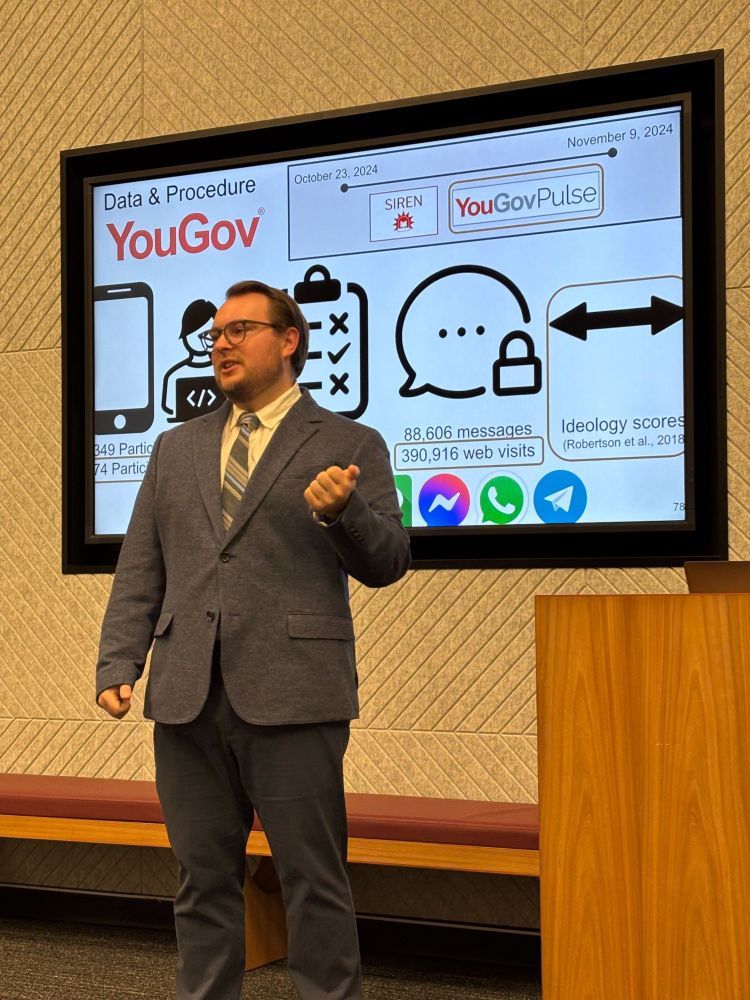
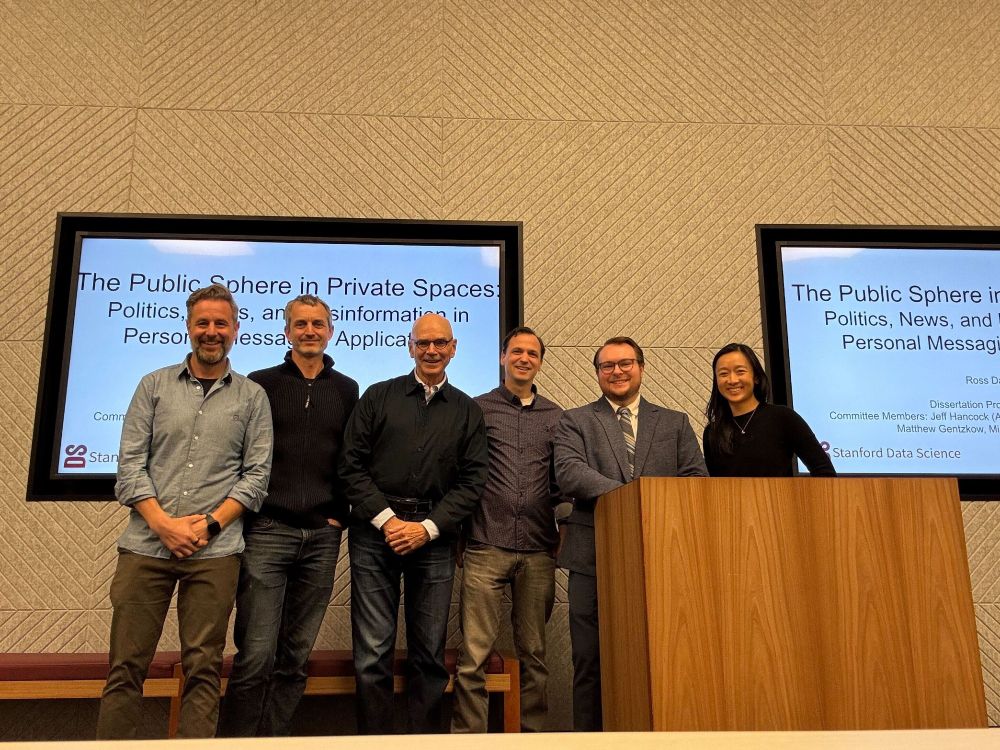
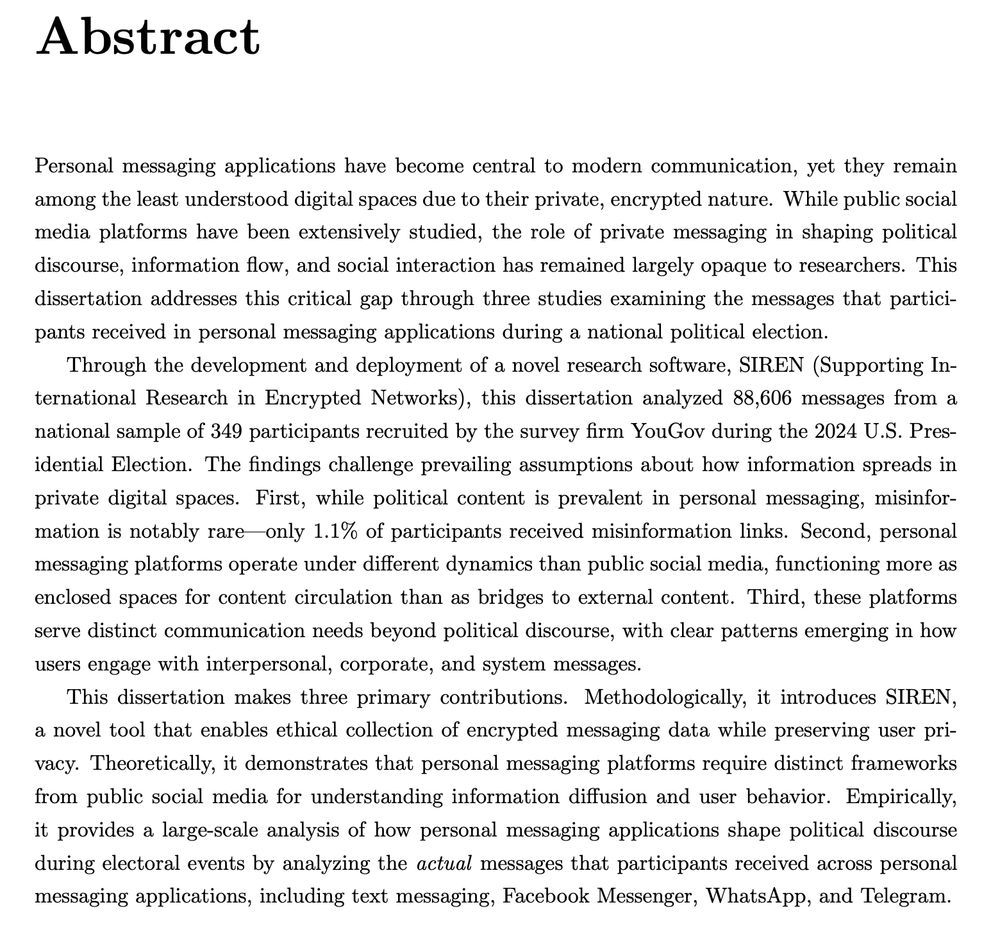
Very happy to say that I passed my PhD dissertation defense, "The Public Sphere in Private Spaces: Politics, News, and Misinformation in Personal Messaging Applications." Grateful for my advisor, committee, and everyone at Stanford
December 11, 2024 at 10:56 PM
Very happy to say that I passed my PhD dissertation defense, "The Public Sphere in Private Spaces: Politics, News, and Misinformation in Personal Messaging Applications." Grateful for my advisor, committee, and everyone at Stanford
Reposted by Elizabeth Mitchell Elder
New paper published @ajpseditor.bsky.social
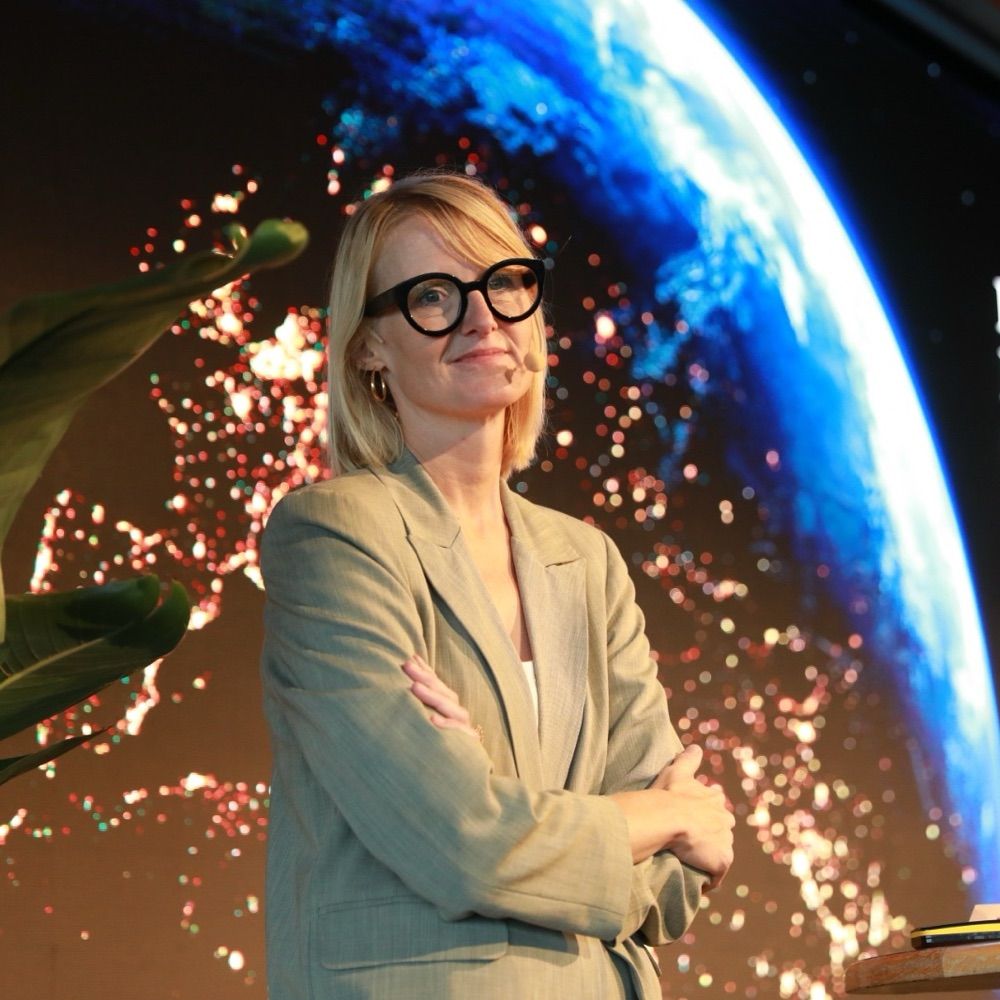
Showing that reduced access to public services fuelled far right support in 🇮🇹
Existing work on far right highlights globalization & migration grievances, what about people’s experiences with the state?
We use 🇮🇹 reform to find out
shorturl.at/zQ8bJ
Showing that reduced access to public services fuelled far right support in 🇮🇹
Existing work on far right highlights globalization & migration grievances, what about people’s experiences with the state?
We use 🇮🇹 reform to find out
shorturl.at/zQ8bJ

December 5, 2024 at 5:22 PM
New paper published @ajpseditor.bsky.social
Showing that reduced access to public services fuelled far right support in 🇮🇹
Existing work on far right highlights globalization & migration grievances, what about people’s experiences with the state?
We use 🇮🇹 reform to find out
shorturl.at/zQ8bJ
Showing that reduced access to public services fuelled far right support in 🇮🇹
Existing work on far right highlights globalization & migration grievances, what about people’s experiences with the state?
We use 🇮🇹 reform to find out
shorturl.at/zQ8bJ
Reposted by Elizabeth Mitchell Elder

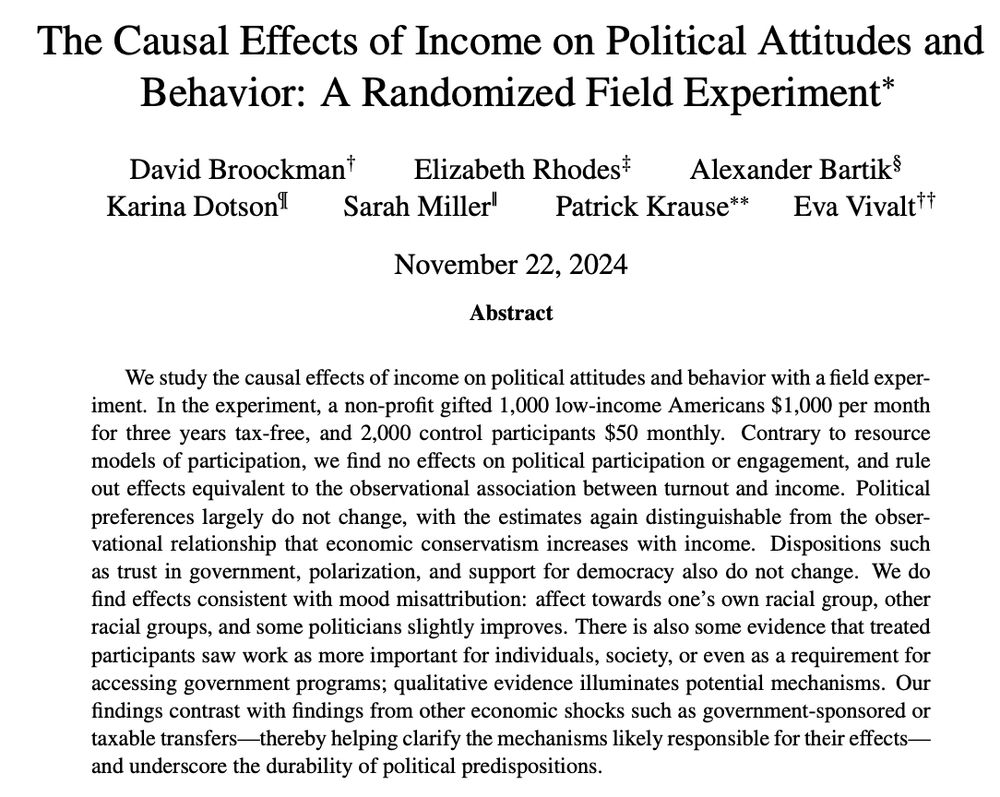
🚨 NEW PAPER: When low-income Americans get $1,000/month for 3 years, what happens to their political views & behavior?
The OpenResearch Unconditional income Study reveals surprising findings about the effects of income on politics... 🧵
The OpenResearch Unconditional income Study reveals surprising findings about the effects of income on politics... 🧵
December 2, 2024 at 7:00 PM
🚨 NEW PAPER: When low-income Americans get $1,000/month for 3 years, what happens to their political views & behavior?
The OpenResearch Unconditional income Study reveals surprising findings about the effects of income on politics... 🧵
The OpenResearch Unconditional income Study reveals surprising findings about the effects of income on politics... 🧵