



Cambridge Hearing Group
@camhearinggroup.bsky.social
Hearing Research in Cambridge, UK 👂🎧🔢🇬🇧
🔗: https://www.hearing-research.group.cam.ac.uk
🔗: https://www.hearing-research.group.cam.ac.uk
Pinned

We compared the Failure Index method (Konerding et al., 2025) to the PECAP method (Garcia et al., 2021) in characterising the electrode-neuron interface in #cochlearimplant: doi.org/10.1121/10.0...
@charlottegarcia.bsky.social
@charlottegarcia.bsky.social
We compared the Failure Index method (Konerding et al., 2025) to the PECAP method (Garcia et al., 2021) in characterising the electrode-neuron interface in #cochlearimplant: doi.org/10.1121/10.0...
@charlottegarcia.bsky.social
@charlottegarcia.bsky.social
August 20, 2025 at 10:18 AM
We compared the Failure Index method (Konerding et al., 2025) to the PECAP method (Garcia et al., 2021) in characterising the electrode-neuron interface in #cochlearimplant: doi.org/10.1121/10.0...
@charlottegarcia.bsky.social
@charlottegarcia.bsky.social
We measured three neural responses (eCAP, eABR, eASSR) to stimulation with #cochlearimplant using the same stimulus to disentangle the effects of response type and of stimulus type on neural response properties: doi.org/10.1016/j.heares.2025.109338

July 23, 2025 at 9:52 AM
We measured three neural responses (eCAP, eABR, eASSR) to stimulation with #cochlearimplant using the same stimulus to disentangle the effects of response type and of stimulus type on neural response properties: doi.org/10.1016/j.heares.2025.109338
Our extended validation of the STRIPES test involves measuring STRIPES and webSTRIPES performance at different presentation levels in Med-El #cochlearimplant users: doi.org/10.1097/AUD.0000000000001676

July 14, 2025 at 10:12 AM
Our extended validation of the STRIPES test involves measuring STRIPES and webSTRIPES performance at different presentation levels in Med-El #cochlearimplant users: doi.org/10.1097/AUD.0000000000001676
@charlottegarcia.bsky.social latest PECAP application to assess differences in current spreads and neural excitation patterns across array types and devices: doi.org/10.1097/AUD.0000000000001673

Assessing Array-Type Differences in Cochlear Implant Users... : Ear and Hearing
geometries, it is possible that the arrays are not only positioned differently inside the cochlea but also produce different patterns of the spread of current and of neural excitation. The panoramic e...
doi.org
July 7, 2025 at 9:31 AM
@charlottegarcia.bsky.social latest PECAP application to assess differences in current spreads and neural excitation patterns across array types and devices: doi.org/10.1097/AUD.0000000000001673
Reposted by Cambridge Hearing Group
Our latest article pools data from 9 centres & shows how the PECAP Method characterises current spread in individual cochlear implant patients & how this varies based on electrode array geometries: doi.org/10.1097/AUD.... #cochlearimplant #personalisedhealthcare @charlottegarcia.bsky.social

July 2, 2025 at 12:17 PM
Our latest article pools data from 9 centres & shows how the PECAP Method characterises current spread in individual cochlear implant patients & how this varies based on electrode array geometries: doi.org/10.1097/AUD.... #cochlearimplant #personalisedhealthcare @charlottegarcia.bsky.social
Earlier this year, Bob Carlyon and John Deeks from our group, together with world experts in cochlear implant research, share their opinions on temporal processing in cochlear implant and propose future research directions. Check out this comprehensive review at: doi.org/10.1177/2331...

Limitations on Temporal Processing by Cochlear Implant Users: A Compilation of Viewpoints - Robert P. Carlyon, John M. Deeks, Bertrand Delgutte, Yoojin Chung, Maike Vollmer, Frank W. Ohl, Andrej Kral,...
Cochlear implant (CI) users are usually poor at using timing information to detect changes in either pitch or sound location. This deficit occurs even for liste...
doi.org
June 27, 2025 at 9:27 AM
Earlier this year, Bob Carlyon and John Deeks from our group, together with world experts in cochlear implant research, share their opinions on temporal processing in cochlear implant and propose future research directions. Check out this comprehensive review at: doi.org/10.1177/2331...
Reposted by Cambridge Hearing Group

Alexis Deighton MacIntyre and Lidea Shahidi @mrccbu.bsky.social will explore the experimental control & generative capabilities of state-of-the-art speech synthesis to produce audiological testing materials and conduct evaluation to ensure fit for use in clinical tests to assess speech perception.
December 9, 2024 at 4:50 PM
Alexis Deighton MacIntyre and Lidea Shahidi @mrccbu.bsky.social will explore the experimental control & generative capabilities of state-of-the-art speech synthesis to produce audiological testing materials and conduct evaluation to ensure fit for use in clinical tests to assess speech perception.
Reposted by Cambridge Hearing Group

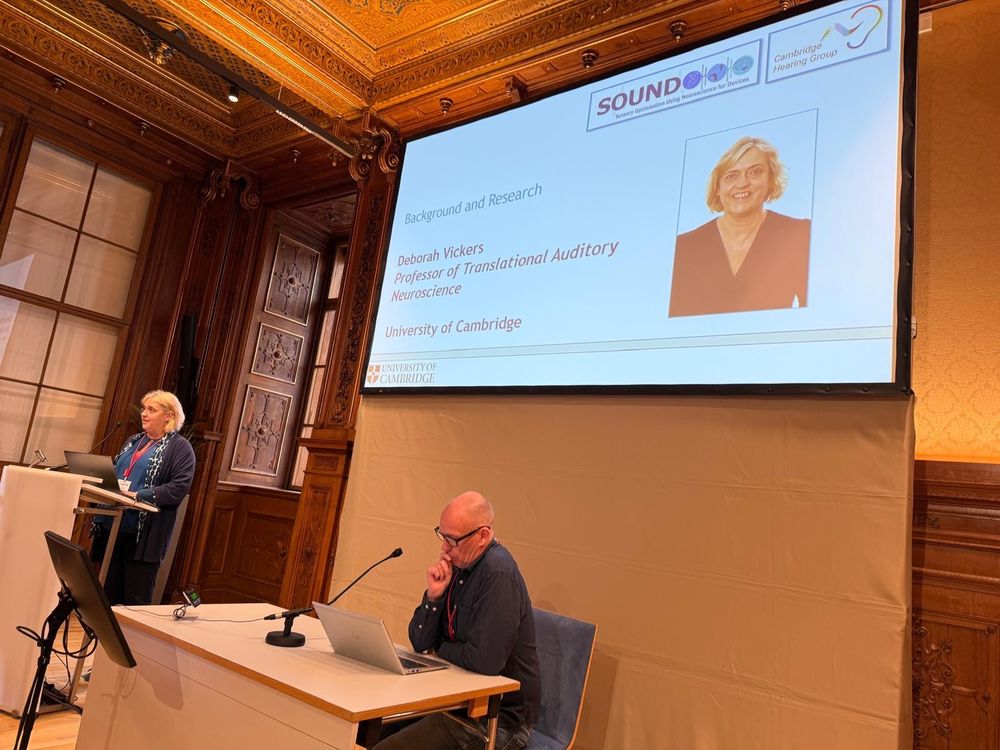
Congratulations to our Lead, Debi Vickers, on being voted in as #President Elect of the #European Federation of Audiological Societies #EFAS. We wish her success in shaping the #future of #Audiology to ultimately improve #hearinghealth for all
May 16, 2025 at 5:16 PM
Congratulations to our Lead, Debi Vickers, on being voted in as #President Elect of the #European Federation of Audiological Societies #EFAS. We wish her success in shaping the #future of #Audiology to ultimately improve #hearinghealth for all
Reposted by Cambridge Hearing Group
On #deafawareness week we highlight the #barriers experienced by people with #deafness and #hearingloss when using the #NHS. Identifying these barriers is the first step to overcome them: journals.plos.org/plosone/arti.... Work led by SOUNDLab researcher Bhavisha Parmar and the @thebsa.org.uk

“I always feel like I’m the first deaf person they have ever met:” Deaf Awareness, Accessibility and Communication in the United Kingdom’s National Health Service (NHS): How can we do better?
Background Barriers to communication significantly reduce access to health services for people with deafness or hearing loss (PDHL). These barriers contribute to reduced healthcare-seeking behaviour, ...
journals.plos.org
May 9, 2025 at 1:41 PM
On #deafawareness week we highlight the #barriers experienced by people with #deafness and #hearingloss when using the #NHS. Identifying these barriers is the first step to overcome them: journals.plos.org/plosone/arti.... Work led by SOUNDLab researcher Bhavisha Parmar and the @thebsa.org.uk
Reposted by Cambridge Hearing Group
Prof. Debi Vickers' SOUND Lab focuses on improving outcomes for people who use #hearing devices. Our clinicians and researchers work with people who use hearing devices to ensure our research is relevant. Visit our new website to learn more about our research: sound-lab.medschl.cam.ac.uk
SOUND Laboratory – Department of Clinical Neurosciences
Department of Clinical Neurosciences
sound-lab.medschl.cam.ac.uk
May 9, 2025 at 8:52 AM
Prof. Debi Vickers' SOUND Lab focuses on improving outcomes for people who use #hearing devices. Our clinicians and researchers work with people who use hearing devices to ensure our research is relevant. Visit our new website to learn more about our research: sound-lab.medschl.cam.ac.uk
Tobias and Baha present their work on AI applications in improving speech perception and speech testing for #cochlearimplant users at #BCIG_UK!
#AI #hearing #speech
#AI #hearing #speech

April 2, 2025 at 3:00 PM
Tobias and Baha present their work on AI applications in improving speech perception and speech testing for #cochlearimplant users at #BCIG_UK!
#AI #hearing #speech
#AI #hearing #speech
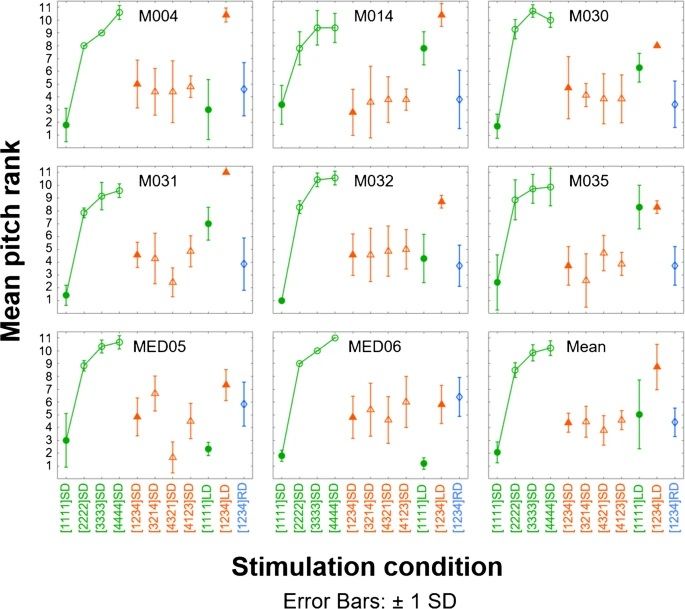
Check out our new paper "Temporal Pitch Perception of Multi-Channel Stimuli by Cochlear-Implant Users"!!! 🥳
New paper - Temporal Pitch Perception of Multi‑Channel Stimuli by Cochlear‑Implant Users: doi.org/10.1007/s101...
April 1, 2025 at 3:45 PM
Check out our new paper "Temporal Pitch Perception of Multi-Channel Stimuli by Cochlear-Implant Users"!!! 🥳
Hi, this is the Cambridge Hearing Group's official Bluesky account! We are hearing researchers at @mrccbu.bsky.social and University of Cambridge. Our focus is on understanding and improving listening with #cochlearimplants
April 1, 2025 at 3:43 PM
Hi, this is the Cambridge Hearing Group's official Bluesky account! We are hearing researchers at @mrccbu.bsky.social and University of Cambridge. Our focus is on understanding and improving listening with #cochlearimplants